

Debunking the 5 Greatest Knife Sharpening Myths: Truth vs. Gatekeeping
As an Amazon Afilliate, I earn commission on qualifying purchases
Step into any online knife forum, and you will quickly encounter a wall of elitist gatekeeping. "Knife experts" and internet trolls will tell you that a blade is useless unless it can push-cut toilet paper, that you must spend hundreds of dollars on exotic gear, and that any deviation from their rigid technique will ruin your cutlery.
This posturing creates unnecessary anxiety for home cooks and culinary professionals alike, turning a simple, rewarding skill into an intimidating chore.
The truth about freehand sharpening is far simpler, far more forgiving, and infinitely more practical than internet folklore suggests. Here is the unvarnished reality behind the five most pervasive sharpening myths.

Burrfection Sharpening knife on water bin
Myth 1: You Must Spend a Fortune on High-End Equipment
There is an endless push toward luxury sharpening gear, but price does not dictate edge keenness. While premium abrasives cut faster and offer refined tactile feedback, expensive stones are a luxury—not a requirement.
To prove this point, a functional, razor-sharp edge can be created on a standard hardware brick. While a brick is hardly a recommended daily replacement for dedicated abrasives, it proves a fundamental rule: technique creates the edge, not the price tag of the stone.
You do not need a five-stone progression to achieve elite performance. A single quality 800 to 1,000-grit stone is all that is required to maintain world-class kitchen edges.

Myth 2:
Professional Line Chefs Are Freehand Sharpening Experts. WRONG
It is widely assumed that professional line cooks and executive chefs spend their off-hours mastering freehand water stones. In reality, most working chefs receive virtually zero formal sharpening instruction.
In high-volume commercial kitchens, time is at a premium. Line cooks rely heavily on ceramic honing rods (such as a standard Shenzhen ceramic rod) to align rolled edges between prep cycles.
(Note: Virtually all ceramic rods on the market originate from identical OEM manufacturing facilities in China—whether you pay $15 or $60, the abrasive ceramic performance remains identical).
Myth 3: You Must Thin Your Blade at Every Sharpening Session
Self-proclaimed forum experts frequently insist that you must lay the blade shoulders flat and thin the blade geometry during every single sharpening session.
Thinning every time you touch a stone is the culinary equivalent of changing your car's engine oil after every drive. It wastes time, consumes steel unnecessarily, and, if executed with poor angle control, scuffs aesthetics and ruins blade geometry.
Master Japanese blacksmiths—such as those at Hinoura Hamono in Sanjo—confirm that a well-engineered blade with proper distal taper only requires shoulder thinning after years of heavy metal removal, or when the primary edge has retreated into the thicker body of the spine.

Burrfection sharpening station
Myth 4: Stones Must Be Flattened Before and After Every Single Use
Blanket statements about whetstone flattening fail to differentiate between different knife geometries. Whether stone flatness is mandatory depends entirely on the blade profile:
Single-Bevel Blades (Yanagiba, Deba, Usuba): Mandatory. The concave back (Urasuki) and flat rim (Uraoshi) require a dead-flat surface to make uniform contact. A dished stone will ruin a single-bevel knife's geometry.
Double-Bevel Blades (Gyuto, Santoku, Chef Knives): Optional. While a flat stone is pleasant to work on, a slight center dip on a water stone will not prevent you from setting a razor-sharp 15° apex on a standard double-bevel knife.
Myth 5:
There Is Only One "Correct" Way to Sharpen a Knife
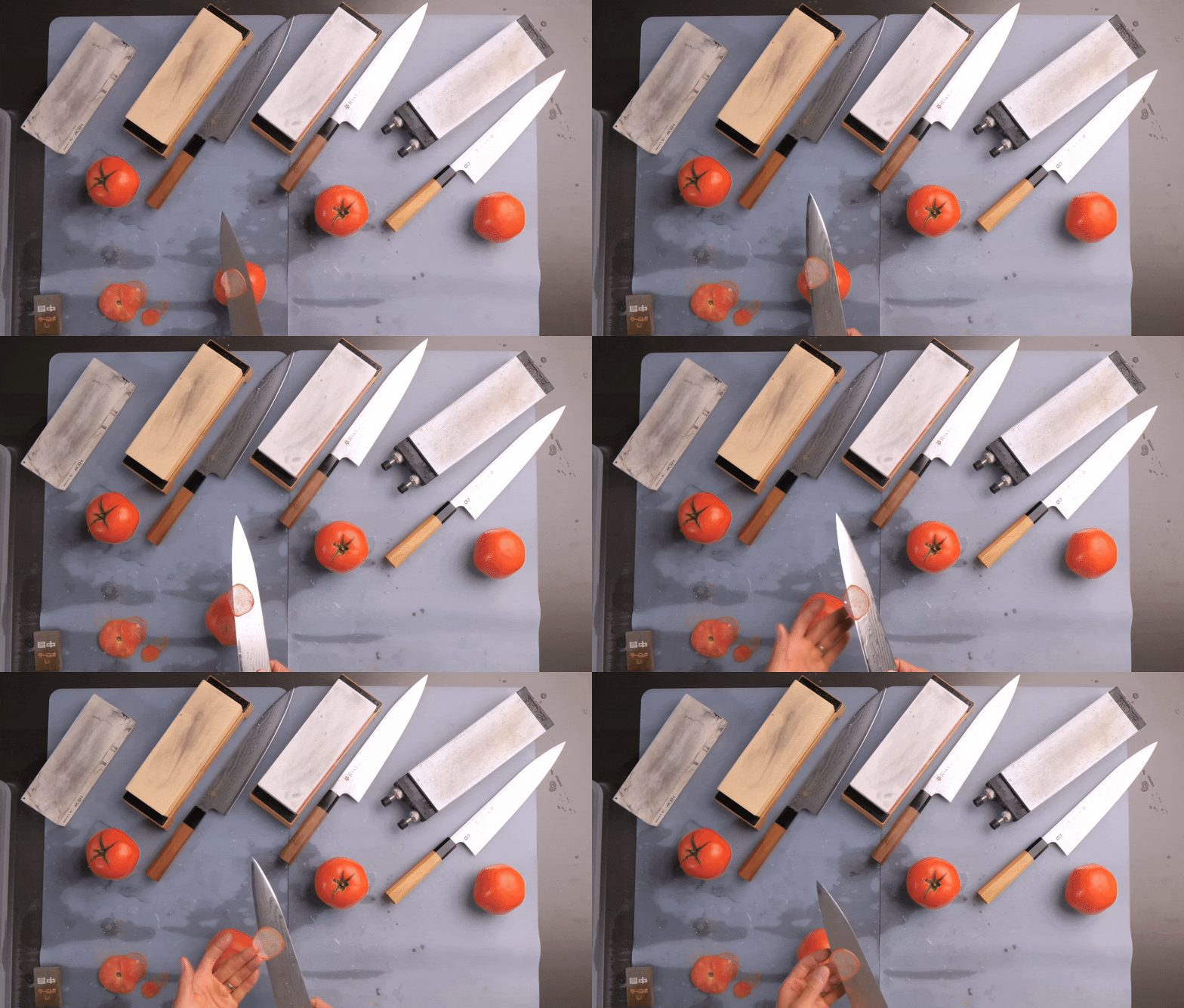
Gatekeepers love to prescribe rigid, dogmatic rules: exact 45-degree blade placement, specific finger pressure counts, or strict pushing versus pulling strokes.
Freehand sharpening is a mechanical process, not a religious ritual. The metal on your blade does not know or care which stroke pattern you used—it only responds to consistent angle holding and clean burr removal.
Whether you use sweeping diagonal passes, sectioned push-strokes, or alternative pressure patterns learned from traditional blacksmiths, the end result is identical: a clean, functional apex. Ignore the dogmatic forum rules, focus on keeping your angle steady, and let the abrasive do the work.