One of the most persistent debates in the sharpening community revolves around resource allocation: If your budget is strictly capped, where should your capital go?
Should you invest in a premium, time-tested Western workhorse like the Wüsthof Classic Ikon and maintain it on a $20 Amazon dual-grit combination waterstone? Or are you better off buying a disposable $20 Kuma chef's knife and shaping its apex on elite bench media like the Naniwa Chosera 800 and 3,000?
To test this dynamic, both knives were intentionally destroyed on a masonry brick to strip their apexes down to zero, then cross-sharpened across opposite ends of the abrasive spectrum.
While the bench results yield a surprising short-term paradox, they expose a fundamental truth about blade geometry, binder chemistry, and the long-term myth of the $20 budget knife.
trust retailers BurrfectionStore | Gyuto | WasabiKitchen | Amazon
Disclosure: As an Amazon Associate, I earn from qualifying purchases.
1. The Test Bench: Hardware & Controlled Baseline
To remove factory bias, both blades were subjected to a destructive baseline: 20 unweighted edge-leading passes across a solid building brick.
This protocol strips the apex entirely, introduces severe micro-gouges, and creates a dead, reflective flat spot along the entire cutting length.
[ THE CROSS-OVER EXPERIMENT SETUP ]

Test Track A: High-End Steel on Budget Media
├── Blade: Wüsthof Classic Ikon 8" (~$170–$200 | DIN 1.4116 @ 58 HRC)
└── Stone: "Love This Kitchen!" 800 / 3000 Combination Waterstone (~$20–$25)
    └── Type: Aluminum oxide soaking stone, soft resin/clay matrix

Test Track B: Budget Steel on Premium Media
├── Blade: Kuma Multi-Purpose 8" Chef’s Knife (~$20 | Unspecified Stainless @ ~57 HRC)
└── Stone: Naniwa Chosera (Pro) 800 & 3000 (~$190 Total)
    └── Type: Magnesia-bonded splash-and-go, ultra-dense abrasive structure
2. Abrasive Dynamics: Where Budget Stones Fail
The difference between premium synthetic stones and budget Amazon combination blocks is not abrasive grit—it is binder chemistry and friability.
BENCH BEHAVIOR UNDER LOAD

Naniwa Chosera (Magnesia Bonded):
  [ Steel ] ────────► Rigid Surface / High Abrasive Density
                      ├── Zero dishing during standard session
                      ├── Crisp, tactile acoustic feedback
                      └── Fast steel removal with zero swarf gouging

Budget Amazon Combination Stone (Soft Clay/Resin Bond):
  [ Steel ] ────────► Premature Binder Breakdown
                      ├── Rapid dishing in center (loss of planar flat)
                      ├── Excessive slurry washes away working edges
                      └── Changing acoustic pitch as blade rides uneven valleys
The $20 Amazon Combination Stone (800 / 3,000)
Marketed under various white-label names, this dual-sided stone requires a full 10-to-15 minute water soak until bubble release ceases completely.
The 800 Side: The bond is excessively soft. Within three push-and-pull cycles, the center began dishing out under standard finger pressure. Instead of cleanly cutting the German steel, the stone released a flood of loose abrasive mud (slurry). As the stone lost its planar flatness, the pitch of the pass changed audibly—signaling that the knife was riding high on the shoulders and dipping into an uneven valley.
The 3,000 Side: The polishing side performed noticeably better than the coarse side. Because finishing strokes require feather-light pressure, the 3,000 grit did not break down as aggressively, leaving a clean, reflective haze along the secondary bevel.
The Naniwa Chosera 800 & 3,000
The Chosera uses a dense magnesia bond that requires zero soaking—only a splash of surface water.
Under the same sharpening strokes, the stone exhibited zero structural dishing.
The abrasive density cuts hardened steel immediately, providing instantaneous, clear acoustic feedback to the fingertips.
The slurry generated consists of exhausted abrasive and suspended steel swarf, rather than crumbling binder layers.
3. Sharpening Nuances: Bolsters, Burrs, and Profiles
Working these two knives on opposite stones highlighted how blade architecture dictates stone stroke mechanics.
BEVEL PROFILES ON THE STONE

Wüsthof Classic Ikon (Curved Belly / Demi-Bolster):
  Heel ───\________________________/─── Tip
  *Requires continuous wrist rotation to follow the belly radius without gouging soft media.

Kuma Chef Knife (Flat Slicing Profile):
  Heel ────────────────────────────/─── Tip
  *Flat, straight section allows linear push-and-pull strokes, but exposes uneven stone dishing instantly.
Grinding the Wüsthof on Soft Media
Sharpening a curved German profile on an excessively soft stone is an exercise in frustration. Because the 800 budget stone dishes out almost immediately, maintaining a stable 15-degree bevel angle across the sweeping belly requires constant manual compensation.
Furthermore, deburring on a soft stone presents a constant risk: an aggressive edge-leading stroke will physically bite into the dished surface, gouging the stone and rolling the apex backward. The knife had to be deburred using ultra-light, edge-trailing passes to avoid cutting into the mud.
Grinding the Kuma on the Chosera
The $20 Kuma behaves surprisingly well on the Chosera. Because its profile is flatter—resembling a utility slicer more than an undulating French or German chef's knife—it can be worked with uniform, linear push-and-pull strokes.
On the Chosera 800, the knife raised a crisp, uniform wire burr within two sets of passes. Because the Chosera holds its dead-flat surface, flipping the burr and refining the apex on the 3,000 grit was effortless.
4. The Paper Test: An Illusion of Equality
Once deburred and polished, both knives were run through standard catalog print and fine newsprint.
+--------------------------------------------------------------------------+
| BENCH PAPER-CUT TEST (POST-SHARPENING)                                   |
|                                                                          |
| Wüsthof Ikon on $20 Budget Stone:                                        |
| ├── Heel-to-tip push cut: Clean, no catches or snags.                    |
| └── Resistance: Crisp slicing acoustic; polished apex from 3,000 side.   |
|                                                                          |
| Kuma on $190 Naniwa Chosera Progression:                                 |
| ├── Heel-to-tip push cut: Razor-sharp, near-silent fiber separation.     |
| └── Resistance: Slightly cleaner entry than the Wüsthof.                 |
+--------------------------------------------------------------------------+
To an untrained observer running a quick paper test on camera, the conclusion seems obvious: the $20 knife sharpened on a premium stone cut just as cleanly—if not slightly cleaner—than the $200 German knife sharpened on budget grit.
Do not be deceived by the paper cut test.
Slicing thin paper is a measure of immediate apex keenness—the microscopic width of the very edge at minute zero. It tells you absolutely nothing about:
Edge Stability: How long that apex can withstand lateral torque against an end-grain cutting board.
Cross-Sectional Geometry: How easily the blade wedges inside a raw sweet potato or dense carrot.
Steel Purity & Heat Treatment: How evenly the carbide matrix resists micro-buckling under board impact.
Technical Comparison Matrix
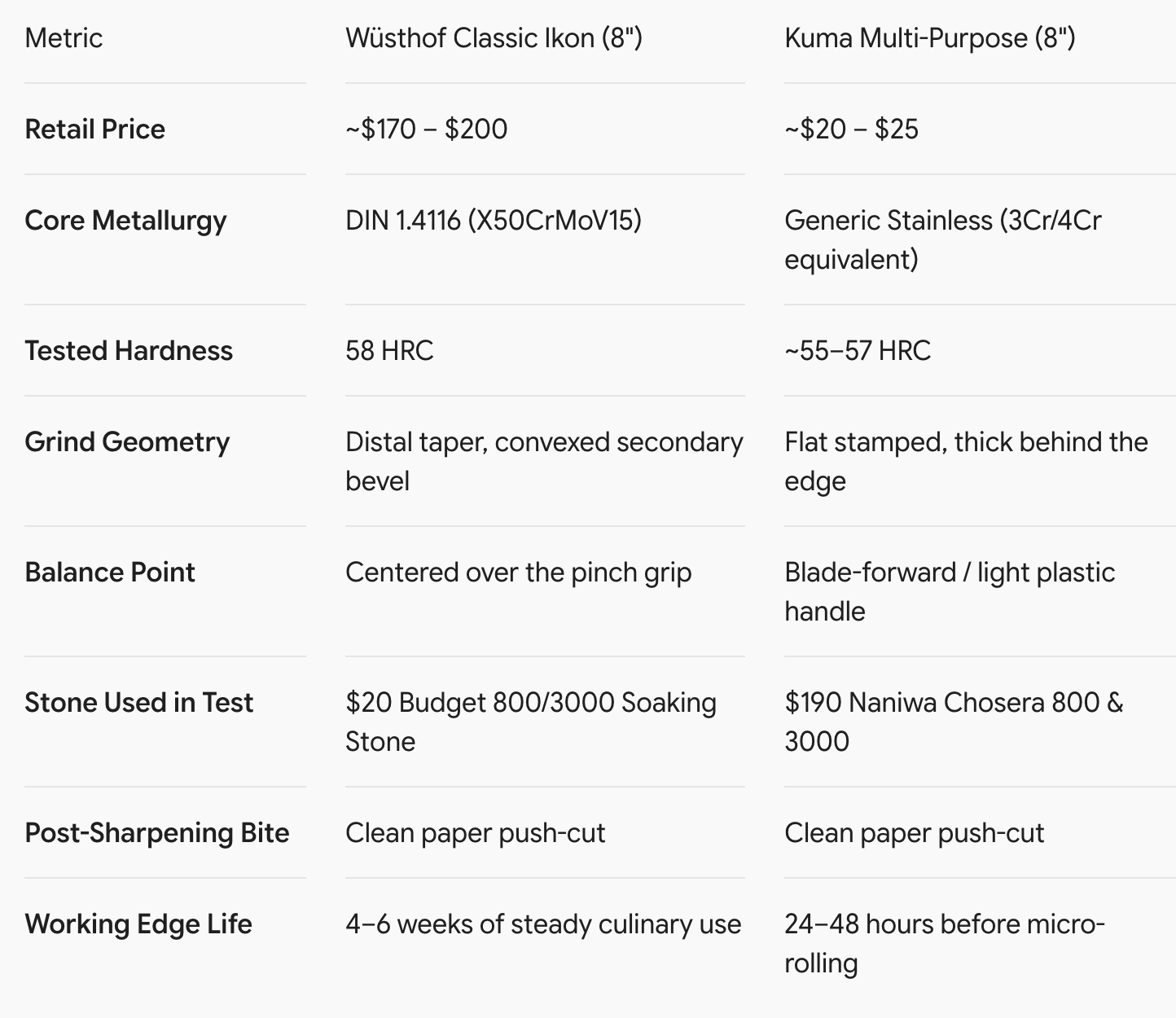
The $20 Illusion: Why Cheap Cutlery Is a Waste of Money
It is tempting to look at this experiment and conclude that you can beat the system: buy a $20 knife, spend your savings on a premium whetstone, and sharpen your way into high-end performance.
In reality, a $20 kitchen knife is a waste of money.
While high-end abrasives like the Naniwa Chosera can temporarily force an apex onto inferior steel, they cannot change the laws of metallurgy. Cheap stamped knives utilize low-grade alloys with uneven carbide distribution and sub-par heat treatments.
The apex you establish on a $20 knife is fundamentally fragile; within a few prep sessions against a wooden cutting board, the soft steel rolls, buckles, and dulls to an unusable state.
More critically, cheap knives lack distal taper and proper blade-road geometry. They are stamped from uniform sheets of metal, resulting in thick shoulders right behind the cutting edge. Even when razor-sharp at the apex, a $20 knife will wedge, bind, and crack dense ingredients rather than gliding through them.
The same rule applies to $20 combination whetstones. A stone that dishes after a single session forces you to immediately purchase a diamond flattening plate just to keep it functional—costing you more in maintenance gear than the stone is worth.
If you have a strict $20 budget, do not waste it on disposable knives or crumbly soaking stones. Save your money. Step up to an entry-level Japanese carbon knife, an affordable Victorinox Fibrox, or a proven German workhorse, paired with a reliable medium stone like a Shapton Pro 1000 or King KDS.
True cutting performance is built on the intersection of proper heat treatment, convex geometry, and resilient stone media. Shortcuts on the bench always cost more in the end.