A technical deep-dive into Nigara Hamono in Hirosaki, Aomori. We examine their 350-year Tsugaru swordmaking lineage, the mechanics of drilling Anmon Damascus billets, hand-dressing rotary water wheels, bare-hand acid etching, and the metallurgy behind true coreless carbon steel.
trust retailers BurrfectionStore | Gyuto | WasabiKitchen | Amazon
Disclosure: As an Amazon Associate, I earn from qualifying purchases.
Get Nigara Knives BurrfectionStore | Gyuto
In the far northern expanse of Honshu, within the apple orchards and snow-covered plains of Hirosaki, Aomori Prefecture, sits one of the most mechanically inventive forges in Japan: Nigara Hamono.
While central production regions like Seki, Sakai, and Echizen command the bulk of global cutlery headlines, Nigara operates under a unique historical identity. Originating during the early Edo period, the workshop holds an unbroken 350-year heritage of forging swords for the Tsugaru samurai clan. Following the post-Meiji disarmament decrees and post-WWII economic pivots, Nigara transitioned its proprietary metallurgy into structural steel fabrication, agricultural blades, and ultimately world-class culinary knives.
Unlike standard factory cutlers that buy pre-laminated steel sheets from commercial rolling mills, Nigara engineers its own high-carbon billets, forge-welds bespoke Damascus clad matrices, and grinds blades using massive, water-cooled rotary stones.
Examining their daily production reveals the engineering behind one of modern cutlery's most revered workshops.
[ THE PRODUCTION WORKFLOW AT NIGARA HAMONO ]

Billets & Thermal Forming ──► Hot Twist / Forge-Welding (White-Hot Thermal Band)
                 │
Primary Grinding Floor    ──► Hand-Dressed Rotary Water Wheels (120 ➔ 200 Grit)
                 │
Geometry & Straightening  ──► Manual Visual Alignment / Cold Hammer Leveling
                 │
Spine & Choil Finishing   ──► Precision Chamfered Shoulders & Stitched Buffing
                 │
Degreasing & Acid Etch    ──► Multi-Stage Ultrasonic Clean ➔ Ferric Immersion
                 │
Final Edge Setting        ──► Horizontal Finishing Wheels (3,000–8,000 Grit Equiv.)
1. The Hot Forge: Spring Hammers, High-Heat Twisting, and Scale Control
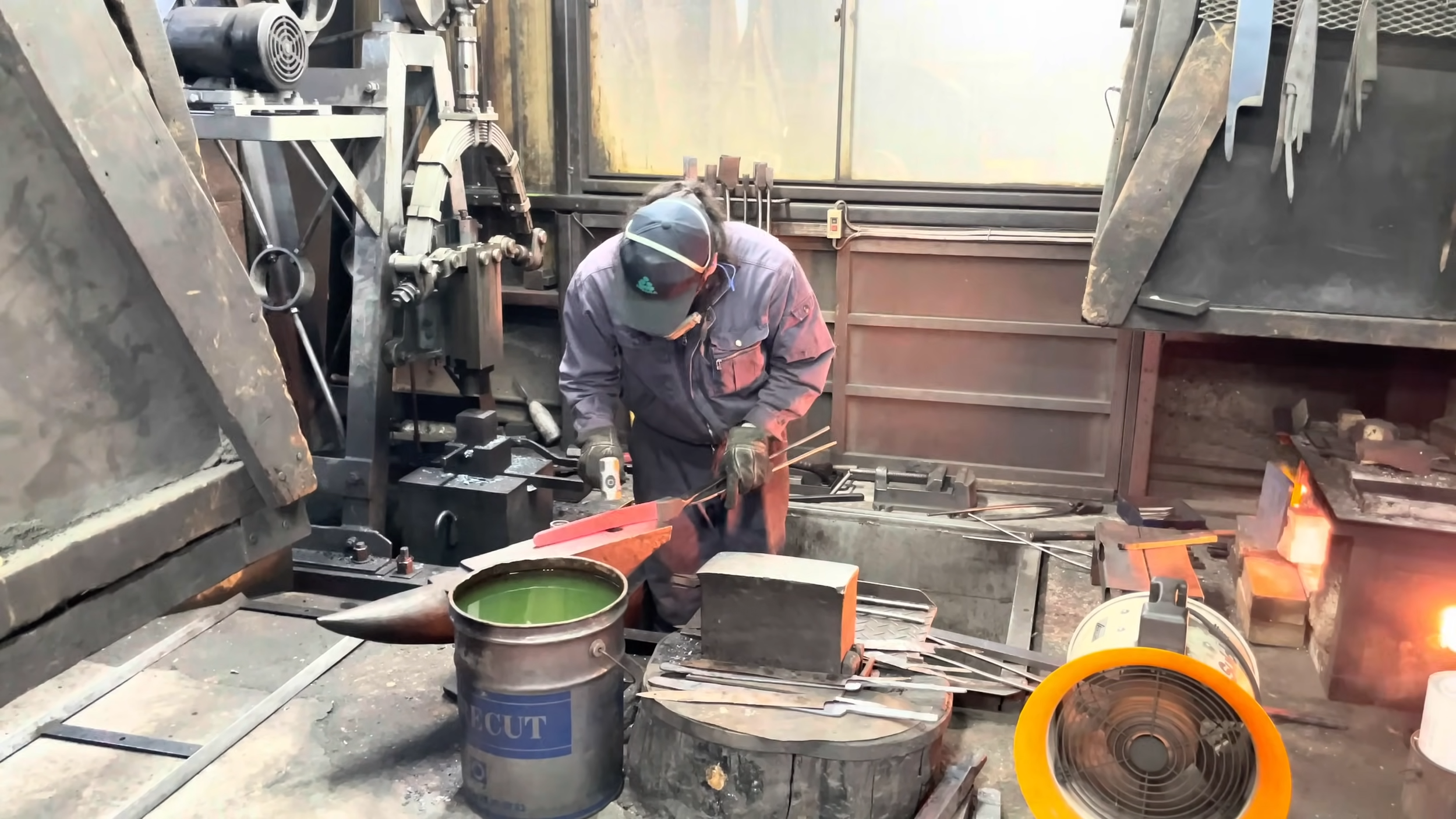
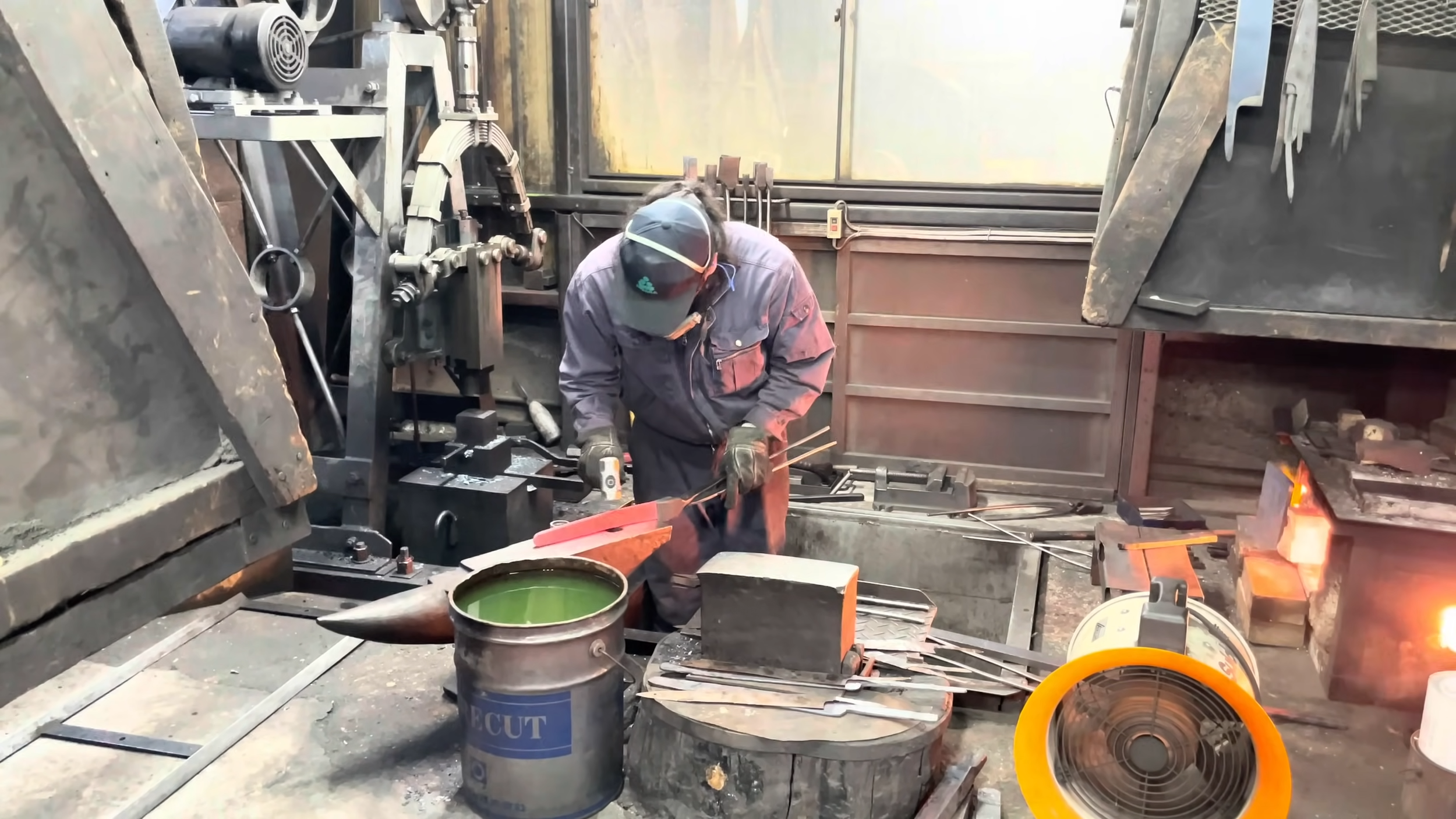
Entering Nigara’s hot-forge room is a kinetic assault: multiple pneumatic spring hammers strike rhythmically against hard anvils, and gas furnaces blast at temperatures exceeding 2,100°F (1,150°C).
Standing over the hearth, master smith Toshihiro Shibata (widely known as Suba-san) monitors raw billets soaking inside the coals. In traditional Japanese hand-forging, optical pyrometry is done by human eye. A smith must read the precise incandescent color of the steel to gauge its internal crystal structure:
THERMAL COLOR AND METALLURGICAL PHASES

Dull Red  (1,300°F / 700°C)   ──► Sub-critical; steel resists deformation; strain hazard
Cherry Red (1,550°F / 840°C)  ──► Austenitizing zone; baseline quenching threshold
Bright Yellow (1,900°F / 1,040°C)──► High plasticity; safe for heavy drawing and reduction
White Heat (2,200°F / 1,200°C)──► Forge-welding window; borax flux liquefies; layer adhesion
When Suba-san pulls a billet destined for a twisted Damascus blade from the forge, the rod glows near yellow-white heat. Operating within a narrow thirty-second window before the steel drops below plastic working temperatures, he clamps the stock in a vise and twists the rod under steady torque.
As the billet twists, hot mill scale (iron oxide, $Fe_3O_4$) blisters and explodes from the surface. With practiced economy of motion, Suba-san uses a hand hammer to tap away loose flakes before the scale can be pressed into the interior layers under the mechanical spring hammer. Allowing spent scale to become trapped inside the core during forge-welding creates voids, cold shuts, and structural fractures that ruin a blade's edge geometry.
Once shaped and normalized, each forged blank is air-cooled on racks beneath the forge hood. Here, silhouettes of yanagibas, gyutos, and kiritsukes hang as dimensional reference templates, ensuring that freehand hammer strikes match the target distal taper and edge sweep.
2. The Grinding Floor: Rotary Water Wheels and Stone Dressing
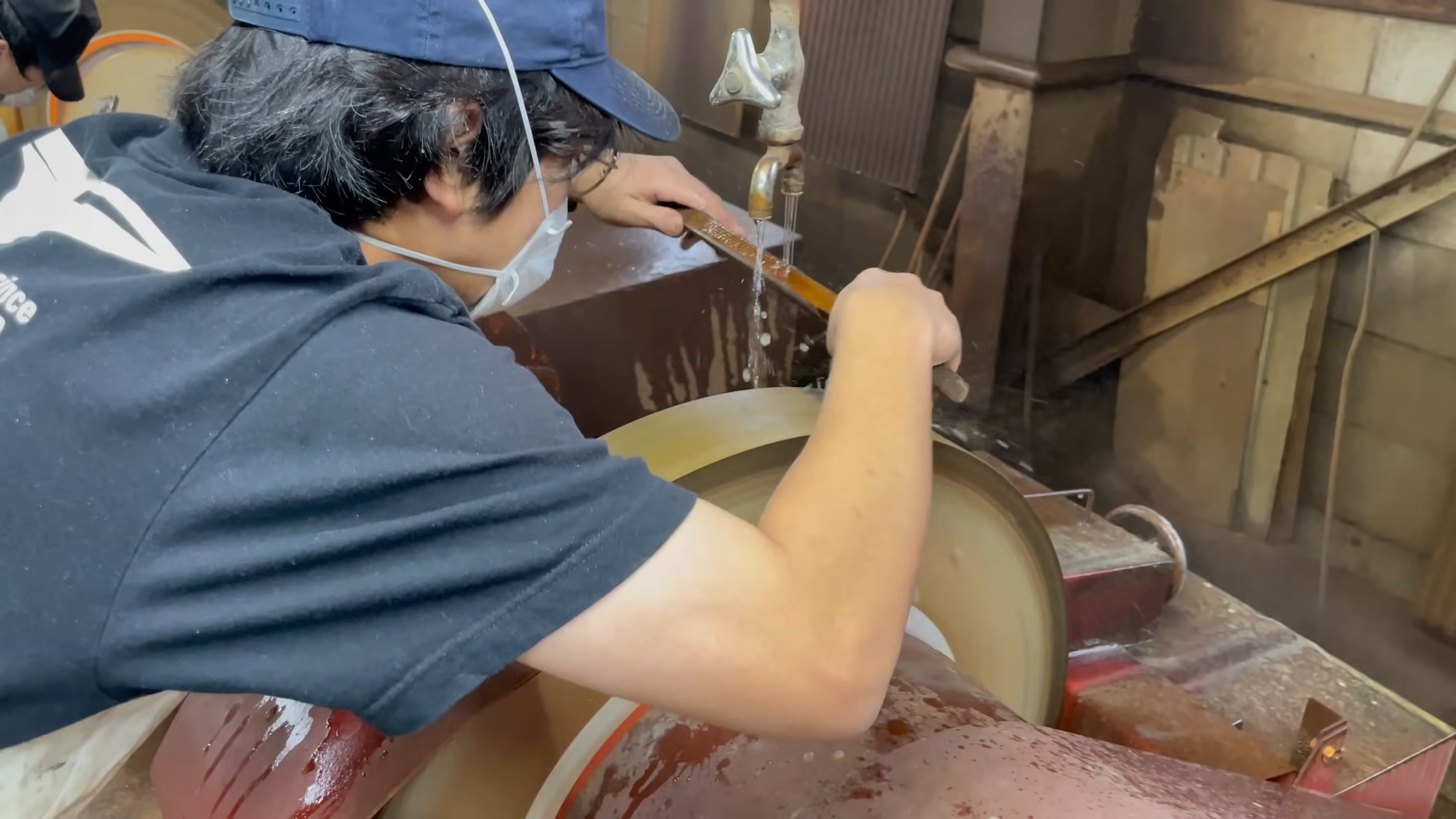
Once forged and annealed, raw blanks move to the grinding stations. The machines here dwarf standard tabletop belt grinders: massive, water-cooled composite wheels spin horizontally and vertically within industrial splash hoods.
The Initial Bevel Grind (~120 Grit)
The first stone to touch the raw steel is a coarse rotary wheel running at high surface speeds. This stage sets the primary bevel road, roughs in the distal taper, and removes the black forge crust (kurouchi).
Because the stone cuts aggressively, the operative risk is extreme: a split-second change in wrist pressure can ruin the bevel plane or overheat a hardened blank.
The Science of "Tread Dressing"
During extended grinding sessions, metallic swarf and pulverized binder load into the pores of the wheel, creating a slick, glazed surface. A glazed wheel loses its abrasive friction, causing the blade to skate unpredictably across the stone face and generating friction heat.
To counteract this, the grinder periodically engages in stone dressing:
The artisan takes a hardened, scrap steel bar and presses it firmly into the spinning stone.
By scoring deliberate grooves across the stone face, the grinder carves "tread" into the surface.
These channels serve two purposes: they expose fresh, sharp abrasive crystal matrix, and they channel coolant water under the blade contact patch, preventing the hydroplaning effect and giving the grinder tactile feedback through his fingertips.
From this station, the blade moves to a secondary wheel (~200 grit) to refine scratch patterns before transitioning to water-cooled belt sanders for mid-grit polishing.
3. Hand Straightening & Edge Profiling
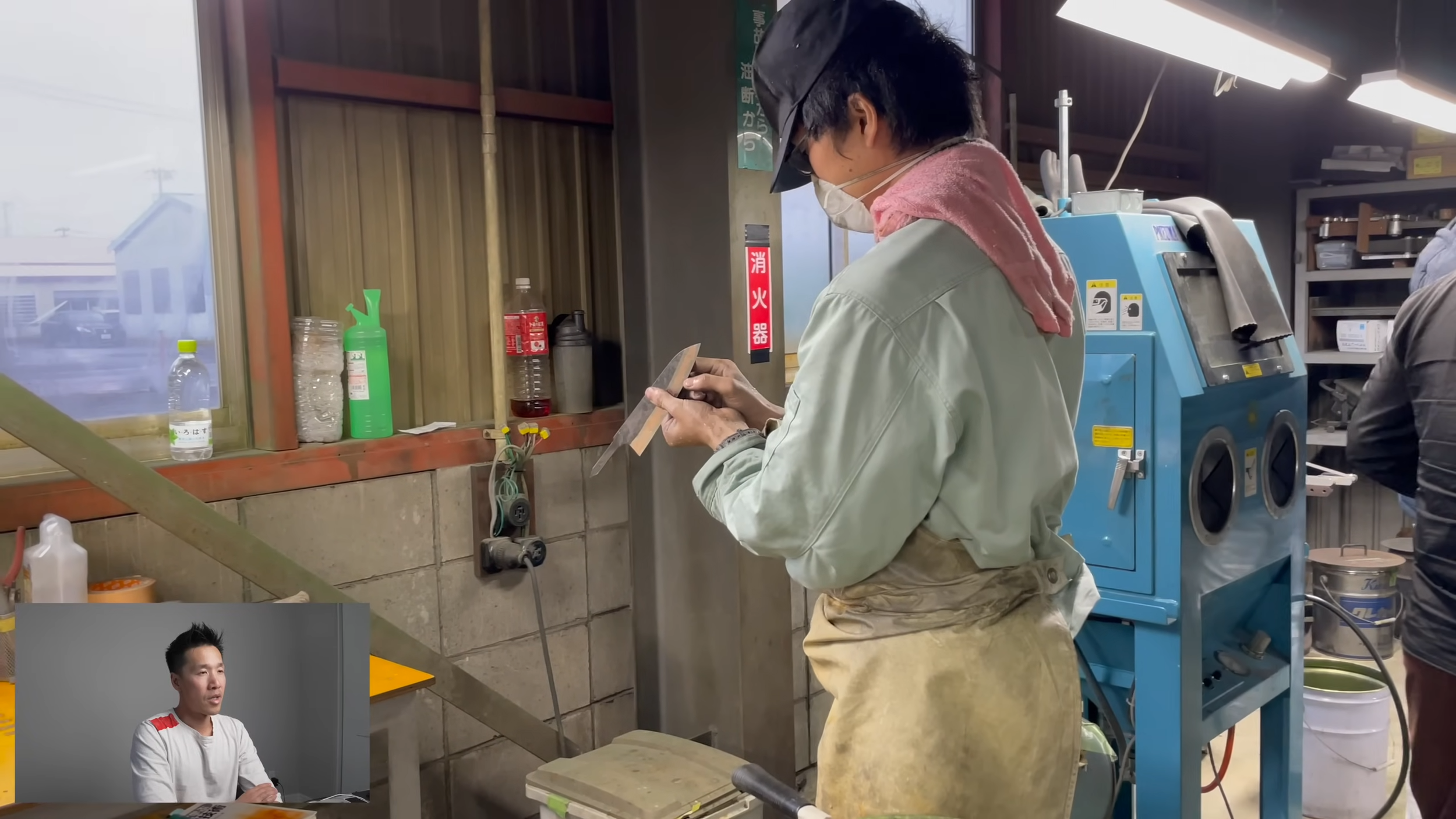
Between grinding cycles, every blade is brought to an inspection bench. No laser guides or automated optical scanners are used.
Holding the blade horizontally toward a directed light source, the smith sights down the spine and cutting edge, checking for axial twisting, lateral s-curves, and warps introduced by thermal stress.
Minor deviations are corrected immediately using wooden straightening mallets or slotted copper-jawed bending levers. Correcting a hardened high-carbon core requires practiced muscle memory: too little leverage fails to yield the steel past its elastic limit; too much leverage shatters the micro-carbide crystalline matrix.
Once straight, the knife heads to the primary sharpening wheels. Watching an artisan establish the primary edge highlights the difference between production-line sharpening and custom grinding:
The sharpener does not simply move from heel to tip in mechanical, uniform sweeps.
He reads the thickness behind the edge: on one pass, he sweeps from heel to tip with rapid linear speed; on the next pass, he concentrates exclusively from the forward belly to the tip, holding the knife at a micro-fraction of an angle higher to build a reinforced apex.
For the final polish, the blade moves to a horizontal finishing wheel—a smooth, spinning disc running continuous water, behaving as the mechanical equivalent of a 3,000-to-8,000 grit synthetic or natural waterstone (awasedo). A single fluid, heel-to-tip trailing pass across this wheel leaves a clean, deburred edge that shaves hair above the skin line.
4. Spine Chamfering, Degreasing, and the Acid Bath
Blade finishing at Nigara emphasizes crisp, contemporary geometry over rounded European contours. Senior grinder and workshop instructor Atsushi Maruyama executes this on high-speed abrasive belts:
Rather than buffing the spine into an indistinct half-round, Maruyama grinds a crisp, uniform 45-degree chamfer along the top corners of the spine. This breaks the sharp 90-degree edge left by the blanking process, ensuring comfort in an aggressive pinch grip while leaving an architectural, faceted ridge down the blade’s spine.
The Degreasing Protocol
After the chamfered spine and choil are buffed to a mirror finish on cotton wheels loaded with green chromium oxide compound, the knife must undergo a demanding chemical cleansing.
Buffing compounds use heavy petroleum, animal fats, or wax binders to suspend micro-abrasives. If a blade is dipped into an acid etching bath with a microscopic trace of wax on its flats, the acid will be blocked by the hydrophobic oil. This results in splotchy, uneven Damascus contrast that ruins the blade face.
To prevent this, the blades are hand-scrubbed through four to five separate steaming-hot degreasing wash cycles. Every trace of polishing compound and fingertip oil is removed using specialized alkaline soaps until water sheets uniformly across the steel without beading.
The blade is then immersed directly into a heated, concentrated ferric chloride etching bath. Maruyama inspects the blades bare-handed, timing the exposure by the second.
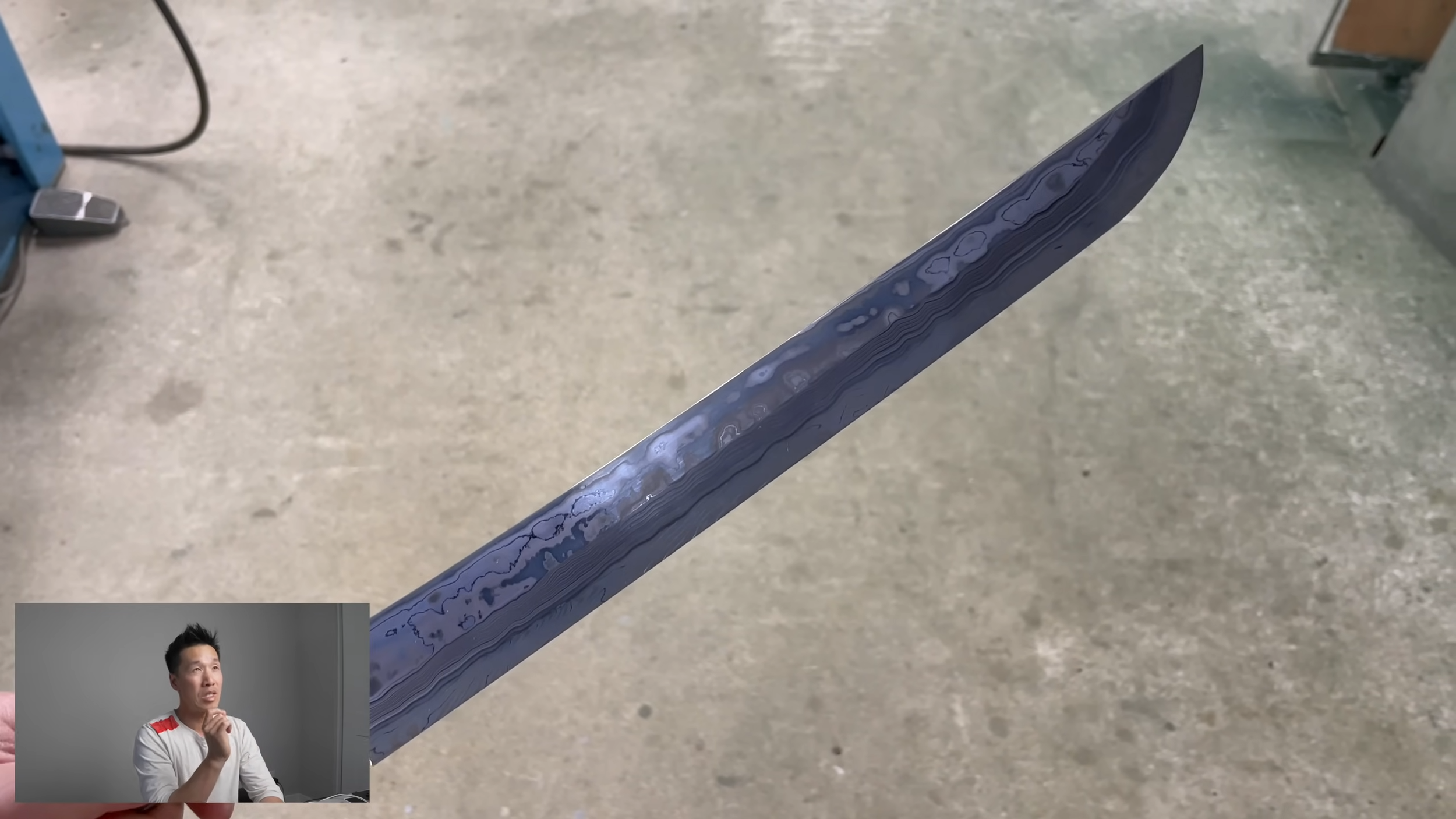
The acid selectively attacks the steel: high-carbon layers oxidize quickly, darkening into a rich charcoal-gray hue, while nickel-rich or specialized stainless layers resist the corrosive acid, remaining brilliant silver.
Once the contrast peaks, the blade is neutralized in an alkaline solution, dried with lint-free microfiber paper, and drenched in pure camellia oil (tsubaki) to seal the reactive surface before final packaging.
5. Structural Metallurgy: The Secrets of Nigara Steel
Nigara’s cutlery exhibits a dense, solid acoustic ring when struck and an authoritative balance point. This unique character is directly tied to the company's metallurgical industrial roots.
Because Nigara maintains historical divisions in structural fabrication and civil engineering steels, their thermal cycling protocols, vacuum furnace controls, and alloy-blending capabilities outpace standard artisanal workshops.
+--------------------------------------------------------------------------+
| CLADDING TOPOGRAPHY AND STRUCTURAL VARIANTS                              |
|                                                                          |
| 1. True Coreless Damascus (Aogami #2 + Shirogami #2):                    |
|    └── Two distinct high-carbon steels forge-welded together without     |
|        an inert cladding jacket. The cutting edge is composed entirely    |
|        of alternating microscopic layers of hard steel, creating an      |
|        eternal micro-serration as the layers wear at differing rates.    |
|                                                                          |
| 2. Anmon Damascus (Drilled Billet Architecture):                         |
|    └── Multi-layer Damascus billet is drilled with hundreds of small     |
|        holes by hand, then forged flat under the spring hammer.          |
|        Distorting the planar layers produces concentric ripple rings     |
|        resembling water droplets striking a still pond.                  |
|                                                                          |
| 3. Stabilized Chemical Storage:                                          |
|    └── Forged blanks are stored long-term in specialized antioxidant     |
|        aqueous holding baths, preventing surface micro-pitting for       |
|        months or years prior to final custom grinding.                   |
+--------------------------------------------------------------------------+
True Coreless vs. Mass-Market Cladding
The vast majority of commercial "coreless" Damascus knives on the global market are stamped from pre-fabricated steel sheets combining a decent alloy (like VG-10) with an inferior, soft alloy (such as VG-2).
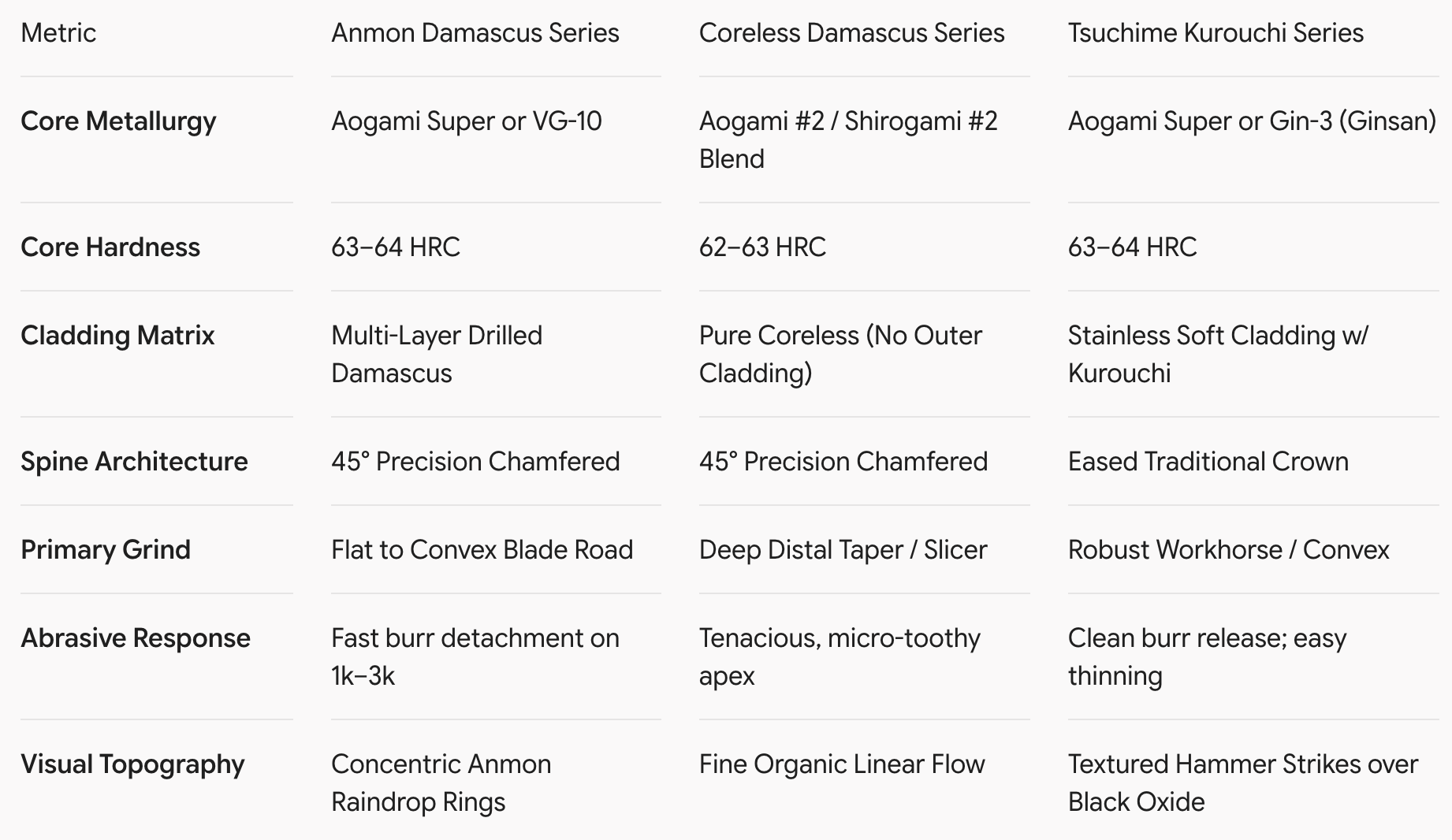
Nigara’s coreless blades take the purist route: they forge-weld authentic Hitachi Blue Paper #2 (Aogami #2) with White Paper #2 (Shirogami #2). Both alloys are pure, high-hardness carbon steels (62–64 HRC).
As the knife is used and sharpened on whetstones, the microscopic boundaries between the White and Blue steels abrade at slightly different rates.
This differential wear creates a self-renewing micro-toothy apex that bites into tomato skins, oily fish, and dense proteins long after standard homogenous apexes roll.
The Engineering of the Anmon Pattern
Nigara’s signature Anmon series takes its name from the sacred Anmon Waterfalls of the Shirakami-Sanchi wilderness. The mesmerizing, droplet-ripple Damascus is not the result of random hammer strikes.
Before forging, a thick billet of pattern-welded steel is placed under a drill press. An artisan systematically drills hundreds of precision holes into the billet face. When this perforated block is brought back to yellow heat and hammered flat under the mechanical spring hammer, the circular voids collapse and squeeze outward.
The horizontal lamination planes are forced into three-dimensional concentric circles. When ground on the rotary water wheels, this reveals hundreds of layered rings that look like rain falling across water.
Technical Comparison: Nigara Hamono Series Architecture
6. The Human Guild: Preserving an Endangered Craft
Walking through Nigara reveals a rare demographic reality in Japan's artisan landscape: the forge is staffed by young craftspeople.

Across Japan, traditional cutlery guilds in Sakai, Sanjo, and Takefu face succession crises, with masters in their 70s and 80s retiring without apprentices. Under the leadership of fifth-generation head master Tsuyoshi Yoshizawa and his brother Kazuki Yoshizawa, Nigara has reversed this trend.
[ THE ARTISAN ROSTER AT NIGARA HAMONO ]

Tsuyoshi Yoshizawa ──► Master Blacksmith / Technical Director (5th Generation)
Kazuki Yoshizawa   ──► Senior Operations & Forge Management
Toshihiro Shibata  ──► (Suba-san) Master Forger (Hot Forge / Twisted Billets)
Atsushi Maruyama   ──► Senior Grinder, Instructor, and Surface Finisher
Etsuo Hanamura     ──► Master Bladesmith (Bespoke Collaborations & Kiritsuke)
Akihiro Furukawa   ──► (Aki) Tokyo Apprentice; Preserving Traditional Sharpening
Craftsmen like Etsuo Hanamura—the artisan behind custom high-profile projects—work alongside young apprentices like Akihiro Furukawa (Aki), who moved across Japan from Tokyo to Aomori for the opportunity to apprentice at the forge.
Apprentices at Nigara undergo years of foundational training: mastering water wheel maintenance, dressing coarse abrasives, and hand-straightening warped blanks before ever swinging a hammer at the hot forge.
It is easy to look at a high-end hand-forged knife as an expensive luxury commodity. But being on the floor of Nigara Hamono strips away that romantic abstraction. Every single millimeter of an Anmon gyuto or a coreless yanagiba is the physical result of intense heat, airborne abrasive swarf, burns, eye-straining alignment checks, and generational muscle memory.
Nigara does not simply manufacture cutting tools; they preserve an unbroken lineage of metallurgical knowledge, proving that ancient samurai swordmaking principles and modern abrasive engineering can coexist on the same workbench.
Get Nigara Knives BurrfectionStore | Gyuto