The $40 Sharpening Gateway: Can a Budget Waterstone Compete with Pro-Grade Glass Ceramics?
A common myth in modern cutlery maintenance is that achieving a razor-sharp kitchen edge requires an expensive suite of professional sharpening gear. When pairing an entry-level $20 chef’s knife with maintenance tools, spending $150 or more on high-end abrasives seems mathematically upside down.
Does a $20 dual-grit combination waterstone actually deliver a practical kitchen edge, or do professional-grade glass ceramics completely render budget stones obsolete?
To determine the real-world value proposition, we put two identical $20 utility chef knives through an identical dulling protocol—20 unweighted passes across a concrete brick—before restoring their edges on two drastically different sharpening setups.
trust retailers BurrfectionStore | Gyuto | WasabiKitchen | Amazon
Disclosure: As an Amazon Associate, I earn from qualifying purchases.
The Testing Ground: Isolating the Abrasives
By utilizing identical, soft-to-mid-range stainless steel blades (~55 HRC), the steel variable is eliminated, leaving only the performance of the abrasives under test:
The Budget Challenger: The Sharp Pebble 400/1000 Dual-Grit Waterstone (~$20). A traditional synthetic combination stone that requires a full water soak prior to use.
The Professional Standard: The Shapton Glass 320 and 1000 Grit System (~$150+ total). High-density, glass-backed ceramic stones engineered for rapid metal removal, minimal wear, and immediate splash-and-go deployment.
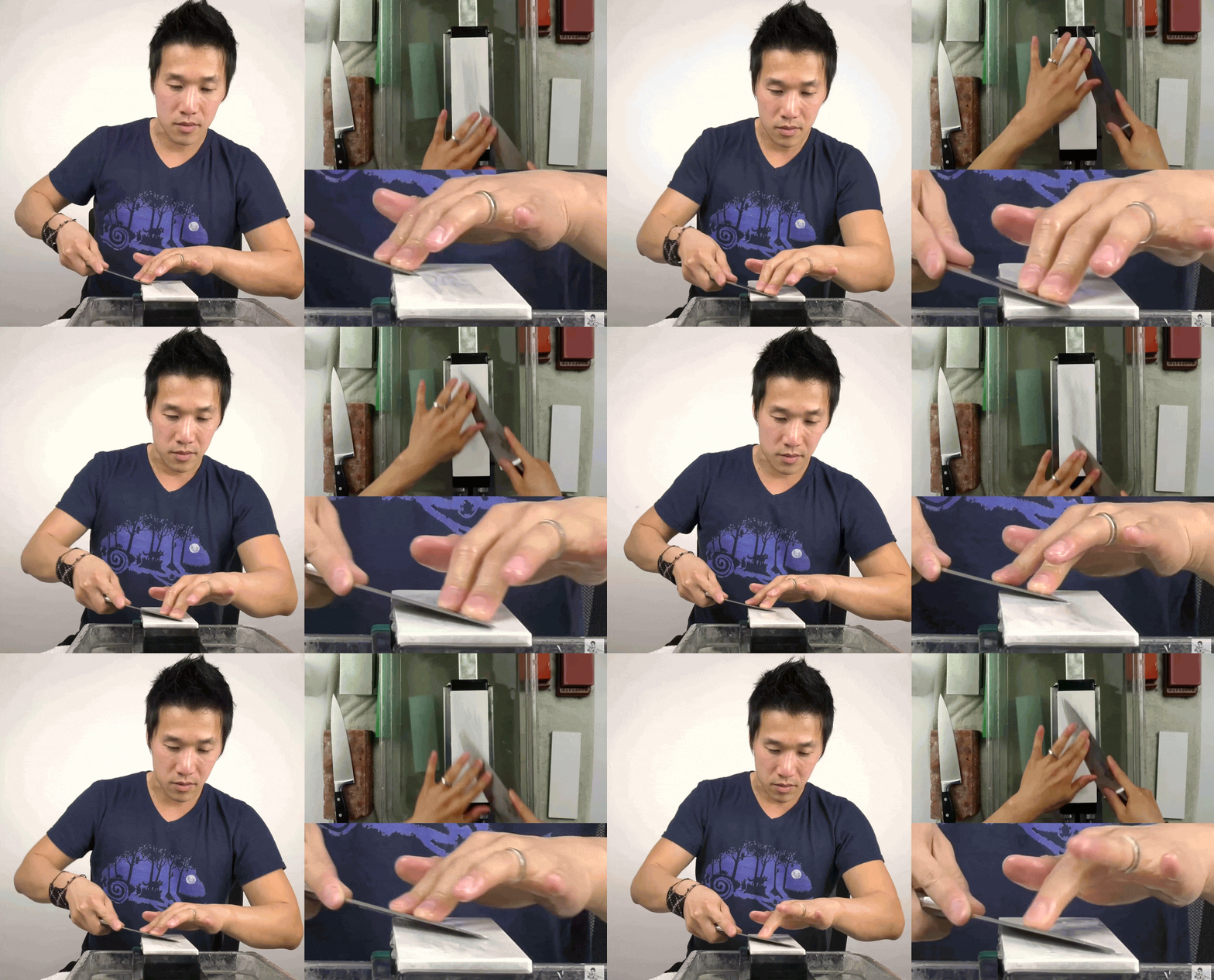
Tactile Dynamics: Soaking Softness vs. Hard Ceramic Speed
The physical experience on the bench reveals distinct mechanical trade-offs between traditional soaking synthetics and modern glass ceramics.
Shapton Glass 320 / 1000: Surgical Speed
Aggressive Cut Rate: The Shapton Glass 320 cuts fast, raising a crisp, uniform burr in minimal passes without requiring heavy downward hand pressure.
Dimensional Stability: The hard ceramic matrix resists dishing out, maintaining flat surface geometry over extended use without requiring constant flattening maintenance.
The Physical Trade-Off: High cost per millimeter of usable stone. Shapton Glass abrasives are ultra-thin mounted sheets, offering far less total abrasive volume by weight than standard waterstones.
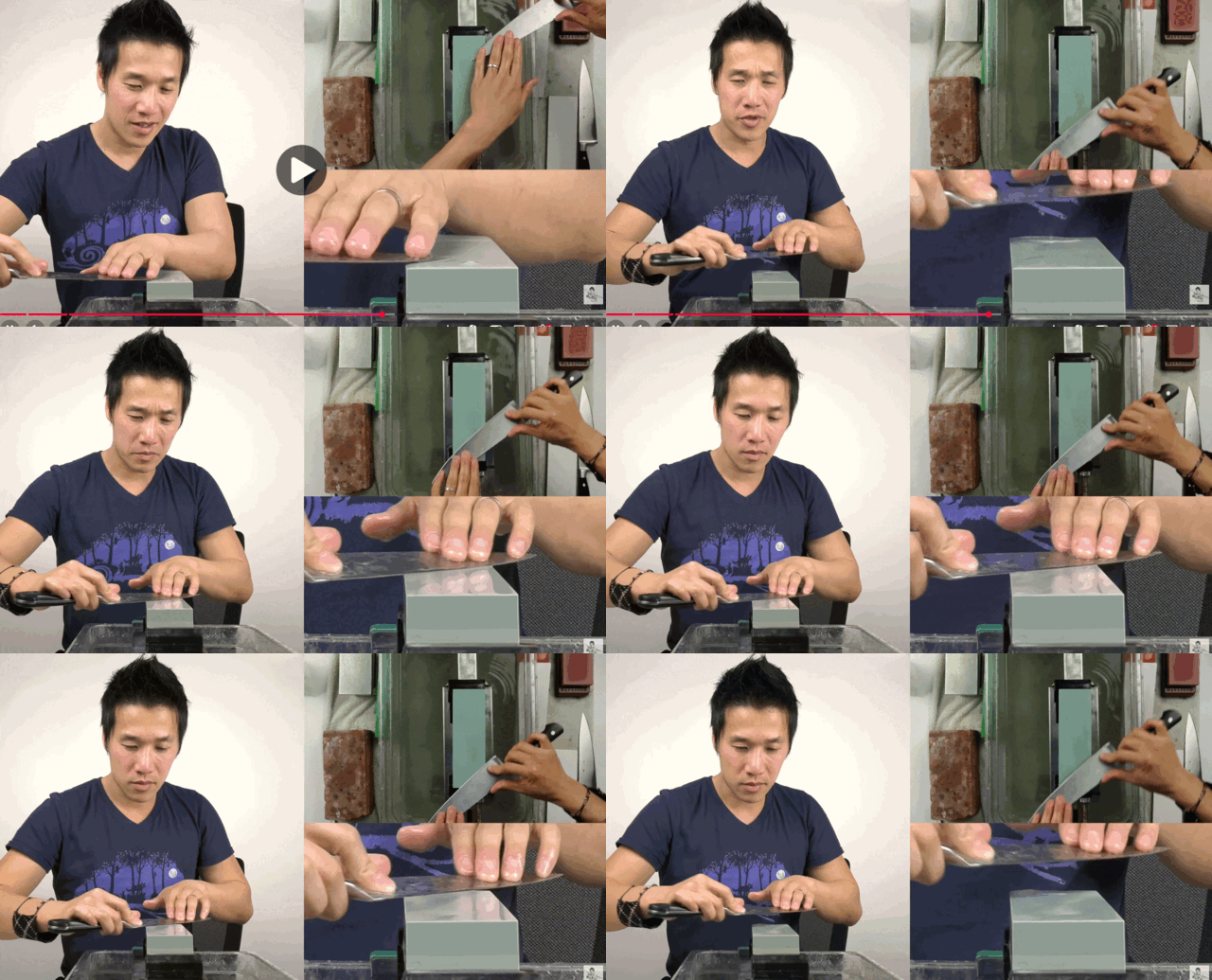
Sharp Pebble 400 / 1000:
Self-Sharpening Soft Matrix
Working Real Estate: The budget stone features a noticeably smaller physical footprint. Managing blade placement across a narrow surface requires tighter hand discipline, making angle control more challenging for beginners.
Active Abrasive Shedding: The 400-grit side uses a softer bonding binder. As the blade passes over the stone, spent particles shed rapidly to continuously expose fresh, sharp abrasives. This prevents heavy metal loading (clogging) and maintains steady cutting speed.
Tactile Feedback: The 400-grit side offers a true-to-grit coarse feedback, while the 1000-grit side delivers the soft, organic "cushioned" drag characteristic of soaked synthetic waterstones.
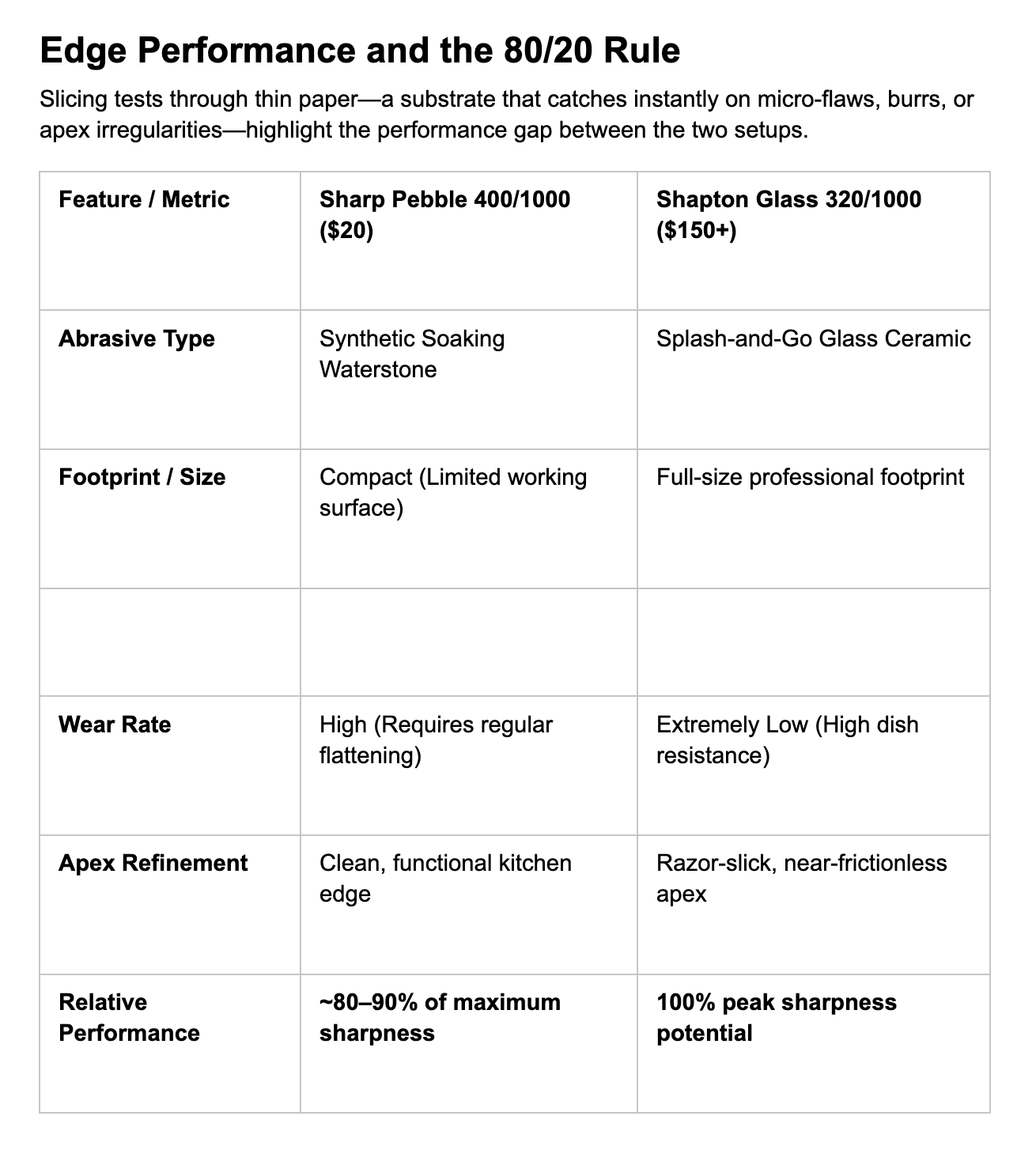
comparing the two whetstones side-by-side
Predictably, the Shapton Glass system produced a cleaner, sharper edge. The blade passed through thin paper silently and without hesitation. The edge refined on the $20 Sharp Pebble stone exhibited slightly more tactile resistance along the cut path.
However, the budget combination stone produced roughly 80 to 90 percent of the sharpness generated by the professional ceramic setup.
The Verdict: Is 90% Sharpness Enough?
While professional glass ceramics remain the undisputed choice for speed, longevity, and working ultra-hard Japanese steels (60+ HRC), the performance gap narrows significantly on standard kitchen cutlery.
If you value splash-and-go convenience, maintain high-end blades, or sharpen daily, investing in a hard ceramic glass system is well worth the capital.
However, for home cooks, hobbyists, or beginners looking to learn freehand sharpening without heavy upfront costs, the math is undeniable: a $20 knife paired with a $20 dual-grit waterstone delivers a complete, resharpenable maintenance kit for $40 total. It delivers nearly 90 percent of the performance of professional-grade setups at a fraction of the price.
For me personally, I prefer high-quality whetstones that I know will always get the job done right.
Shapton Glass whetstones take the win, but see which whetstones I personally use at home in this article.