The proliferation of digital affiliate marketing has introduced a predatory trend into the culinary world: white-label drop-shippers masquerading as generational Japanese cutlery houses.
Mainstream publications and digital lifestyle portals routinely lease out their credibility to syndication networks, serving readers ads for knives with manufactured pedigrees, fabricated MSRP discounts, and metallurgical claims that defy the basic physics of steel.
A prime case study in this deceptive ecosystem is the aggressive promotion of brands like "Damasukasu"—a phonetic caricature designed to sound authentic to Western ears—marketed through sponsored editorial widgets on sites like Popular Mechanics, Salon, AskMen, and Groupon.
To the uninitiated cook, a "handmade Japanese Damascus chef set" marked down by 91% looks like the bargain of a lifetime. To anyone who understands knife making, heat treatment, and sharpening mechanics, it is an aggressive, coordinated grift.
trust retailers BurrfectionStore | Gyuto | WasabiKitchen | Amazon
Disclosure: As an Amazon Associate, I earn from qualifying purchases.
1. Deconstructing the Marketing Mythos
The sales copy fueling these syndicated campaigns relies on exotic buzzwords strung together to overwhelm consumers who have never handled a whetstone or researched Japanese blade making.
[ THE DECEPTIVE MARKETING STACK ]
"Samurai Sword Lineage"   ──► Mythological framing; obscures factory stamping.
"120 Hours of Labor"      ──► Industrial batch stamping reframed as bespoke artisanal work.
"67-Layer Nickel Steel"   ──► Cosmetic acid-etching or cheap cladding over low-grade cores.
"Cryogenic / Nitrogen"    ──► Standard commercial sub-zero quenching marketed as aerospace tech.
"12° Per Side Apex"       ──► Mechanical impossibility on sub-55 HRC steel without immediate failure.
When evaluated against baseline cutlery engineering, the promotional claims collapse under their own weight:
"Borrowing the Method of Samurai Swords": Traditional Japanese cutlery production relies on specific regional guilds—such as the forging centers of Sakai, Seki, Sanjo, or Echizen—utilizing distinct carbon or powder-metallurgy alloys (Hitachi White/Blue paper steels, Takefu VG-10, SG2). Vague references to "samurai swords" are an immediate indicator that a knife lacks verifiable geographic provenance.
"Undergoing 120 Hours of Completion": This is an intentional misrepresentation of batch processing. Industrial vacuum heat-treating and tempering cycles for thousands of stamped blanks simultaneously are tallied up and presented as individual hand-craftsmanship.
"67 Layers of Nickel-Rich Steel": Multi-layer pattern-welded steel (modern decorative Damascus) has zero correlation with cutting performance; it is purely aesthetic cladding. In budget drop-shipped cutlery, this is frequently nothing more than a shallow, laser-etched or acid-printed graphic applied over a low-carbon, unhardened stainless base.
The "12-Degree Laser Cutting Edge": An acute 12-degree bevel angle requires exceptionally hard, fine-grained steel (60–64+ HRC) with high yield strength to prevent plastic deformation. Grinding a 12-degree apex onto a soft, stamped alloy results in an edge that will roll, buckle, and fail after a single prep session against an end-grain cutting board.
2. The Syndicate Network: How the "90% Off" Grift Operates
These brands do not operate traditional, independent retail storefronts. Instead, they leverage third-party affiliate aggregators (such as StackCommerce) that syndicate promotional "deals" across dozens of reputable media outlets simultaneously.
                    ┌──► Popular Mechanics Store
                    ├──► AskMen Commerce Portal
                    ├──► Daily Caller Shop
[ StackCommerce ] ──┼──► Salon Marketplace
  Affiliate Feed    ├──► StackSocial
                    └──► Groupon Goods
                             │
                             ▼
              [ Unified White-Label Checkout ]
              ├── Shared Inventory: Stamped Yangjiang Blanks
              ├── Hardcoded "Social Proof": Identical Review Counts
              └── Fake Anchor Price: $599 MSRP marked down to $49.99
When tracking these offers across distinct media properties, the operational footprint becomes clear:
The Identical Cart Backend: Clicking through an ad on Popular Mechanics opens an e-commerce page styled to look like an official sub-domain of the magazine. However, opening the exact same offer on AskMen or Salon reveals identical sales copy, identical product photography, and identical shopping carts.
Hardcoded Review Metrics: Across every single publication domain, the review databases are locked to identical figures: precisely 351 reviews for the standard three-piece set, and 156 reviews for the "Master Set." The reviews are static marketing assets rather than verified customer feedback.
The Artificial Price Anchor: The core conversion mechanism is the fabricated MSRP. By setting an arbitrary "original" price of $599 and discounting it to $49.99, the seller manufactures an illusion of a 91% discount. No retailer has ever sold these stamped knives for $600; the $50 discounted price already carries a massive profit margin over the $5-to-$8 factory production cost in Yangjiang.
3. Bench Analysis: What Actually Arrives in the Box
A knife can be deceptive in marketing copy, but it cannot lie on the sharpening bench. When these drop-shipped "Damascus" knives are placed on synthetic waterstones, their physical reality is immediately exposed.
WATERSTONE DIAGNOSTICS: AUTHENTIC VS. DROP-SHIPPED

True Japanese San-Mai (e.g., Takefu VG-10 @ 60-61 HRC):
  1000-Grit Stone ──► Clean, microscopic wire burr forms across the bevel.
  Deburring       ──► Light edge-leading passes snap the burr off cleanly.
  Cutting Board   ──► Micro-carbide apex bites aggressively; maintains geometry.

Drop-Shipped Import "Damascus" (Low-Grade Stainless @ ~52-54 HRC):
  1000-Grit Stone ──► Ductile, gummy metal displacement.
  Deburring       ──► Burr refuses to separate; rolls endlessly from side to side.
  Cutting Board   ──► Apex rolls over on contact; thick shoulders wedge in vegetables.
1. Ductility and the "Gummy Burr"
When working authentic high-carbon or powder-metallurgy cutlery, a 1,000-grit bench stone raises a crisp, uniform burr that releases cleanly under light edge-leading passes or on a loaded leather strop.
With cheap import knives, the metal behaves like soft, ductile wire. Because the steel lacks proper hardness and thermal cycling, the abrasive pushes the metal back and forth across the apex without severing it. Deburring becomes an exercise in frustration as the soft foil rolls rather than shears.
2. Fake Cladding and Surface Drag
True clad cutlery features forge-welded layers that can be thinned and polished as the blade ages. Drop-shipped blades frequently utilize superficial chemical etching or surface laser printing to mimic pattern-welded steel.
Not only does this decorative layer offer zero structural utility, but the textured acid treatment often introduces microscopic surface friction, causing the blade to drag and bind when slicing through starchy vegetables like potatoes and carrots.
3. Stamped Geometry vs. Distal Taper
Authentic cutlery is ground with a distal taper—thick at the spine near the handle, tapering progressively toward a fine, nimble tip—along with convex blade faces that promote food release.
Drop-shipped knives are punched from sheets of uniform-thickness rolled steel. While the apex itself may be ground to a functional sharpness at the factory, the blade remains excessively thick directly behind the cutting edge. The knife will pass a superficial paper-cut test out of the box, but it will immediately wedge, crack, and bind inside dense root vegetables.
Technical Comparison Matrix
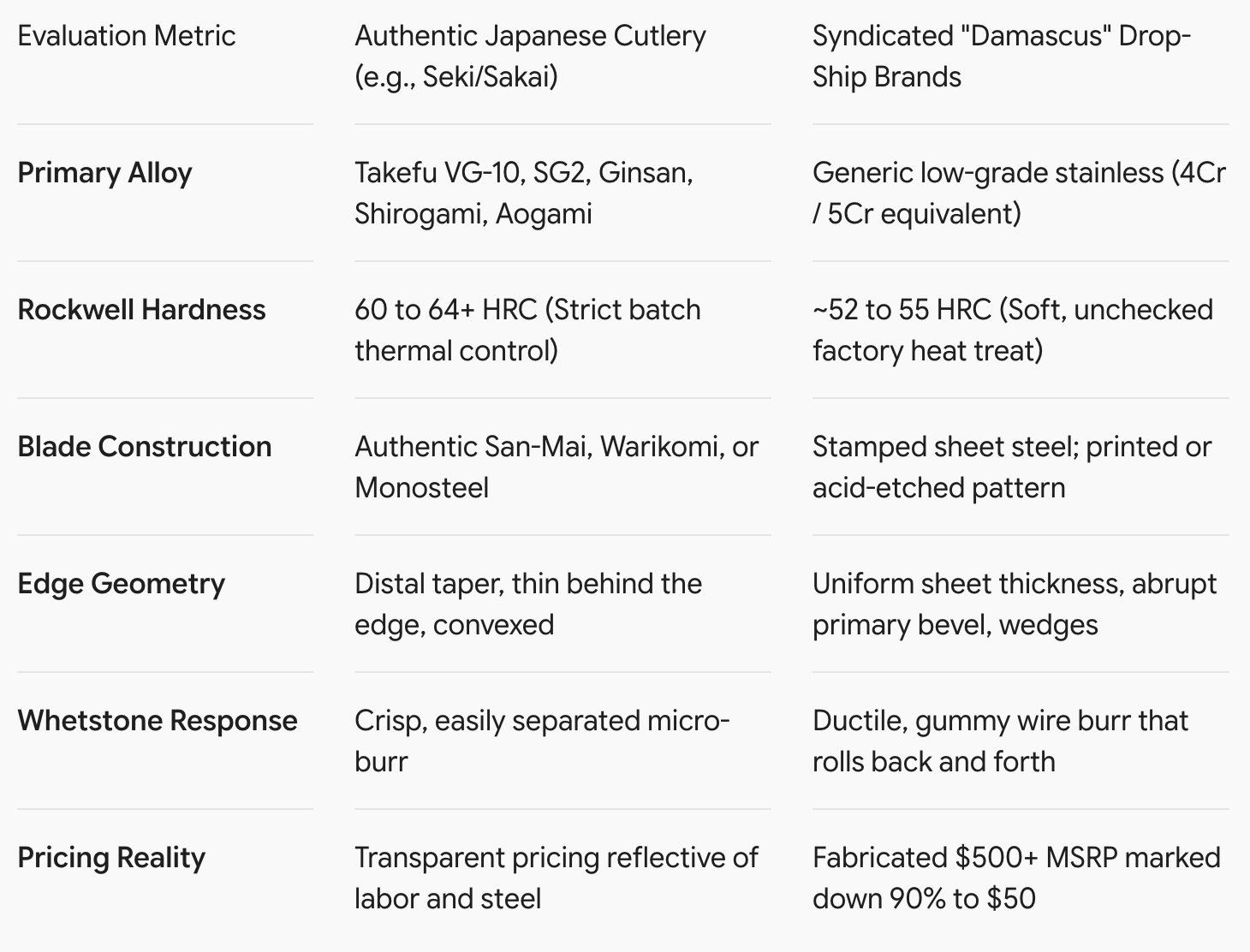
4. The Buyer’s Protocol: How to Verify Provenance
Navigating the cutlery market requires a strict verification framework. Before buying a knife marketed as "Japanese," run it through the following operational checks:
+--------------------------------------------------------------------------+
| THE CUTLERY VERIFICATION CHECKLIST                                       |
|                                                                          |
| 1. Specific Alloy Naming:                                                |
|    └── Does the manufacturer name the exact steel foundry and alloy?     |
|        (e.g., "Takefu VG-10", "Hitachi White #2", "Aichi AUS-10")        |
|        *If it just says "Damascus Steel" or "Japanese Steel", walk away. |
|                                                                          |
| 2. Geographic Guild Origin:                                              |
|    └── Can you trace the blade to a specific city or artisan guild?      |
|        (Seki City, Sakai, Echizen/Takefu, Sanjo, Tosa)                   |
|        *Vague claims of "Japanese heritage" mean mass-produced OEM.      |
|                                                                          |
| 3. Retail Distribution Mechanics:                                        |
|    └── Is it sold through dedicated cutlery retailers, or syndicated via |
|        lifestyle magazine widgets, Amazon storefronts, and Facebook ads? |
|                                                                          |
| 4. Pricing Sanity:                                                       |
|    └── Is the knife advertising a perpetual 70% to 90% discount?         |
|        *Legitimate cutlery houses do not slash $600 MSRPs to $50.        |
+--------------------------------------------------------------------------+
A sharp piece of steel is not automatically a fine knife. Stamped metal can be ground down on an industrial belt and made sharp enough to slice a tomato on camera. But culinary cutlery is an investment in geometry, ergonomic balance, metallurgical purity, and long-term whetstone maintainability.
When digital publishers rent out their mastheads to peddle white-label imports under the guise of ancient samurai traditions, the consumer loses. Support authentic blacksmiths, buy from reputable cutlery purveyors, and never let artificial discounts replace real technical provenance.