

The Great Grit Lie: Why You Don’t Need a $300 Whetstone for a Razor-Sharp Edge
As an Amazon Associate, I earn from qualifying purchases.
If you spend any time on knife forums, social media, or enthusiast groups, you’ve seen the ritual flex. A creator pulls out a polished, ultra-premium Japanese knife, sets up a pristine cutting board, and glides through a tomato to produce slices so sheer they’re practically see-through.
The implicit message is always the same: If you want an edge like this, you need a progression of 8,000, 10,000, or even 20,000-grit whetstones.
It’s an impressive show, but it’s mostly theater. The obsession with ultra-high-grit polishing has created a pay-to-play myth in the sharpening community. You are told that extreme sharpness lives behind a $300 stone paywall, but the reality is much simpler—and vastly cheaper.
The truth is that you can achieve mind-bending, tomato-slashing sharpness on low-grit stones, standard sharpening gear, and even a coarse diamond plate.
items used in video
Debunking the High-Grit Myth
The belief that astronomical grit numbers equate directly to usable sharpness is one of the most persistent misconceptions in edge maintenance.
High-grit stones (8,000 and above) excel at refining a bevel, removing microscopic scratches, and creating a mirror finish. They are essential for specialized tasks—such as single-bevel Japanese sushi knives where hair-thin aesthetic perfection matters—or for enthusiasts who simply enjoy the meditative process of mirror-polishing steel.
However, polishing an edge is not the same as shaping a sharp edge. Sharpness comes from geometric alignment: forming a clean apex where two planes meet without a burr. A properly apexed edge at a lower grit will cut effortlessly, regardless of whether it shines like a mirror.
Putting the Theory to the Test
To prove how little high-grit polishing actually impacts real-world slicing performance, I put three dulled knives through a series of controlled tests across vastly different grit progressions.
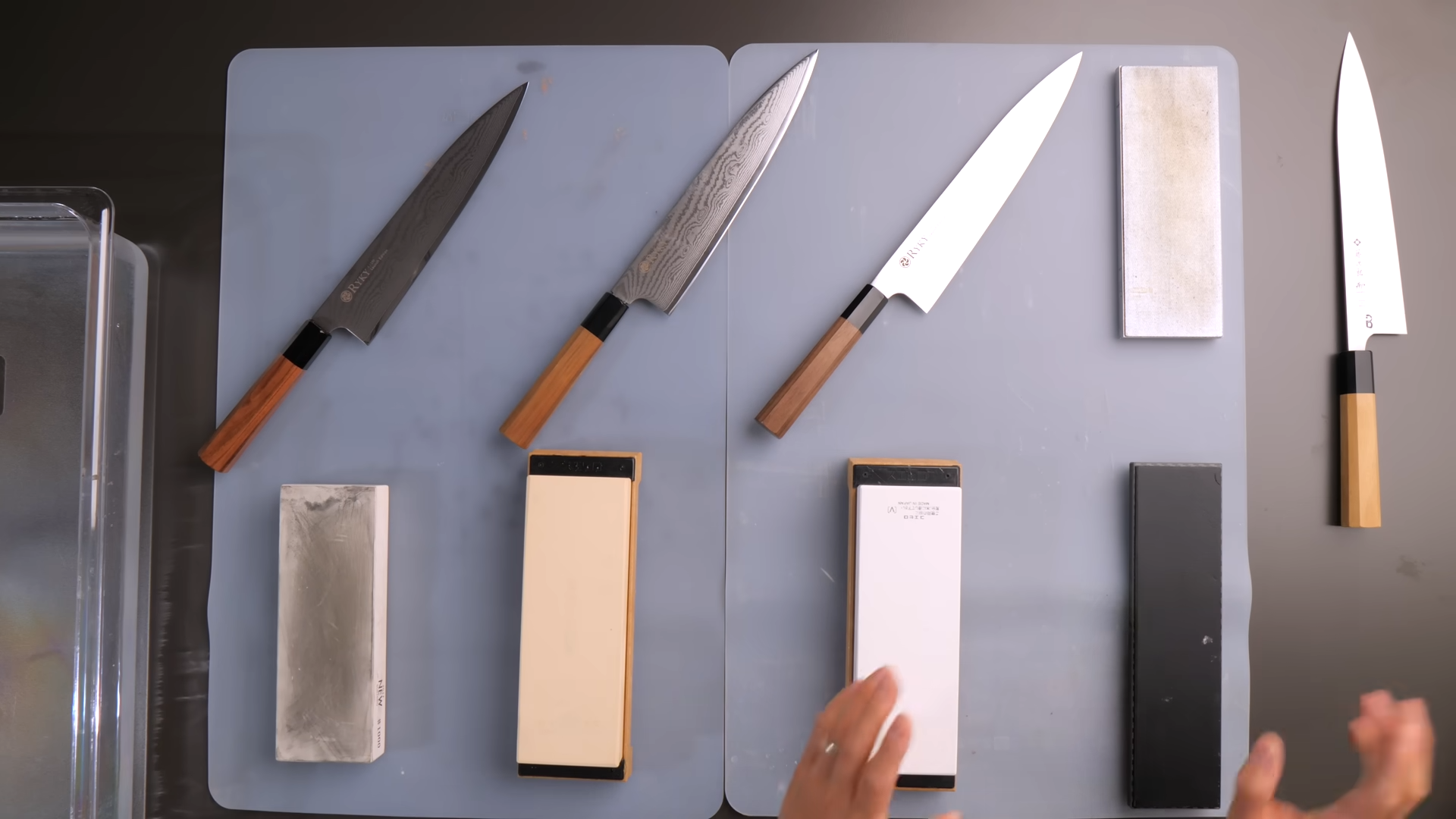
The Setup
To eliminate any residual factory sharpness, every knife was "bricked"—grinding the cutting edge directly against a brick for roughly 50 back-and-forth strokes from tip to heel. The result was a completely dead edge: zero bite, incapable of cutting paper, and completely safe to press directly against a finger.
The dull knives were then sharpened across three controlled setups:
Knife 1: Sharpened on a 1,000-grit stone, followed by a quick leather strop.
Knife 2: Sharpened on a 1,000-grit stone, then refined on a 3,000-grit stone.
Knife 3: Sharpened on a 1,000-grit stone, progressed through 3,000, and finished on a 6,000-grit stone.
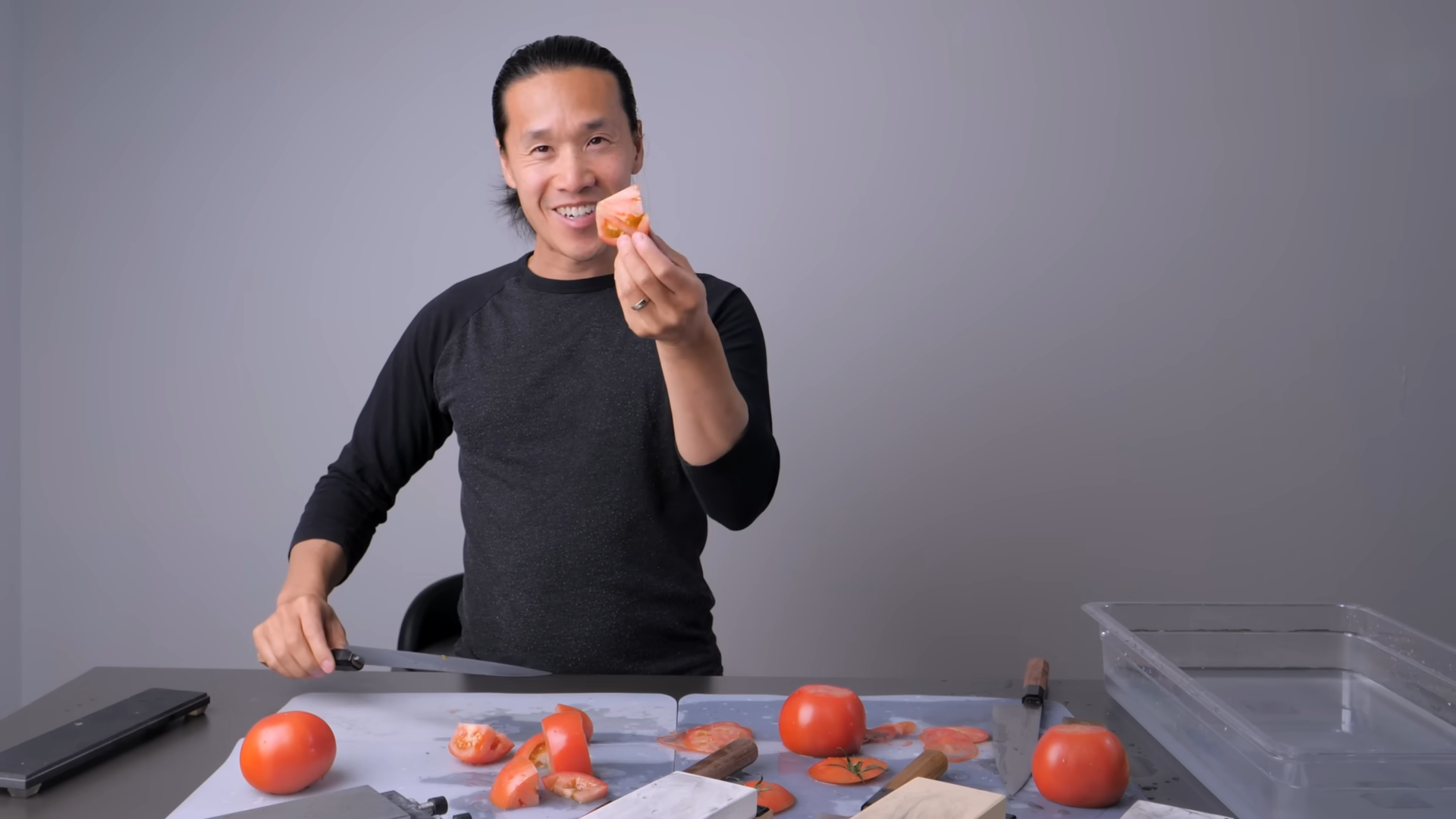
Anyone can do the tomato drop test
The Standard Tomato Test
The bench test was simple: cut paper-thin, transparent tomato slices. To make the test more challenging, the cutting surface was kept wet and slippery, preventing the tomato from anchoring securely to the board. No tricks, no flat-cut bases for extra traction, and no dry surface grip.
1,000-Grit Finish: The 1,000-grit edge produced wafer-thin, completely transparent slices straight off the bat. It glided through the tomato skin without crushing the flesh underneath.
3,000 & 6,000-Grit Finishes: The higher grit progressions produced identical results. While the polish on the bevel was noticeably finer, the practical ability to produce transparent slices did not change.
The 1,000-grit stone—a budget staple for anyone getting into sharpening—achieved 100% of the functional cutting performance of the higher-grit finishes.
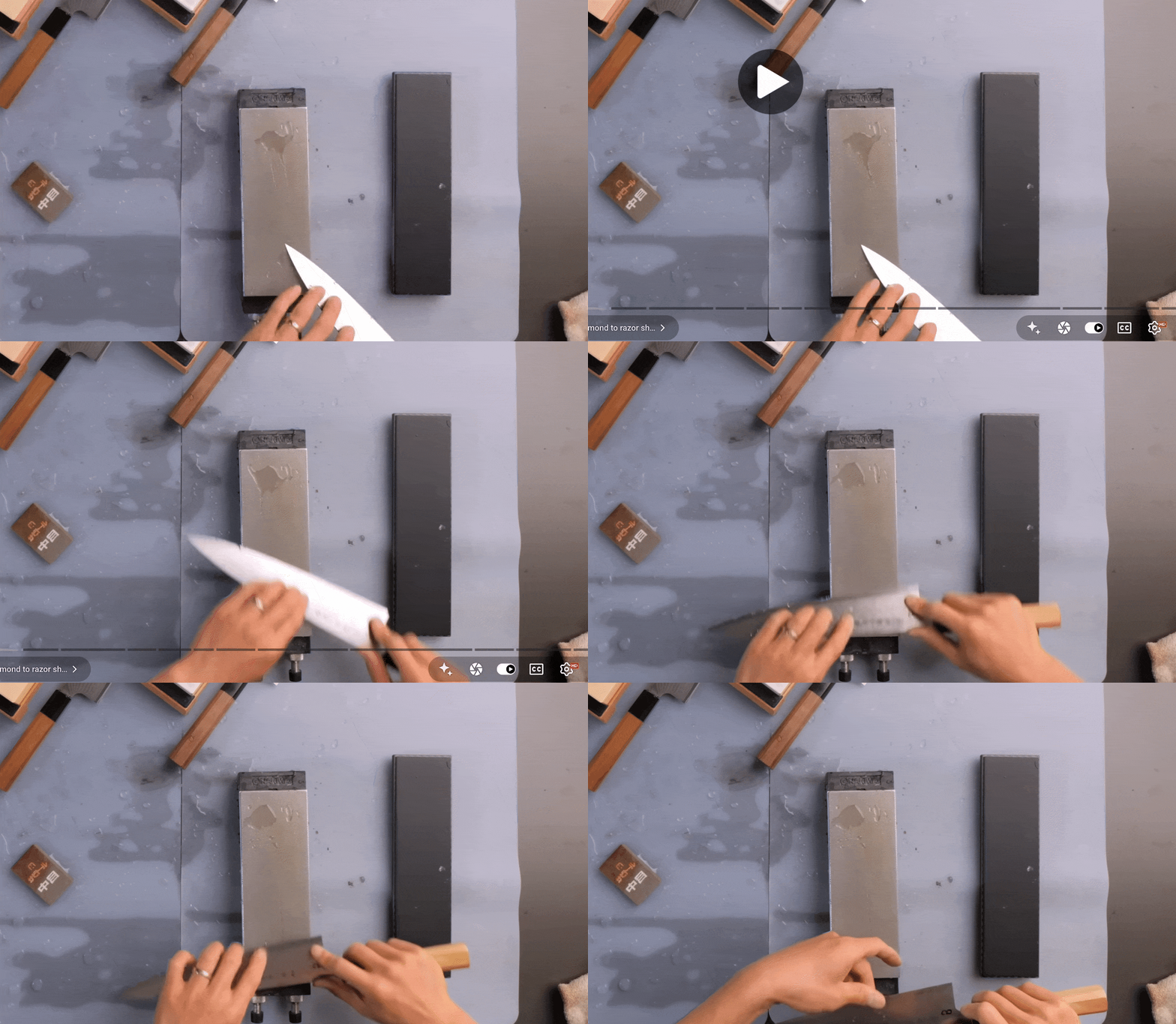
sharpening on the coarsest diamond plates I have : Atoma 140
The Coarse Diamond Test: Taking It to the Extreme
To push the experiment to its logical limit, I brought out the coarsest plate available: an Atoma 140-grit extra-coarse diamond plate.
A 140-grit plate is designed for heavy repair work, removing chips, and flattening other stones. It leaves deep, visible scratch patterns on steel. Under the high-grit doctrine, an edge finished on a 140-grit plate should tear tomatoes to shreds.
The Result
After shaping the edge on the 140-grit plate—with zero time spent on a leather strop—the knife was brought directly to the cutting board.
It produced wafer-thin, see-through tomato slices with ease.
Because the edge retained a micro-serrated, "toothy" bite from the coarse diamond abrasives, it grabbed the slick skin of the tomato instantly. In real-world kitchen tasks, an aggressive, toothy edge often outperforms an over-polished edge on slick foods like tomato skins, pepper peels, and raw proteins.
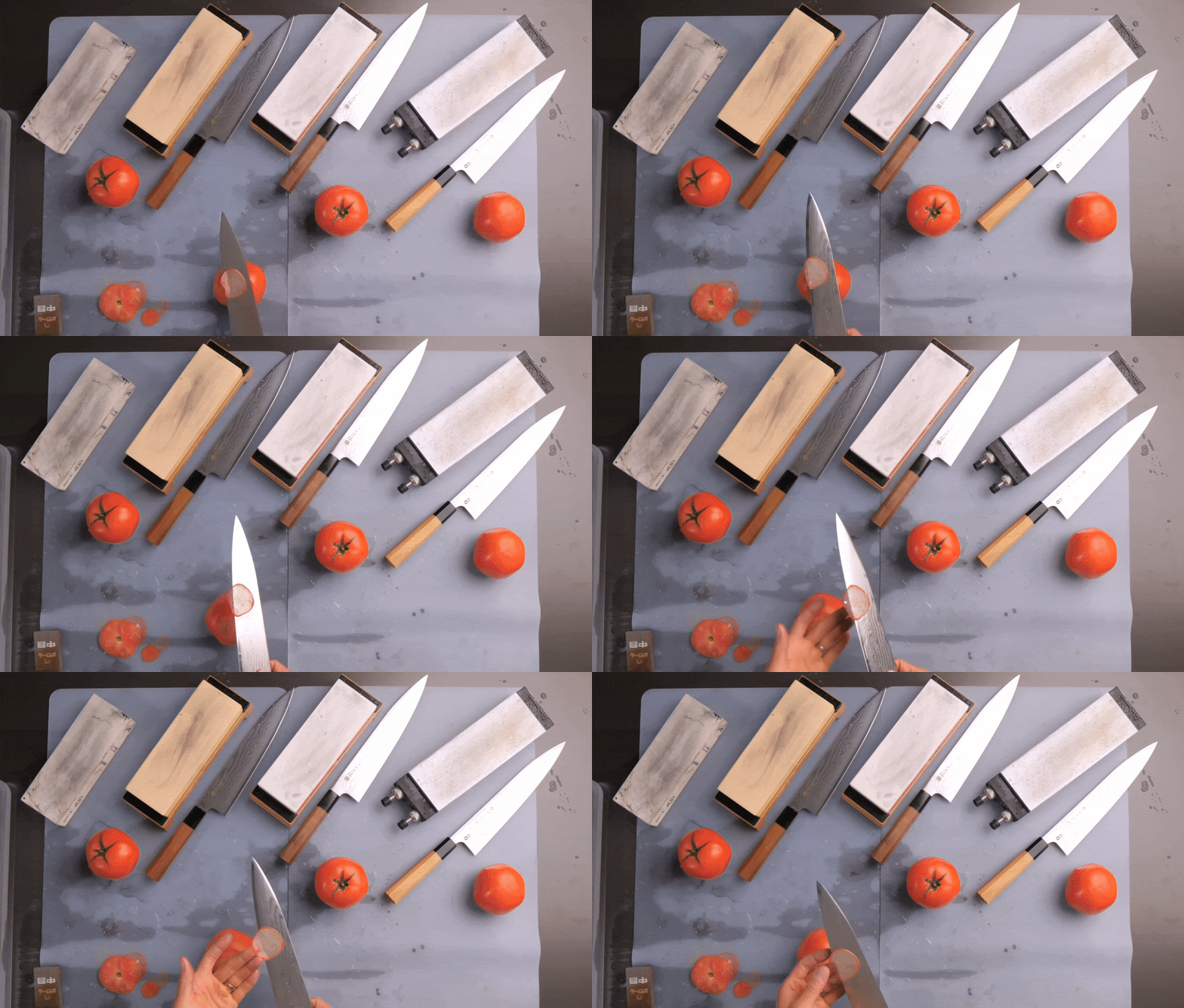
This is the ultimate tomato cut test
Unmasking the "Drop Test" Gimmick
You’ve likely seen viral ads for Kickstarter knives or custom steels where a tomato is dropped from counter height onto a blade fixed at a 45-degree angle, splitting effortlessly upon impact.
These demonstrations rely on basic physics rather than magic steel or high-grit magic:
Gravity and Momentum: Dropping a dense, heavy object like a whole tomato from 4 feet creates enough kinetic force to force it through almost any reasonably thin edge.
The Low-Height Reality: A true test of keenness minimizes momentum.
Using the knife finished on the coarse 140-grit diamond plate, a tomato half was dropped from a height of just 6 to 8 inches. The toothy, coarse edge caught the skin and split the tomato cleanly in mid-air—no 12,000-grit mirror polish required.
Viral Ads: ~48 inches (High Momentum) ---> Easily cuts on basic edges
Real Test: ~6-8 inches (Low Momentum) ---> Requires true edge keenness
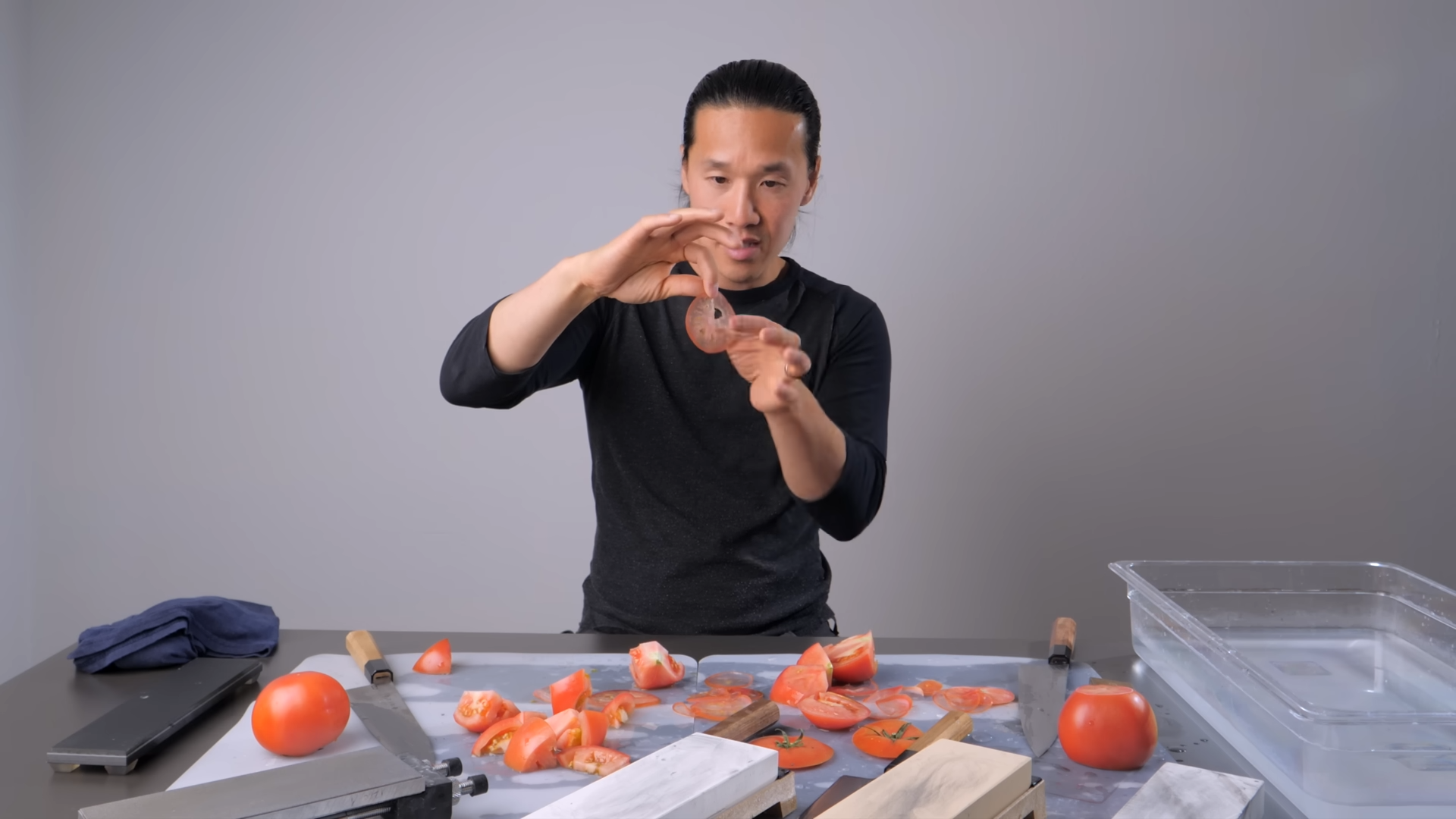
How thin can you cut tomato slices?
Technique Trumps Hardware
High-grit stones are satisfying to use, offer refined feedback, and serve a real purpose for specialized cutlery or aesthetic finishes. But they are not a prerequisite for razor-sharp kitchen performance.
Apexing and Deburring Matter Most: Sharpness relies on creating a clean, burr-free intersection of steel at the edge. A well-executed 1,000-grit edge will out-cut a poorly deburred 10,000-grit edge every time.
Aggressive "Bite" Is Your Friend: Ultra-polished edges can slick off glossy food skins. Coarser abrasives leave refined micro-serrations that dig into food immediately.
Save Your Money: You do not need to invest hundreds of dollars in multi-stone progressions to get professional results at home. Master the basics on a standard medium-grit stone before expanding your setup.
The next time someone claims you need a luxury whetstone setup to get elite slicing performance, remember that a clean technique and a coarse diamond plate can slice tomatoes just as thin—at a fraction of the cost.