Few production kitchen knives have achieved the mythic, almost untouchable status of the Masamoto Sohonten KS 240mm Gyuto.
In the collector and culinary communities, the KS is often referred to simply as the "unicorn." Between 2015 and 2018, the knife virtually vanished from global retail inventories. Prominent importers like Korin and Japanese cutlery purveyors quietly delisted it as backorders stretched from months into years. Rumors of permanent discontinuation swirled as Tokyo workshops struggled with artisan labor shortages, raw material sourcing, and the meticulous handwork required to forge unclad high-carbon mono-steel.
When a sudden shipment of ten authentic, factory-fresh Masamoto KS 240mm gyutos arrives directly from Tokyo—complete with prized blonde buffalo horn ferrules—it offers an unprecedented opportunity to dissect what makes this specific blade the blueprint for modern high-performance culinary cutlery.
trust retailers BurrfectionStore | Gyuto | WasabiKitchen | Amazon
Disclosure: As an Amazon Associate, I earn from qualifying purchases.
1. The Geometry That Rewrote Modern Cutlery: Sabatier Meets Tokyo
The legendary status of the Masamoto KS does not stem from exotic powdered alloys or decorative Damascus cladding. Its reputation was forged on a single element: flawless cross-sectional and profile geometry.
[ THE MASAMOTO KS PROFILE ARCHITECTURE ]

Heel                                      Mid-Blade                                 Tip
 │                                            │                                      │
 └─── Extended Flat Section (Push-Cut Zone) ──┴── Gradual Slicing Rise ──────────────┘
                                                                               ▲
                                  Extreme Distal Taper (Needle Apex) ──────────┘
In the mid-20th century, Japanese cutlery makers largely adapted Western chef's knives by copying heavy, curved German profiles. Masamoto Sohonten took a radically different path with the KS, drawing direct inspiration from antique French Sabatier carbon knives:
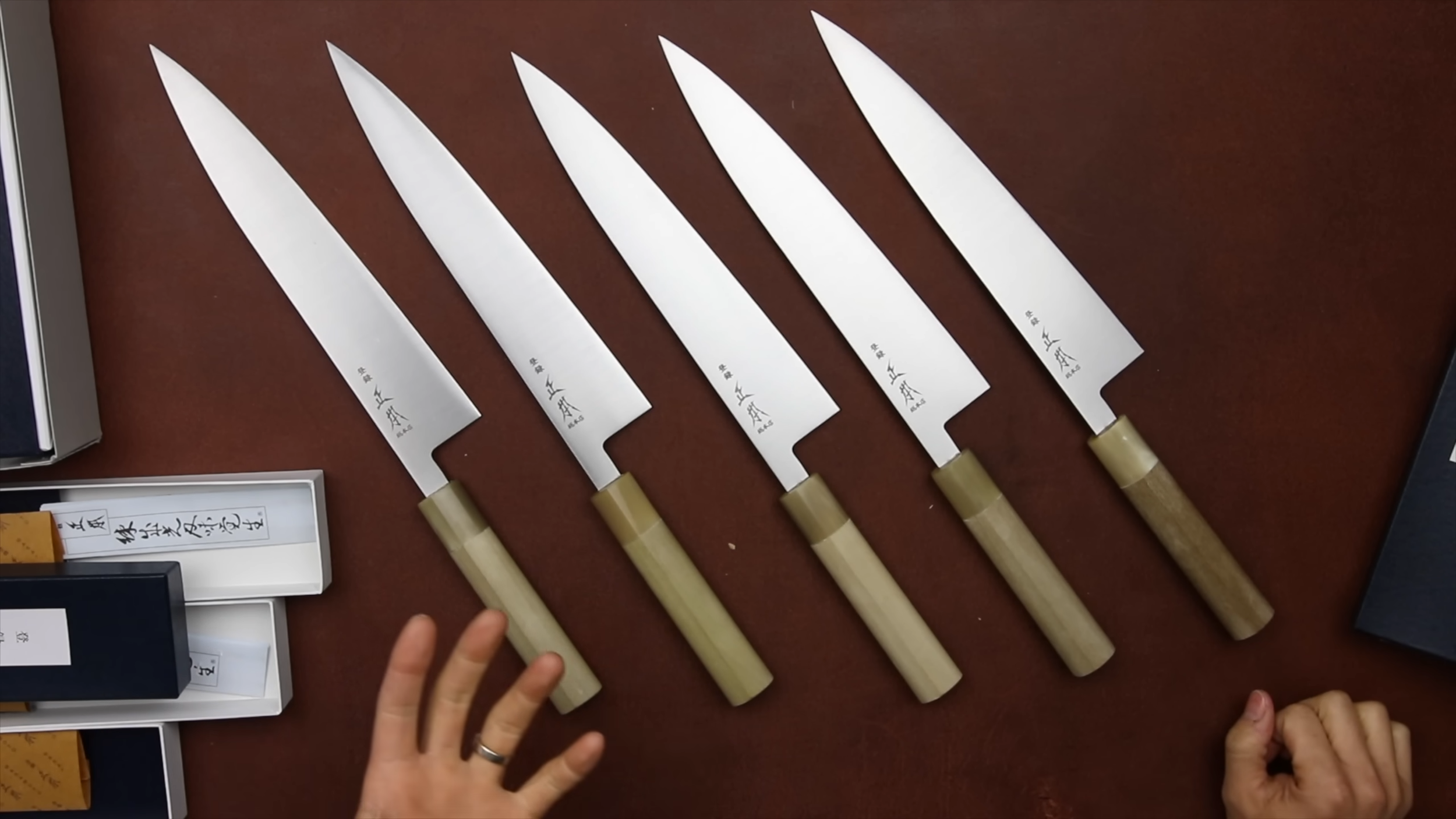
The Extended Flat Runway: Unlike modern German blades with deep, sweeping bellies built for aggressive rocking, the KS features an elongated, remarkably flat cutting profile extending forward from the heel through more than half the blade’s length. This profile provides an unyielding sweet spot for clean accordion-free push-cutting and rapid horizontal chopping.
The Slicing Rise and Needle Tip: Past the mid-section, the blade transitions into a gentle, continuous rise toward an acute, laser-like tip. The tip sits low relative to the spine, creating an exceptional platform for delicate allium dicing and horizontal scoring.
The Nominal 240mm Anomaly: While stamped as a 240mm gyuto, the KS runs notoriously long. Measured along the cutting edge from the heel to the tip, a standard KS 240mm consistently clocks in closer to 250mm to 255mm, giving the cook professional slicing stroke clearance without feeling unwieldy.
The Distal Taper: The spine is thickest right where it exits the handle (approx. 2.8mm to 3.0mm), providing structural rigidity in the hand. It tapers continuously down the spine, thinning out to fractions of a millimeter behind the tip. This allows the knife to fall through dense produce without wedging.
2. Metallurgy: The Purity of Hitachi Shirogami #2 Mono-Steel
In an era dominated by multi-layer stainless claddings and high-carbide powdered steels, the Masamoto KS remains an uncompromising testament to Zenko (Mono-Steel) High-Carbon construction.
HITACHI WHITE PAPER STEEL #2 (SHIROGAMI #2) COMPOSITION

Carbon (C)       │ 1.05% – 1.15%  ──► High hardness matrix (62–63 HRC)
Manganese (Mn)   │ 0.20% – 0.30%  ──► Deoxidizing agent / minimal toughness
Silicon (Si)     │ 0.10% – 0.20%  ──► Baseline deoxidation
Chromium (Cr)    │ None (<0.04%)  ──► Zero corrosion resistance; ultra-pure
Sulfur/Phosphorus│ <0.025% max    ──► Minimal impurities / low micro-embrittlement
Why Mono-Steel Matters
Most Japanese knives employ a San-Mai (three-layer) lamination: a hard core steel jacketed between two layers of softer stainless steel or iron. While San-Mai simplifies forging and dampens shock, mono-steel offers distinct advantages on the cutting board:
Uninterrupted Taper: Without lamination shoulders or cladding lines (shinogi), the grind from spine to edge is completely continuous, reducing surface drag.
Harmonic and Tactile Feedback: When mono-steel White #2 contacts a board or separates fiber, the acoustic and tactile resonance transmits directly into the handle with surgical precision.
The Whetstone Advantage
Shirogami #2 is the gold standard for freehand waterstone sharpening. Because it lacks large chromium or vanadium carbides, the steel matrix abrades evenly without shedding coarse carbide clusters.
On a 1,000-grit synthetic waterstone, the KS forms a crisp, microscopic wire burr almost immediately.
On fine finishing stones (such as a Shapton Glass 6,000 or an authentic Japanese Natural Stone / JNAT), the steel takes an apex capable of shaving hair above the skin line.
Deburring is instantaneous: light edge-leading passes cleanly strip the burr without the stubborn, gummy rolling typical of softer European alloys.
The trade-off is total reactivity. White #2 possesses zero chromium protection. Slicing warm proteins, citrus, or alliums initiates an immediate patina. Left wet in a commercial prep sink, it will develop surface rust within minutes.
3. Fit, Finish, and the Prized Blonde Ferrule
While Masamoto has historically prioritized cutting performance over ornate boutique finishing, the KS features subtle, master-level bench handwork:
[ ANATOMY OF THE KS HANDLE & FIT ]

  D-Shaped Magnolia (Ho Wood)         Rare Blonde Buffalo Horn Ferrule
  ┌─────────────────────────────────┐┌─────────┐
  │                                 ││  ░░░░░  │====== [ Hand-Eased Spine ]
  └─────────────────────────────────┘└─────────┘
                                      ▲
                                      └── Hand-Polished Choil Radius
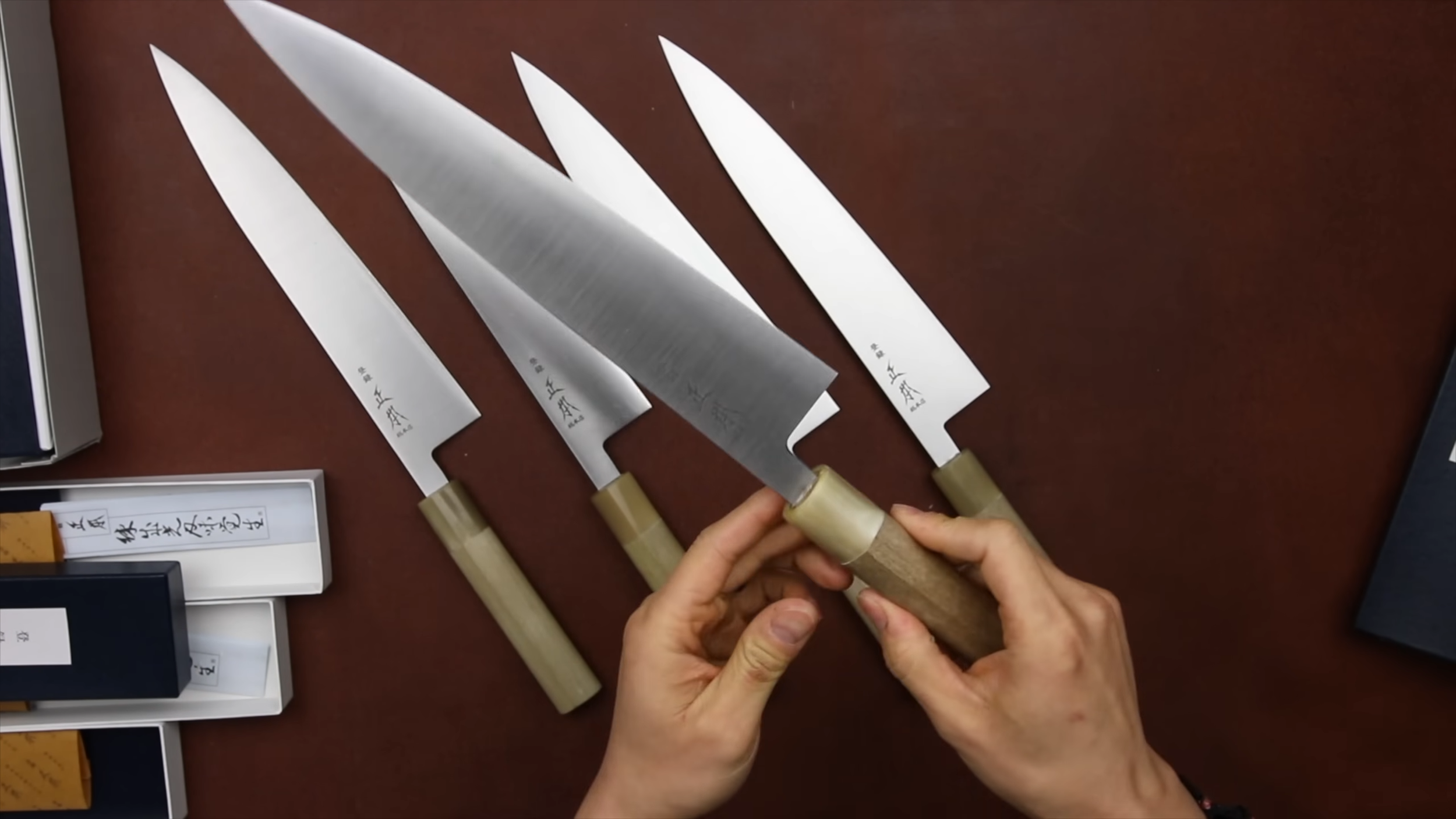
Eased Spine and Choil: Unlike budget production blades with sharp, stamped 90-degree edges, the KS features a hand-eased, crowned spine and a radiused choil. In an aggressive pinch grip, the index finger rests comfortably against the neck without hot spots during hours of prep.
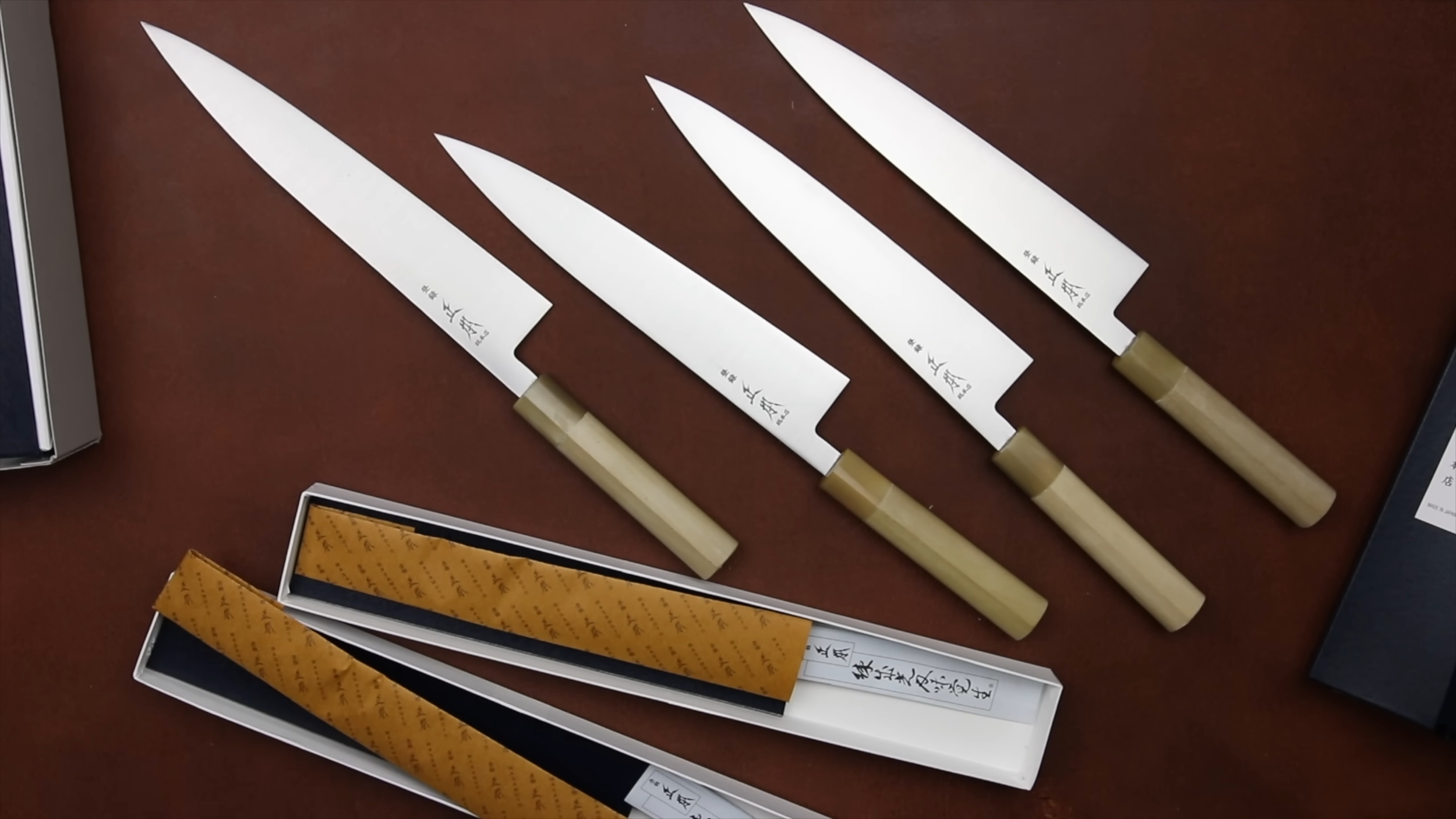
The Blonde Horn Ferrule: Standard production Japanese wa-handles utilize black water buffalo horn ferrules. Blonde (translucent or honey-colored) horn represents a tiny fraction of natural buffalo horn yields. Finding blonde ferrules mounted to an entire batch of KS gyutos is an extraordinary rarity, elevating the knife from a workshop tool to an heirloom collector's piece.
D-Shaped Ho Wood: The handle is crafted from untreated Japanese magnolia (Ho wood), carved in a traditional right-handed "D" profile. Ho wood is naturally water-resistant, lightweight, and gains a grippy, velvet-like texture when exposed to moisture during service.
Technical Specifications: Masamoto KS 240mm Gyuto
MetricSpecificationOriginTokyo, JapanFoundry / ForgeMasamoto SohontenConstructionZenko (Mono-Steel)Core MetallurgyHitachi White Paper Steel #2 (Shirogami #2)Rockwell Hardness62–63 HRCNominal Length240 mmActual Edge Length~252 mm (Heel to Tip)Blade Height at Heel~47–49 mmSpine Thickness (Heel)~2.8 mm – 3.0 mm (Pronounced Distal Taper)Handle ProfileRight-Handed D-ShapeHandle MaterialNatural Magnolia (Ho) WoodFerrule MaterialNatural Blonde Water Buffalo HornEdge Geometry70/30 Asymmetrical Double BevelIntended MaintenanceSynthetic & Natural Whetstones (1,000 to 8,000+ grit)
4. The Vanishing Production: Behind the Scarcity
Why did the Masamoto KS become so difficult to purchase between 2016 and 2018? The answer lies in the harsh realities of Tokyo’s aging cutlery guilds.
Unlike automated industrial manufacturers in Seki or Solingen that churn out hundreds of knives an hour via CNC laser stamping, the KS relies on small-batch artisan labor:
The Straightness Challenge: Forging mono-steel blades of this length and thinness is extraordinarily difficult. Without cladding to stabilize the blade, high-carbon steel experiences severe thermal stress during the water quench, leading to high rejection rates due to warping.
Master Grinders: Grinding an asymmetrical 70/30 convex bevel across a 250mm blade requires decades of hand-eye coordination on large rotating water wheels. As senior sharpeners in Tokyo retired without immediate apprentices, workshop throughput plummeted.
The Global Enthusiast Explosion: Simultaneously, the rise of digital cutlery communities, culinary forums, and culinary media exposed the KS to thousands of Western chefs and hobbyists. A workshop designed to produce dozens of knives per month was suddenly faced with global demand for thousands.
5. Bench Testing & Stewardship: Beyond the Vault
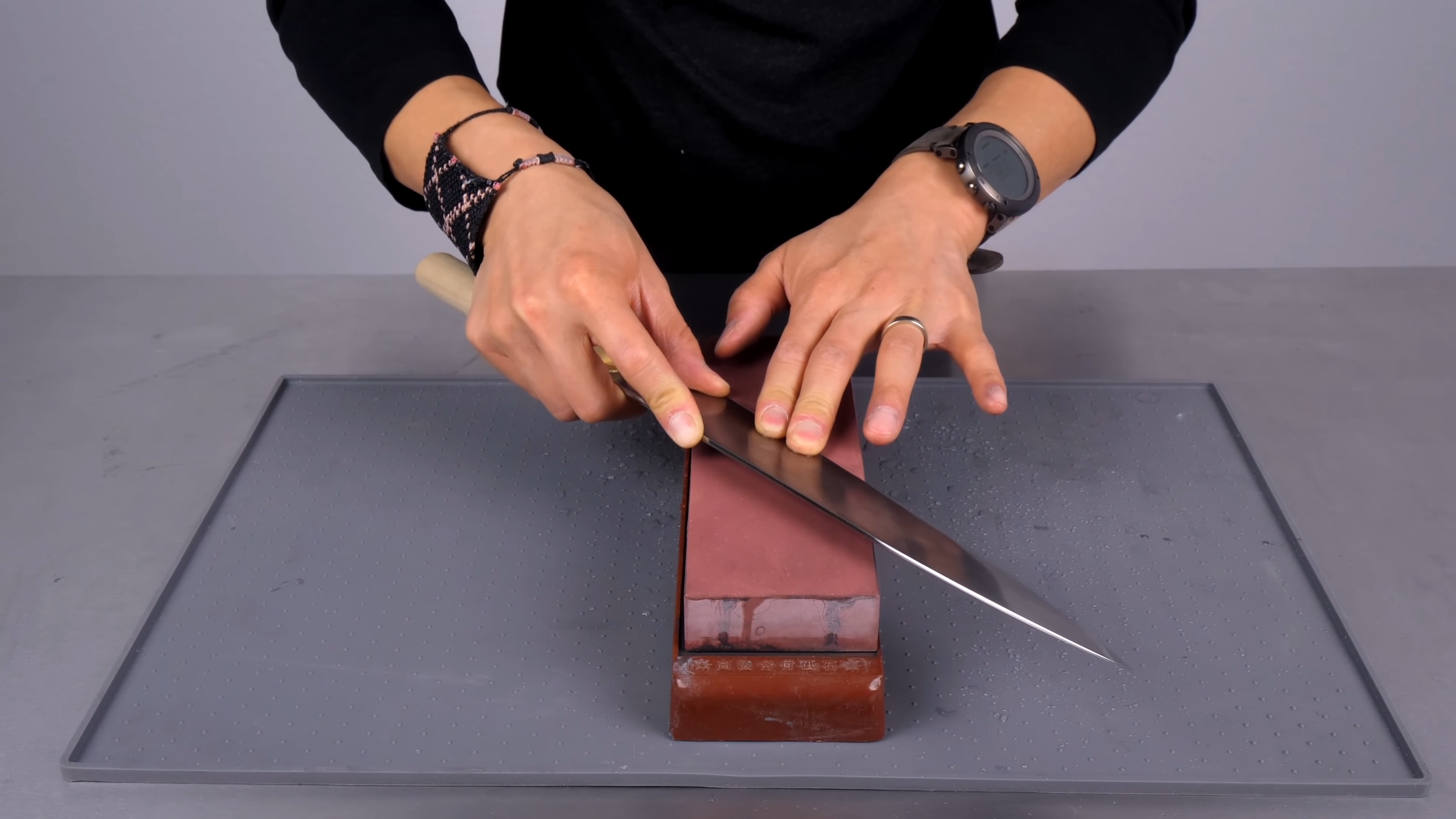
It is tempting to treat a batch of ten rare Masamoto KS gyutos as museum investments to be locked away in a safe. But a kitchen knife only fulfills its true purpose when steel meets stone, and apex meets the cutting board.
Holding ten identical specimens provides an unprecedented diagnostic baseline:
Apex Profiling: Mapping out-of-the-box factory BESS scores across multiple untouched KS blades to evaluate Masamoto's traditional final honing standards.
Sharpening Response: Evaluating how modern synthetic abrasives (Naniwa Chosera, Shapton Glass, Suehiro Debado) and traditional Japanese natural finishing stones (Awasedo) interact with Masamoto’s specific heat treatment of White #2.
Community Stewardship: Ensuring that these tools are not merely hoarded, but placed into the hands of working line cooks, passionate sharpeners, and restorative testing environments where their geometry can be studied and appreciated.
The Masamoto KS earned its legendary reputation not through marketing, but through three centuries of Tokyo forging heritage distilled into an unyielding, high-carbon silhouette. It remains the benchmark against which all modern production gyutos are judged.