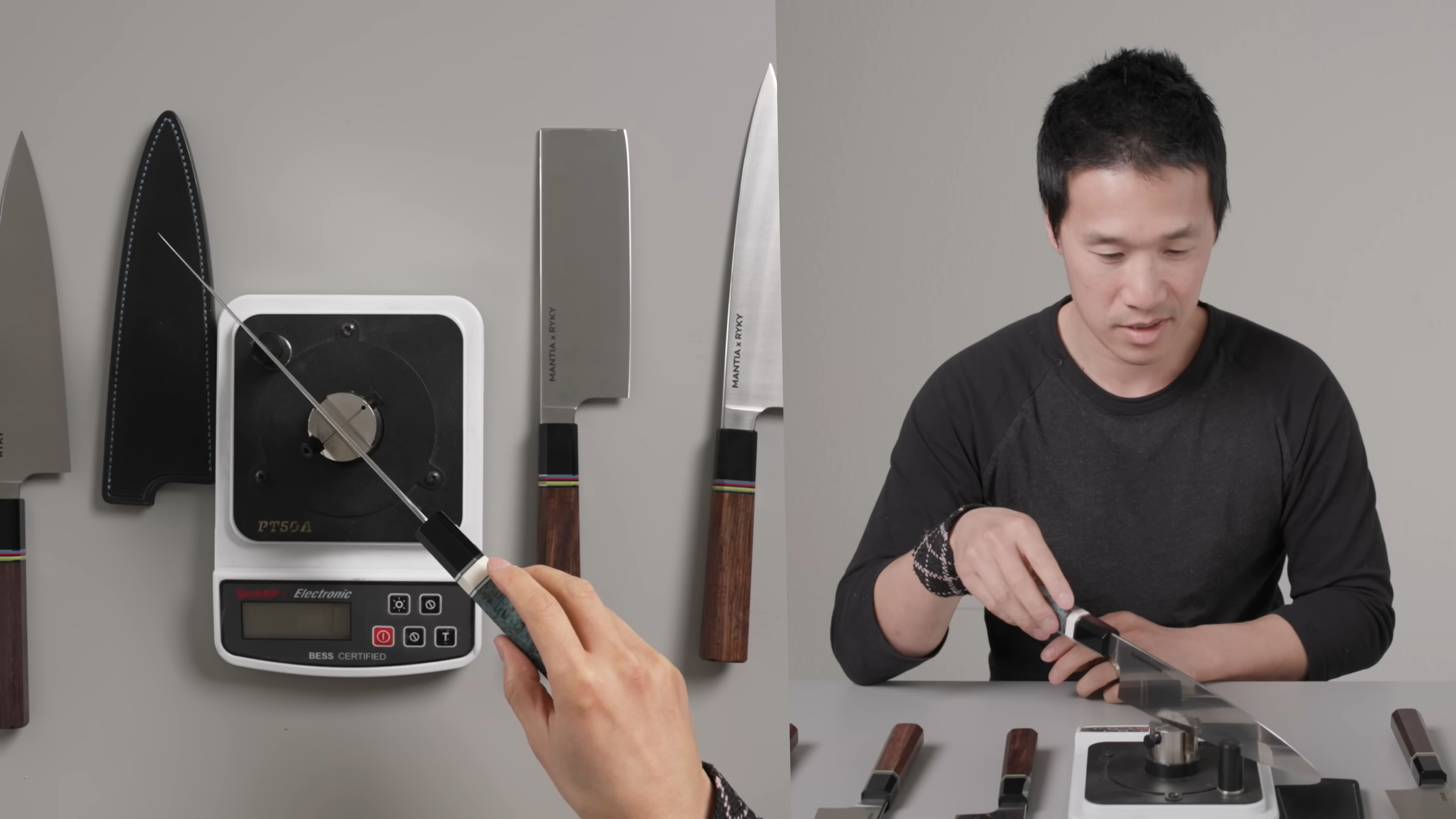
When evaluating custom culinary cutlery, out-of-the-box sharpness is frequently quantified using the BESS (Brubacher Edge Sharpness Scale) system.
trust retailers BurrfectionStore | Gyuto | WasabiKitchen | Amazon
Disclosure: As an Amazon Associate, I earn from qualifying purchases.
By measuring the exact force (in grams) required for a blade's apex to sever a standardized synthetic filament, the BESS scale provides an objective baseline:
200g – 300g: Standard factory-sharpened Western cutlery (e.g., Wüsthof, Henckels).
100g – 200g: Razor blade territory and high-grade hand-finished Japanese cutlery.
Sub-50g: Experimental custom edges, surgical scalpels, and elite hand-ground custom steel.
[200g - 300g] Western Factory Edge
└─► [100g - 200g] High-Grade Japanese / Utility Razor
└─► [Sub-50g] Extreme Custom Edge

During a recent benchmark test of custom blades—forged to celebrate long-track speed skater Joey Mantia's third Olympic appearance—we recorded BESS values dropping past the 50g barrier down to 8g to 15g.
Scores this low border on theoretical limits. Understanding how a knife achieves a single-digit BESS score requires diving into extreme metallurgy, seamless handle ergonomics, and the fundamental physics of blade geometry.
1. High-Hardness Metallurgy:
Pushing Past 70 HRC
To achieve and hold an apex thin enough to sever testing filament under less than 20 grams of pressure, the core steel must possess extreme compressive strength.
Standard kitchen stainless steel (56–58 HRC) or high-grade Japanese alloys (60–64 HRC) flex or micro-roll under extreme apex thinning.
The Sabal Brothers custom series utilizes advanced powder metallurgy alloys heat-treated between 62 HRC and an astonishing 71 HRC:
Matrix Density: At 68–71 HRC, the alloy's carbide structure is exceptionally dense and fine-grained, allowing the maker to grind the primary bevel to an ultra-acute angle without risking edge collapse.
Deformation Resistance: High Rockwell hardness prevents micro-deformation at the microscopic apex. When the blade touches the testing filament, the steel shears the material instantly rather than pushing or bending it before cutting.

2. Uncompromising Fit and Finish:
Ergonomics as Art
An extreme edge is useless without matching structural balance and ergonomic refinement. Inspecting the custom Sabal collection reveals hand-finishing standards that rival the highest tiers of Japanese artisan craftsmanship:
Satin-Mirror Spine & Choil Polish: The spine and choil (the neck near the heel) feature a liquid-smooth, hand-rounded satin mirror finish. This eliminates friction against the index finger during high-pressure pinch grips.
Zero-Step Handle Construction: The handles feature custom-turned birchwood, buffalo horn bolsters, and synthetic ivory resin separated by silver accent rings.
Precision Flush Tolerances: Passing a thumb over the handle transition reveals a zero-step finish—there is no tactile ridge or microscopic gap between the metal rings, horn, and resin scales.
[Buffalo Horn] === (Zero-Step Silver Ring) === [Resin Ivory] === [Birchwood]
3. Apex Sharpness vs. Food Separation Geometry
A critical distinction in custom cutlery is understanding that edge sharpness and cutting performance are two entirely different metrics:
Apex Sharpness (BESS Score): Measures only the microscopic width and keenness of the immediate edge. It dictates how easily the blade initiates a cut through a surface.
Separation Geometry (Food Release): Governed by the cross-sectional grind of the blade face (convexing, distal taper, and shoulder thinning). This dictates how easily the blade glides through dense food (like carrots or potatoes) without wedging or sticking.
A knife can register a sub-20g score on a filament tester, but if the blade face behind the edge is thick and boxy, it will wedge severely in hard root vegetables.
The Sabal custom blades combine a razor-thin apex with an aggressive, thin-behind-the-edge profile.
When tested against light diffusion paper—an ultra-light, fibrous substrate notorious for catching micro-burrs and sliding off dull edges—the blades executed effortless, silent push-cuts using strictly the deadweight of the knife itself.

test cutting on the thinnest paper i have
The Verdict: The Benchmark for Custom Performance
Achieving single-digit BESS scores is a testament to the intersection of extreme metallurgy and master-level hand grinding.
While custom blades operating at 65–71 HRC require delicate handling on end-grain wood boards, they demonstrate what is possible when custom makers push steel chemistry and edge geometry to their absolute physical limits.