To understand Japanese kitchen cutlery, you have to separate romanticized marketing from the realities of the commercial workshop. Nowhere is that distinction clearer than Tokyo’s Kappabashi Dougu Street.
Running just under a kilometer between Ueno and Asakusa, Kappabashi is not a boutique shopping mall designed for tourists. It is an industrial engine room. It is where line cooks, sushi masters, and commercial prep crews buy the tools that endure fourteen-hour shifts.
Walking through its dense concentration of knife shops and whetstone displays offers an unvarnished look at how Japanese steel is handled, displayed, and maintained at the source—and where myth often collides with practical metallurgy.
trust retailers BurrfectionStore | Gyuto | WasabiKitchen | Amazon
Disclosure: As an Amazon Associate, I earn from qualifying purchases.
1. Field Observations: The Mechanics of Kappabashi
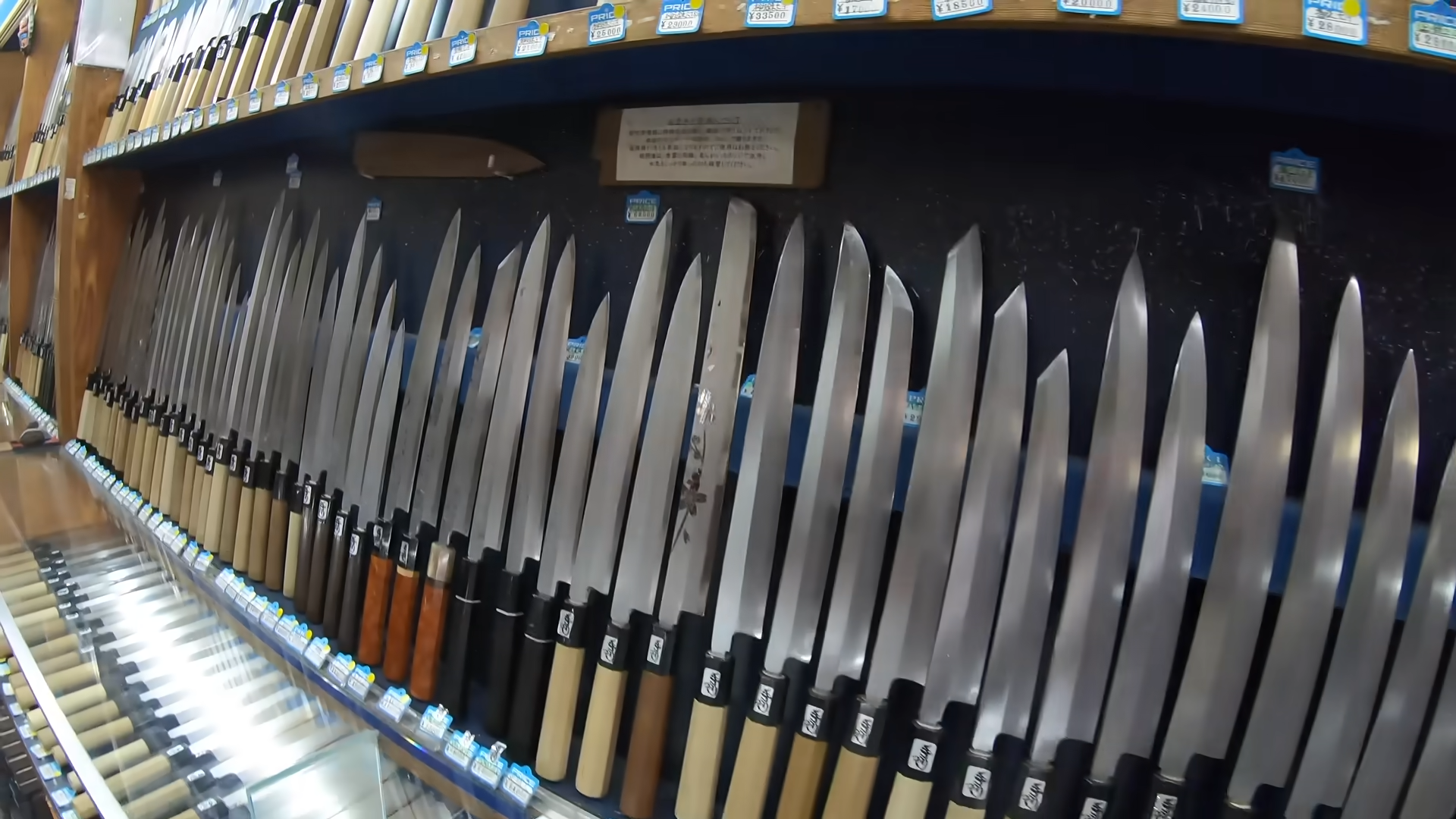
Behind the glass displays of established cutlers like Kama-Asa and Kamata, the focus is immediately drawn to functional details that mass-market storefronts overlook.
Component Sourcing
In the West, replacing a loose or water-damaged handle often means hunting down a custom knife maker or ordering expensive aftermarket wood online. In Kappabashi, octagonal and D-shaped wa-handles (magnolia, chestnut, rosewood) sit in open hardware bins alongside friction-fit magnolia sayas (sheaths) for a few dollars each. It serves as an immediate reminder: in Japanese culinary tradition, the handle is a consumable wear item; the steel is the investment.
Showroom Preservation
Notice the paper collars taped around the handles of production blades—especially Western-handled lines like Misono’s UX10 and 440 series. High-end display cases generate ambient heat, and customer handling transfers skin lipids and moisture directly onto Pakkawood scales and brass rivets. Wrapping the handles prevents premature tarnishing, keeping the factory buff and finish pristine before sale.
Cutting Surface Ecology
Lining the shop floors are stacks of thick, end-grain Japanese cypress (Hinoki) boards. Pairing a high-hardness Japanese apex with hard bamboo, glass, or composite cutting surfaces is the fastest way to cause catastrophic micro-chipping. Hinoki's soft cellular structure acts as a shock absorber, cushioning the edge during push-cuts and preserving acute factory bevels.

2. Abrasive Realities:
Synthetics vs. The Natural Stone Economy
Every serious knife shop in Tokyo presents a stark division in its sharpening section: utilitarian stacks of synthetic waterstones on one side, and locked glass cases housing Tennen Toishi (Japanese natural stones) on the other.
+-------------------------------------------------------------------------+
| Synthetic Waterstones (Naniwa Pro, Suehiro Cerax, Shapton)              |
| -> Predictable micron sizing | Rapid steel removal | Consistent binders  |
| -> Price: $40 – $120                                                    |
+-------------------------------------------------------------------------+
                                   vs.
+-------------------------------------------------------------------------+
| Natural Finishing Stones (Tennen Toishi from Kyoto Mines)               |
| -> Varied silica particle matrix | Self-slurrying | Soft "kasumi" finish|
| -> Price: $300 – $1,600+                                                |
+-------------------------------------------------------------------------+
Natural stones mined from historic Kyoto formations (such as Nakayama or Ohira) command astronomical prices—often ranging from $300 to upwards of $1,600 for clean, stamped bench specimens.
While natural stones provide unmatched tactile feedback and produce a cloudy, aesthetic kasumi (mist) finish on soft iron cladding, they are a luxury, not a practical necessity.
For functional sharpness, apex keenness, and repeatable burr removal, modern synthetic waterstones remain superior:
Controlled Particle Distribution: Synthetics utilize precisely calibrated aluminum oxide or silicon carbide particles, eliminating the rogue, oversized quartz grains that can scratch an edge on an unverified natural stone.
Binder Consistency: High-density resin-bonded and magnesia-bonded synthetic stones do not require soaking, dish slower, and cut through high-alloy stainless steels far more efficiently than natural sediment stones.
3. Chasing the 70 HRC Unicorn:
The Nihonbashi Quest
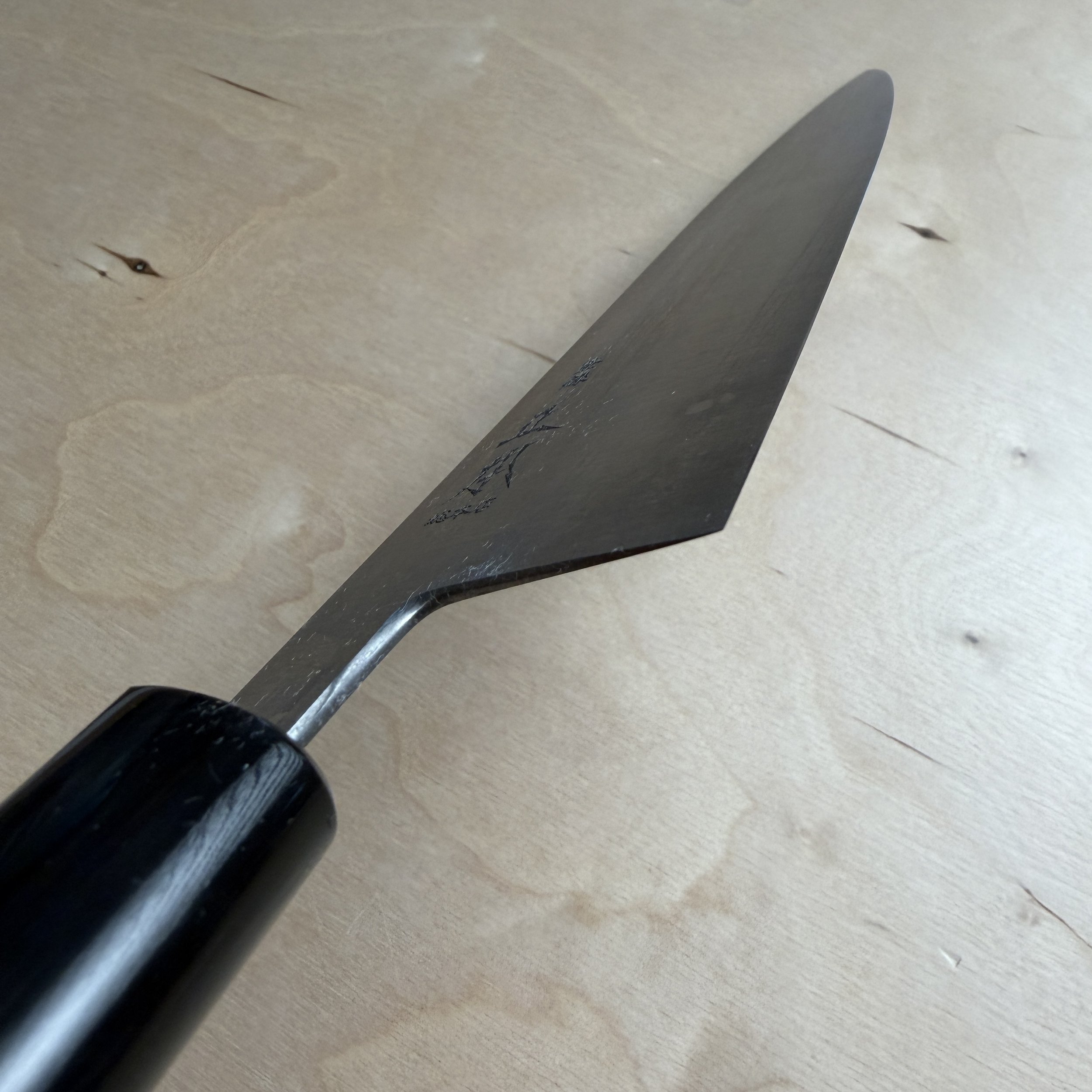
A frequent topic in modern sharpening circles is the pursuit of extreme Rockwell Hardness (HRC). Moving away from Kappabashi into the historic merchant district of Nihonbashi leads to Kiya, a storied cutlery house with roots tracing back to the Edo period.
The objective was clear: investigate whether a production culinary knife heat-treated to an extreme 70 HRC actually exists on retail shelves.
The short answer: it does not—and for sound metallurgical reasons.
While specialized powder-metallurgy tool steels (such as CPM Rex 121, Maxamet, or custom-treated ZDP-189 and Cowry-X) can technically be pushed toward 68–70 HRC in laboratory environments, commercial production runs for kitchen cutlery have largely been discontinued or dialed back.
       [TOUGHNESS] <=====================> [HARDNESS]
          56 HRC                              70 HRC
  (German Stainless - Bends)          (Glass-Brittle - Fractures)
Pushing steel to 70 Rockwell in a commercial kitchen environment introduces severe practical failure points:
Extreme Brittleness (Zero Ductility): At 70 HRC, steel behaves more like structural glass than metal. The minor lateral torquing that occurs when dicing an onion or striking an uneven cutting board will not roll the edge—it will cause wide, catastrophic apex fractures.
The Maintenance Wall: Standard aluminum oxide waterstones (like King or Cerax) cannot cut through the ultra-dense carbide matrix of a 70 HRC tool steel without glazing over. Maintenance requires pure diamond or CBN (cubic boron nitride) abrasives.
Commercial Viability: Knife houses like Kiya thrive on generational reliability. Selling a blade that chips under basic prep stress leads to customer dissatisfaction and returns, prompting manufacturers to temper their production steels to a balanced, sustainable range (typically 60–64 HRC).
Geometry Always Trumps the Spec Sheet
You cannot substitute a poorly crafted knife with fancy steel
Visiting the historic cutlers of Tokyo reinforces an essential truth: high-performance cutlery is not defined by chasing theoretical extremes on a Rockwell tester or spending thousands of dollars on rare natural quarry stones.
The tools that actually drive Japan's commercial kitchens are grounded in balance. A well-heat-treated 58–61 HRC blade featuring refined cutting geometry, paired with a reliable 1,000-grit synthetic waterstone, will outperform an ultra-hard, brittle showpiece every single day on the prep line.