In the era of algorithmic commerce and hyper-targeted social media feeds, purchasing high-end cutlery has become a minefield. Glossy ads, slick marketing copy, and commission-driven influencer reviews often obscure critical technical flaws in geometry, heat treatment, and material sourcing.
Whether you are looking to purchase your first serious kitchen tool or expanding a curated collection, here are five types of knives you should avoid—along with the metallurgical and practical reasons why.
trust retailers BurrfectionStore | Gyuto | WasabiKitchen | Amazon
Disclosure: As an Amazon Associate, I earn from qualifying purchases.
Check out my curated list of quality Japanese knives
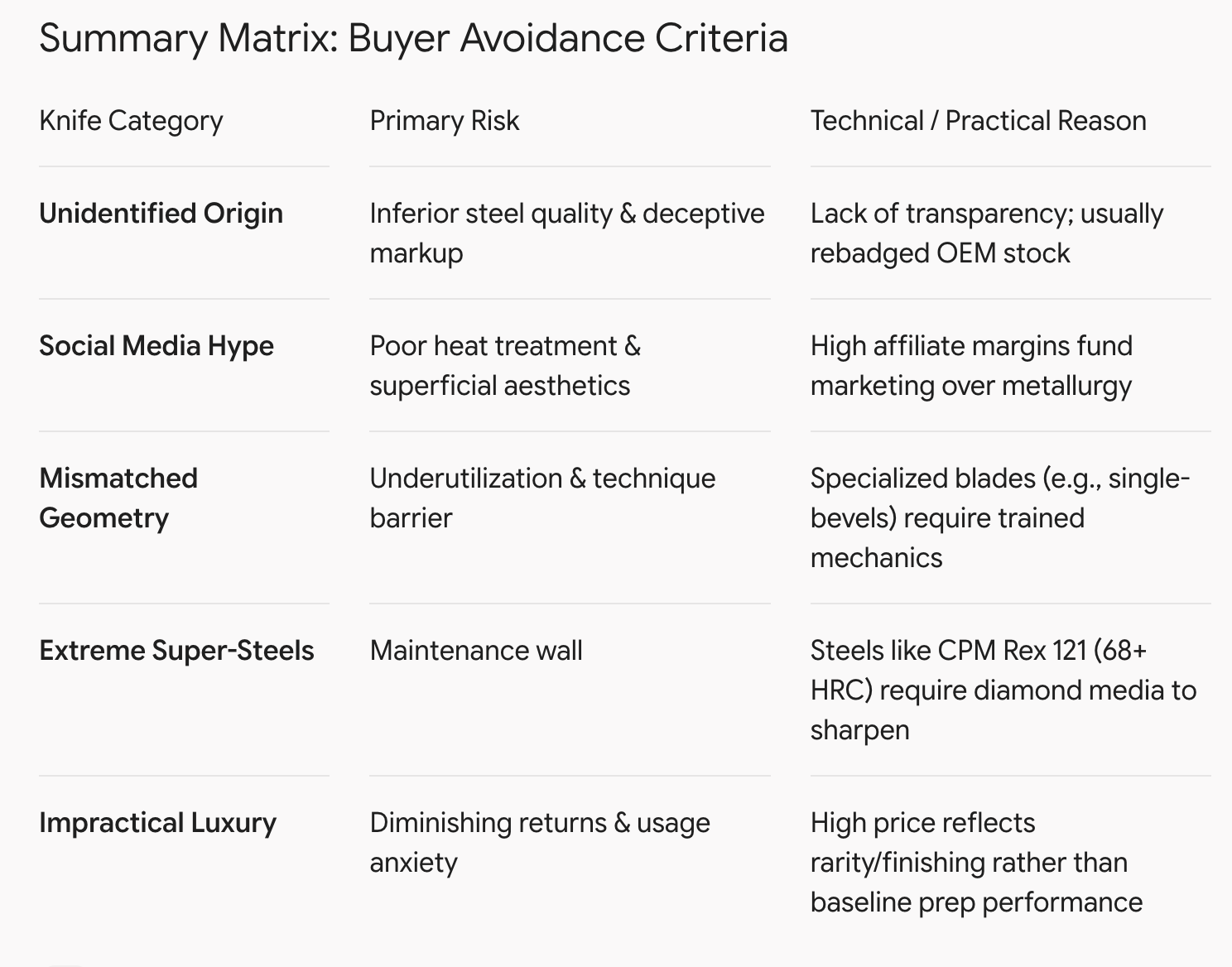
1. Unidentifiable Sourcing: The "Japanese" Origin Trap
Japanese blacksmiths and regional guilds (whether in Sakai, Takefu, Sanjo, or Seki) operate with immense pride in their provenance. True Japanese cutlery almost universally states its origin, specific maker, or forging location on the packaging or via blade kanji (engraving).
Currently, a prolific segment of direct-to-consumer brand marketing relies on rebadging low-cost factory blades—often manufactured in industrial hubs like Yangjiang, China—and styling them with faux-Damascus laser etching and generic terms like "Japanese Style" or "Goyo."
The Takeaway: If a knife marketed as Japanese lacks an explicit "Made in Japan" designation, an identified blacksmith, or a verified producing region, it is virtually guaranteed to be an imported OEM blade marked up for marketing margins.
2. Heavily Advertised "Social Media" Knives
High-margin affiliate programs incentivized by massive commission payouts (often 10% to 30% per sale) have created a system where content creators are motivated to endorse questionable tools.
These knives frequently employ visual embellishments—such as heavy fake hammer marks (Tsuchime), printed Damascus patterns, or stabilized resin handles—to mask inferior steel quality and erratic heat treatments. By the time an end-user realizes the blade lacks edge stability or proper blade geometry, returning the item is often impossible.
Red Flags to Watch For:
Aggressive discount codes ("50% off today only").
Overreliance on dramatic lifestyle clips cutting through soft targets without showing long-term edge retention.
Absence of technical specifications regarding steel type, hardness rating (HRC), or grind profile.
3. Knives Outmatching Your Practical Usage & Technique
Buying a highly specialized blade—such as a single-bevel Yanagiba designed exclusively for long, single-draw raw fish preparation—without understanding its underlying usage profile creates frustration rather than efficiency.
Single-bevel tools and extreme geometry blades require precise technique (steering compensation, specific cutting board interaction) and specialized maintenance (Uraoshi flattening on water stones). A knife sitting unused in a box because it feels awkward or intimidating represents wasted capital that could have funded a high-performance, everyday workhorse like a 210mm Gyuto or a Santoku.

4. Blades Forged from Super-Steels You Cannot Sharpen
such as knives made with Rex121 steel heat treated over 70 Rockwell
The modern knife industry is in an arms race toward extreme Rockwell Hardness (HRC) ratings using ultra-tough powdered metallurgy tool steels. While ultra-hard steels deliver incredible edge retention, they present extreme abrasiveness resistance during maintenance.
The Case of CPM Rex 121
Consider CPM Rex 121, an ultra-high vanadium tool steel capable of being heat-treated to an astronomical 68–70 HRC.
[Standard Synthetic Whetstones] ---> Ineffective (Vanadium Carbides resist Aluminum Oxide/Silicon Carbide)
[Electrolytic Diamond Plates]    ---> Required (Ultra-hard abrasive bond required to cut steel matrix)
To sharpen an edge formed with this level of vanadium carbide density efficiently, standard aluminum oxide or silicon carbide synthetic whetstones (such as Naniwa Chosera or Shapton Glass) are virtually ineffective. You are forced to invest in high-concentration diamond or resin-bonded diamond stones running $100 to $200+ per stone.
Unless you possess an advanced sharpening setup and diamond abrasive media, purchasing extreme super-steels creates a disposable tool once the initial factory edge degrades.

5. Knives That Exceed Your Reasonable Budget
Such as this $3000 Yanagiba made from ZDP189
Exotic custom blades—such as a hand-forged Yanagiba in ZDP-189 ($3,000+)—have a legitimate place in professional sushi kitchens where hours of high-volume precision slicing justify the marginal gains in edge life and prestige.
However, high price tags do not linearly correlate with culinary performance for standard kitchen tasks. Ultra-premium price points reflect rare steel stock, labor-intensive hand-finishing, and artisan scarcity rather than practical utility. Exceptional meals are routinely prepped on humble, properly sharpened $50 to $150 entry-level blades. Investing beyond your financial comfort zone often leads to anxiety over chipping or damaging the blade, defeating the purpose of acquiring a fine tool.
why you should avoid such knives