In the current landscape of Japanese cutlery, finding an authentic, hand-forged blade from a traditional blacksmithing region for under $100 has become nearly impossible. Escalating steel costs, an acute generational labor shortage across Japan, and the rapid industry shift toward automated CNC stock-removal have driven entry-level artisan knives well beyond the $150 to $200 threshold.
The Naru 165mm Bunka defies this trajectory.
Forged in the rugged coastal workshops of Tosa, Japan, this blade pairs a high-carbon Aogami #2 (Blue Paper Steel #2) core with a protective Kurouchi blacksmith finish and genuine hand-hammered geometry. It represents the culmination of a multi-year effort to refine regional fit-and-finish while preserving an endangered category: honest, accessible, hand-hammered Japanese carbon steel.
trust retailers BurrfectionStore | Gyuto | WasabiKitchen | Amazon
Disclosure: As an Amazon Associate, I earn from qualifying purchases.
Technical Specifications & Blade Architecture
Plaintext
[SPECIFICATION MATRIX: NARU 165mm BUNKA]
Core Steel: Aogami #2 (Blue Paper Steel #2)
Hardness: 62–63 HRC
Blade Finish: Kurouchi (Blacksmith Protective Oxide)
Spine Thickness: 2.8mm (Above Heel) ---> 1.8mm (Mid-Blade) ---> Distal Taper to Tip
Blade Height: 46 mm at Heel
Total Weight: 149 grams (Ebony Handle Variant)
Handle Construction: Wa-Style (Ebony or Stabilized Wood)
Profile Geometry: Reverse-Tanto K-Tip Bunka
Metallurgy: The Aogami #2 Advantage
At the core of the Naru is Hitachi Blue Paper Steel #2 (Aogami #2), heat-treated to an optimal 62–63 HRC. By alloying high-purity white carbon steel with chromium (for wear resistance) and tungsten (for carbide formation and hardness stability), Aogami #2 delivers superior apex longevity over White Steel (Shirogami) without sacrificing ease of deburring on standard synthetic waterstones. At 63 HRC, the edge holds a toothy, bite-heavy apex through extended vegetable prep while remaining ductile enough to avoid excessive micro-chipping on end-grain boards.

Naru hand forged in Tosa Japan
Distal Taper and Mass Distribution
A common flaw in budget cutlery is a flat, stamped blank of uniform thickness from handle to tip. The Naru features a distinct, hand-forged distal taper:
2.8mm at the spine above the heel: Delivers structural rigidity and gives the blade enough mass to initiate cuts without flexing.
1.8mm through the spine's center: Gradually sheds weight to balance the blade right at the pinch-grip pinch point.
Acute needle tip: Drops down into a paper-thin profile at the reverse-tanto clip, allowing the knife to glide effortlessly through the horizontal layers of shallots and onions without wedging.
Profile Dynamics: Why the Bunka Trumps the Santoku
While the general kitchen consumer gravitates toward a standard curved Santoku or Gyuto, the Bunka profile offers distinct mechanical advantages for compact prep spaces.
Board Clearance (46mm Heel Height): At 46mm tall, the heel provides generous clearance for fingers and knuckles, eliminating any awkward wrist-cocking when executing vertical chopping motions.Extended Push-Cutting Flat Spot: Unlike a Santoku, which frequently features a continuous gentle belly, the Naru Bunka provides a relatively flat cutting edge along its rear two-thirds. This makes it an exceptional push-cutter, ensuring complete contact with the board to eliminate "accordion" vegetable cuts.
The Reverse-Tanto (K-Tip): The aggressive clipped point brings the tip lower toward the cutting plane. For intricate trimming, scoring protein skins, or fine dicing, the user gains surgical tip control that standard rounded profiles simply cannot match.

The Tosa Region:
The Last Bastion of Hand-Hammered Steel
To understand why this knife exists at this price point, you have to understand the geography and economics of Tosa (located in modern-day Kochi Prefecture on Shikoku Island).
Unlike the polished commercial factories of Seki City or the prestigious artisan guilds of Sakai, Tosa's cutlery heritage has always been rooted in agricultural and forestry tools: sickles, axes, and field knives. Because of this utilitarian lineage:
Over 90% of cutlery leaving Tosa remains hand-forged. Blacksmiths still hammer layered billets under spring hammers rather than stamping blades out of pre-laminated sheet stock.
The Traditional Kurouchi Finish: The dark, scale-like iron oxide coating left on the blade after heat treatment isn't decorative; it is a rustic, functional layer that protects the reactive carbon core from rapid corrosion.
The Problem With Traditional Tosa Cutlery (and the Fix)
For years, regional Tosa knives sold online suffered from inconsistent quality control. Blades were frequently warped, out-of-the-box edges rated a meager 5 or 6 out of 10, handles had uncomfortable rough spots, and the steel directly behind the edge was too thick.
The development of the Naru line required a year of direct, iterative prototyping with Tosa smiths to correct these issues. By re-engineering the primary grind to ensure thinness behind the edge while retaining the thick, supportive spine, the knife achieves an ideal balance: food separates cleanly without binding, while the edge retains the hand-forged soul of classic Tosa smithing.
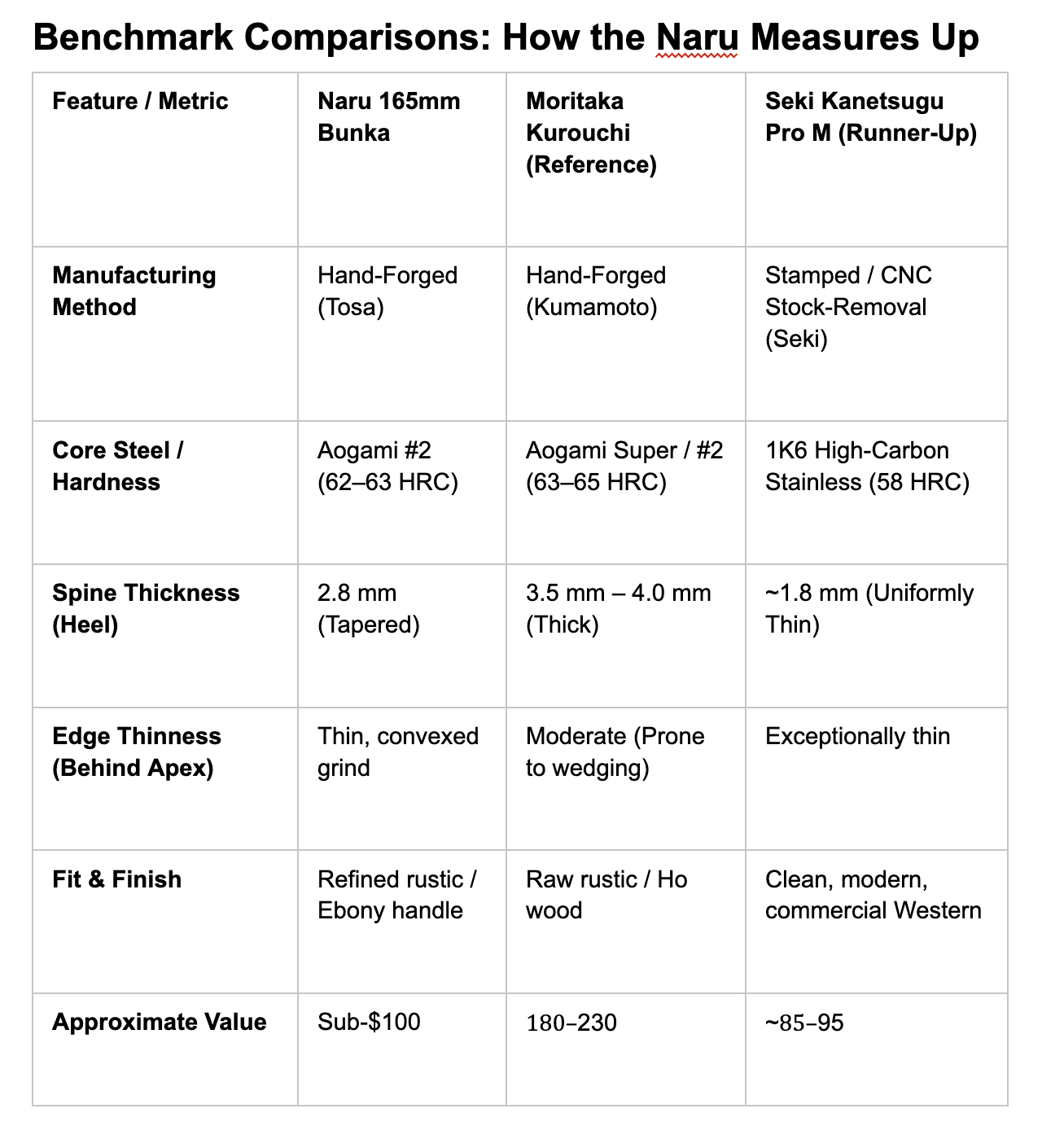
Naru Knife Comparison

1. The Moritaka Comparison:
Refining the Kurouchi Heavyweight
Moritaka Hamono remains an iconic reference for traditional Kurouchi knives, but their blades typically feature a thick, wedge-like cross section that demands substantial hand-thinning on waterstones to prevent splitting hard produce like squash or carrots. The Naru addresses this out of the box: it retains the dark rustic aesthetic of a Moritaka, but grinds away the bulky shoulders behind the apex for immediate high-performance cutting.

2. The Seki Kanetsugu Pro M:
Handcraft vs. Monosteel Precision
For cooks who refuse to manage carbon steel patinas or who prefer a lightweight, laser-like feel, the Seki Kanetsugu Pro M is the strongest alternative in the sub-$100 range. Built with a modern stainless alloy and an ergonomic Western handle, the Pro M offers clinical cutting performance. However, it lacks the metallurgical hardness, edge feel on waterstones, and hand-forged character that define the Naru.
Daily Performance & Prep Station Dynamics
At 149 grams, the Naru feels light and maneuverable in the hand, but its 2.8mm spine provides an anchor of stability that ultralight stamped "lasers" often lack.
On dense synthetic cutting boards (such as high-density prep composites or traditional rubber boards like Asahi/Hasegawa), the Aogami #2 core maintains its crisp apex through heavy dicing sessions. The knife exhibits exceptional push-cutting mechanics on fibrous produce—celery, leeks, and onions—gliding through cellular walls with minimal resistance.
Carbon Steel Maintenance Note: Because this blade utilizes a non-stainless Blue #2 core with carbon Kurouchi cladding, it will develop a unique patina over time. It requires fundamental carbon habits: wipe the blade down with a dry towel during extended prep, wash and dry it immediately after use, and never leave it resting in a wet sink.
The Naru 165mm Bunka proves that the hand-forged Japanese knife is not dead at the budget level. By taking the raw, unyielding hammer-work of Tosa's blacksmiths and holding it to rigorous edge-thinness standards, this knife establishes a new benchmark for what $100 can buy in authentic Japanese cutlery.