Your cutting board dictates edge retention more than almost any other variable in your kitchen. You can execute a flawless bevel progression on synthetic waterstones, refine the apex on sub-micron diamond emulsions, and achieve hair-whittling sharpness—only to fold or micro-chip that edge in minutes against the wrong cutting surface.
For decades, the culinary standard has been 2-inch-thick end-grain hardwood. But while end-grain maple, walnut, or hinoki is forgiving on edges, it comes with grueling realities: 20-pound heft, continuous mineral oil maintenance, and vulnerability to warping or bacterial absorption in high-volume environments.
After four years of continuous daily testing across home kitchens, prep stations, and outdoor smokers, modern synthetic and composite materials have fundamentally displaced traditional butcher blocks.
Comparing the three dominant modern cutting board architectures—Asahi Synthetic Rubber, Hasegawa Wood-Core Polyethylene, and Dunn Board Richlite Composite—reveals how each material interacts with Japanese cutlery, handles thermal stress, and holds up over years of hard use.
trust retailers BurrfectionStore | Gyuto | WasabiKitchen | Amazon
Disclosure: As an Amazon Associate, I earn from qualifying purchases
1. Asahi Synthetic Rubber: The Soft-Apex Specialist
Manufactured in Japan, Asahi boards are formulated from a specialized synthetic rubber compound engineered specifically for high-hardness Japanese cutlery (Shirogami, Aogami, and high-carbide stainless steels).
Unlike standard commercial poly boards that create hard, plastic-on-steel deflection, Asahi rubber yields under the apex, absorbing the downward energy of push-cuts and chop-strokes.

The Base Model vs. Professional Series
The Base Model Flaw: Asahi’s entry-level consumer board is marginally cheaper than their professional line, but lacks structural density. In testing, running a base Asahi board through a single dishwasher cycle induced immediate thermal warping, lifting the edge roughly 1mm off the counter. Rule of thumb: Never put rubber cutting boards into a heated dishwasher drying cycle.
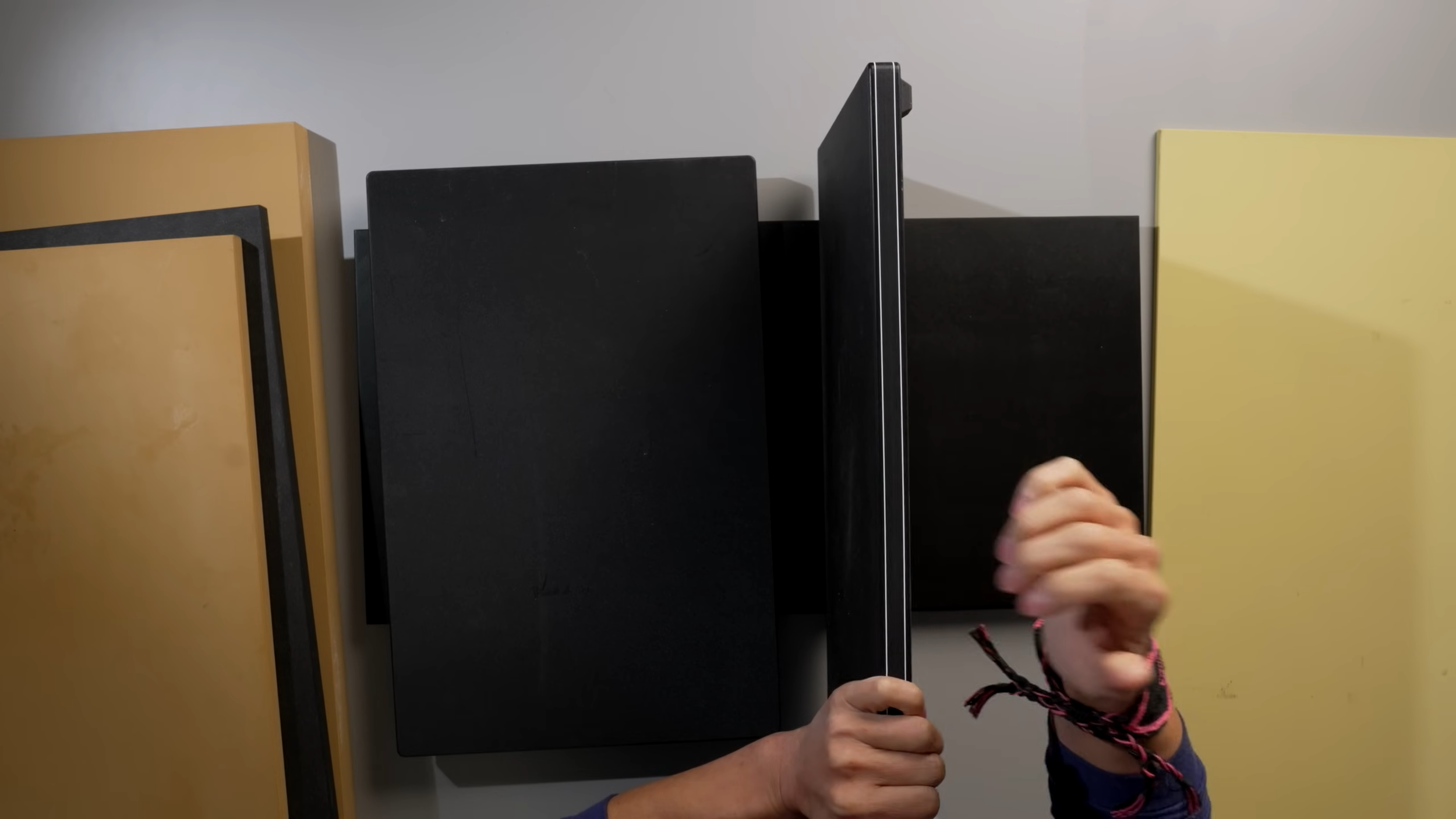
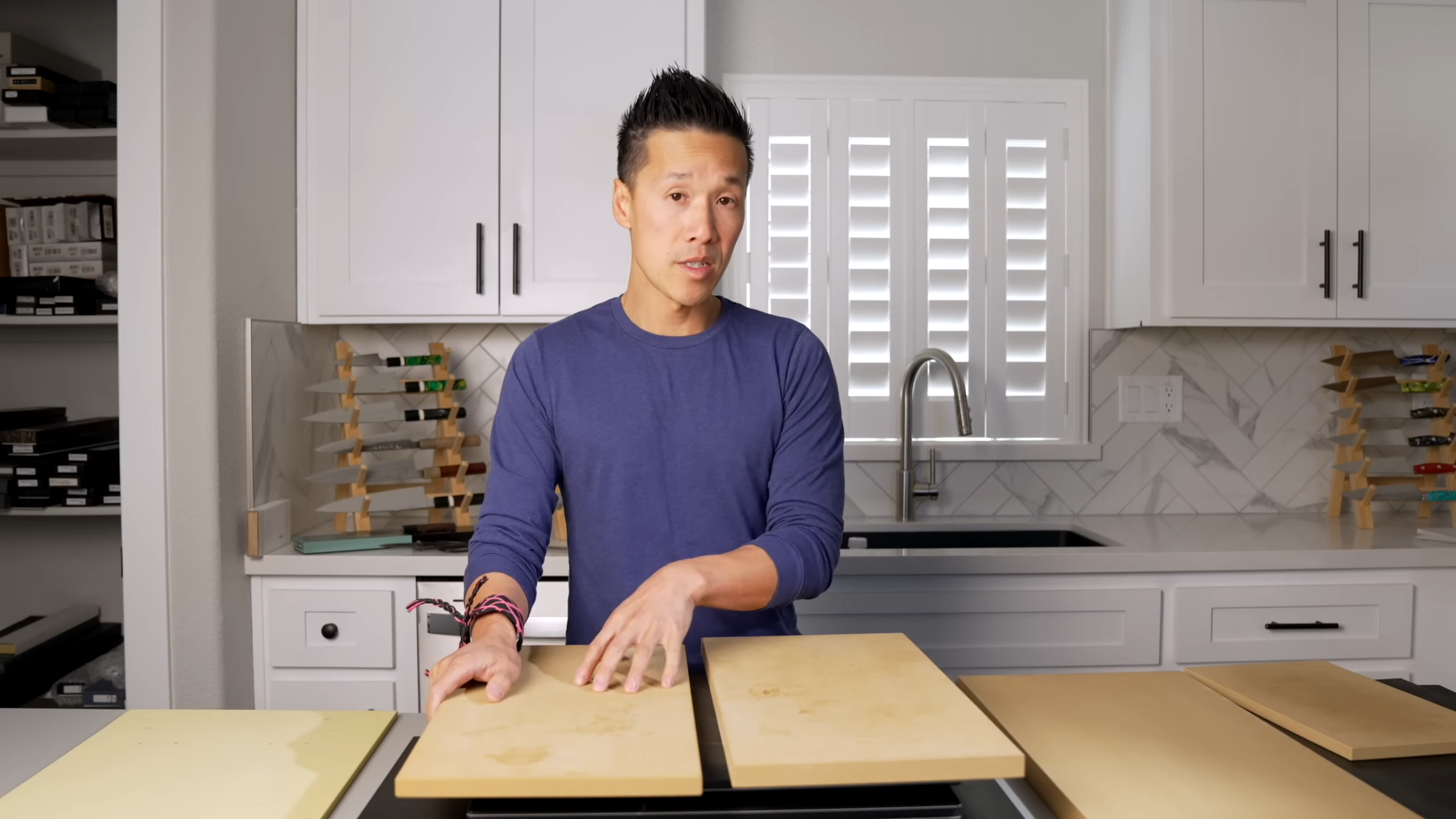
The Professional Benchmark: The Asahi Professional Series comes in three calibrated thicknesses: 1.5cm, 2.0cm, and 3.0cm. The 1.5cm Pro board (roughly 19.7 x 9.8 inches) offers superior rigidity, a non-slip textured finish, and zero flex. For raw fish fabrication and precision vegetable work, the tactile "thud" and edge-cushioning of the 2cm and 3cm Pro boards set the global culinary benchmark.
The "Black Board" Tax: Asahi recently introduced a black rubber line. While black boards provide striking visual contrast when slicing white fish or light-colored vegetables, the material composition is functionally identical to the standard tan board. The black edition costs nearly double ($149 vs. $86 for a 15x8-inch footprint) and comes in limited sizes. Unless aesthetic contrast is critical to your prep station, the tan Professional board delivers identical cutting mechanics at a far more rational price point.

The Asahi Professional Soft Board (0.8cm):
Brilliant with One Fatal Flaw
Asahi’s 8mm (0.8cm) ultra-thin Soft Board is an innovative product: light, durable, and highly impact-resistant. Dropping it on concrete will not dent or fracture the core. It provides a massive 23x13-inch working surface that functions beautifully on flat countertops.
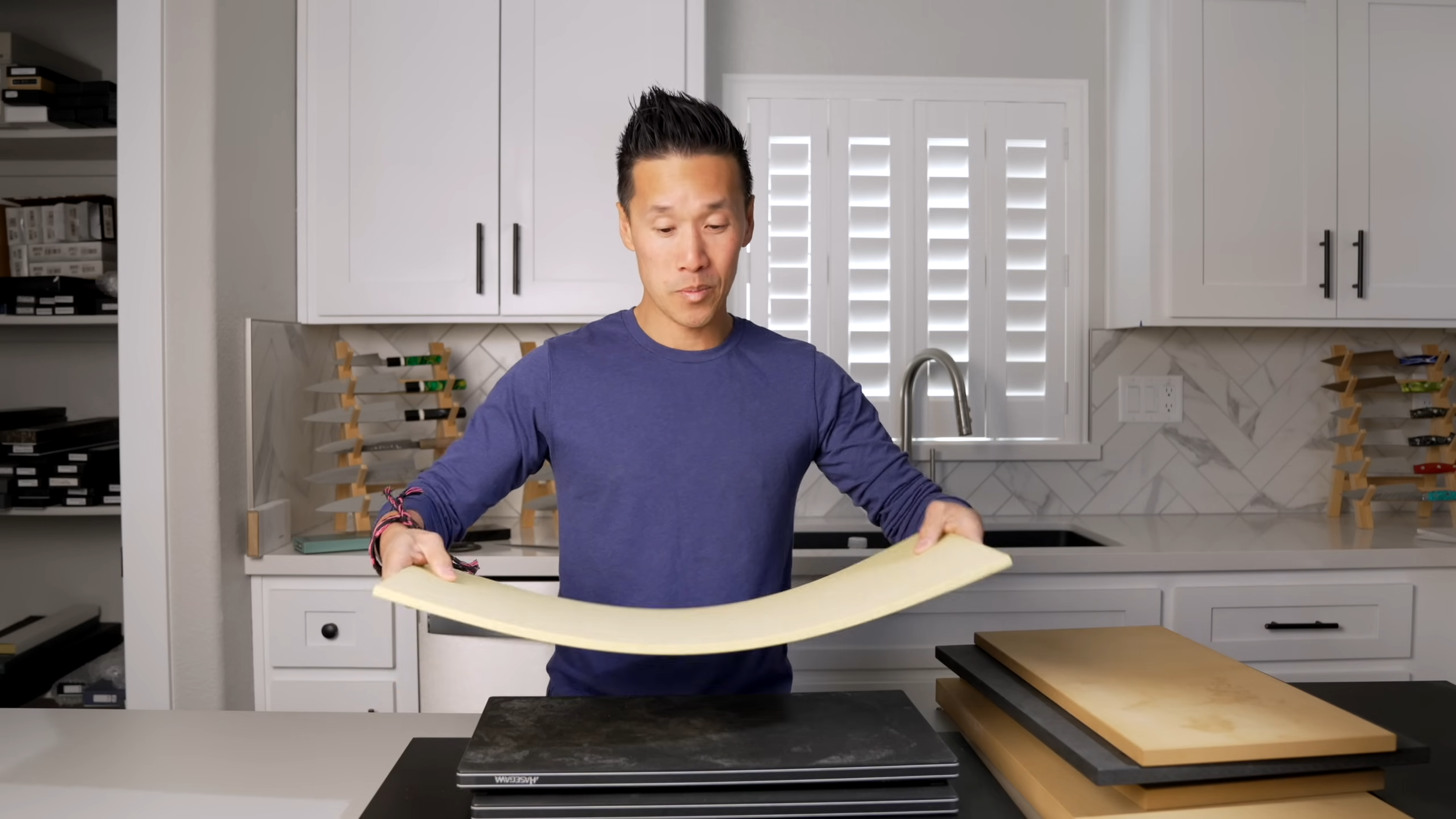
However, its extreme flexibility introduces a mechanical hazard: The "Brisket Flex."
Because the board lacks a rigid substrate, picking it up two-handed with a heavy roast, smoked brisket, or pile of butchered poultry causes the center to bow downward. The resulting sag dumps hot rendered fats and juices straight over the edges. It is a fantastic rollable prep mat for flat counters, but a liability for transport.

2. Hasegawa: The Wood-Core Polyethylene Solution
Hasegawa approaches cutting board engineering from an entirely different mechanical angle: composite lamination.
The Wood-Core Architecture
A solid slab of high-density rubber or thick plastic is heavy. Hasegawa solves this by encasing an integrated wood core between two layers of soft, micro-textured polyethylene (PE).
Weight Reduction: The wood core reduces overall weight by 30% to 40% compared to solid rubber slabs of equivalent footprint, making daily transfers to the sink effortless.
Structural Stability: The internal wood matrix acts as an anti-warping truss. Even under intense hot-water wash cycles, the board maintains structural flatness.
Grip Texture: Hasegawa embosses both cutting surfaces with a distinct micro-texture that anchors slick proteins, preventing raw fish and wet vegetables from hydroplaning during thin slicing.
Decoding the Model Hierarchy
Hasegawa’s naming convention is notoriously convoluted. Understanding the lineup prevents costly purchasing errors:
FSR Series: The premier flagship. It utilizes the softest surface formulation in Hasegawa’s catalog, offering the greatest edge preservation and apex cushion.
FRK / FP / FSB Series: Mid-tier commercial variants featuring slightly firmer PE surface layers laminated over the standard wood core.
Hasegawa Black Pro: Shares the same core composition and surface hardness as the FRK line, but adds a matte black surface. Unlike Asahi’s massive price hike, Hasegawa prices their black boards reasonably close to their tan equivalents ($79 for 13x9 vs. $89 for a 15x10 tan).

3. Dunn Board (Richlite Composite): The Modern Indestructible Workhorse
Richlite is an industrial resin-infused paper composite originally engineered for aerospace, marine, and commercial architectural surfaces. Formed by saturating unbleached paper sheets with thermosetting resin and pressing them under extreme heat and pressure, it forms a dense, non-porous solid.
The 4-Year Long-Term Wear Reality
Tested daily over four years—handling everything from high-volume vegetable prep to refrigerator dry-aging and outdoor barbecue—Richlite exhibits wear characteristics that outclass both wood and rubber:
Impervious to Deep Grooving: Soft rubber and standard plastics develop deep knife scars over years of hard chopping. These crevices become traps for bacteria and grease. Richlite develops only fine, microscopic surface abrasions; the material will not allow an apex to bite deep enough to crater the core.
Complete Resistance to Moisture & Oil: Animal blood, rendered briskets, and acidic citrus juices rinse completely off the surface with zero liquid penetration. It never requires oiling, seasoning, or re-sanding.
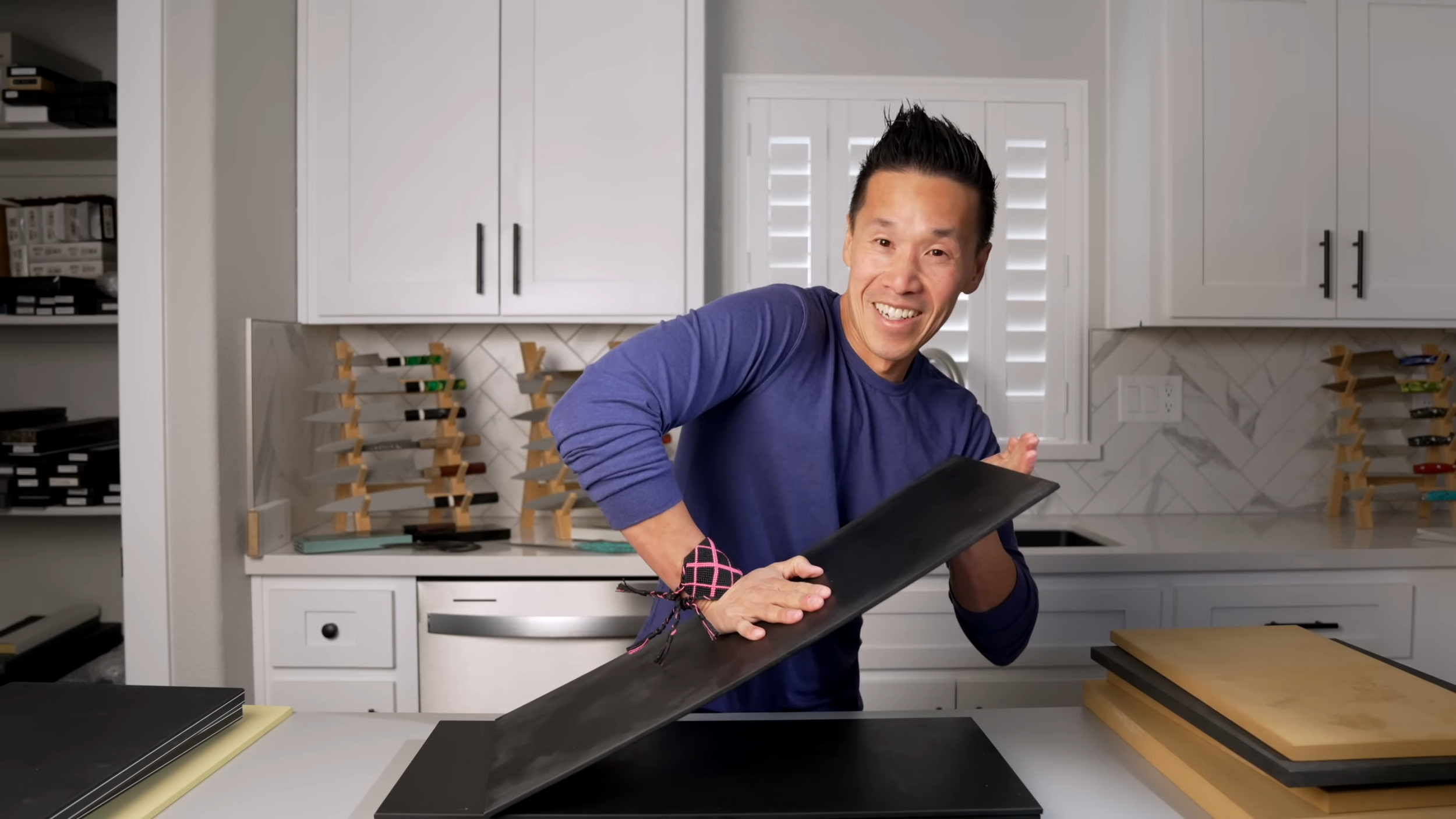
Total Structural Rigidity: Even at 1/4-inch (6mm) thickness, Richlite exhibits zero flex. A 24x12-inch slab can support a 15-pound smoked brisket carried one-handed without bowing. At 1/2-inch (12mm) thickness, it delivers the stability of a 2-inch hardwood block at a fraction of the weight and maintenance.
The Acoustic and Tactile Trade-Off: "Clack" vs. "Thud"
Richlite is not soft rubber. When you push-cut or tap-chop dense vegetables like carrots or celery, the cutting feedback is immediate:
Asahi Rubber: Yields a muffled, absorptive thud.
Richlite: Produces a sharp, immediate clack.
While Richlite is substantially more forgiving on knife edges than glass, granite, or bamboo, it is noticeably firmer than Asahi rubber or Hasegawa FSR. If your sharpening style involves high-frequency chopping with thin, laser-ground edges running at 63+ HRC, the tactile feedback requires a minor adjustment period.
Technical Comparison Matrix
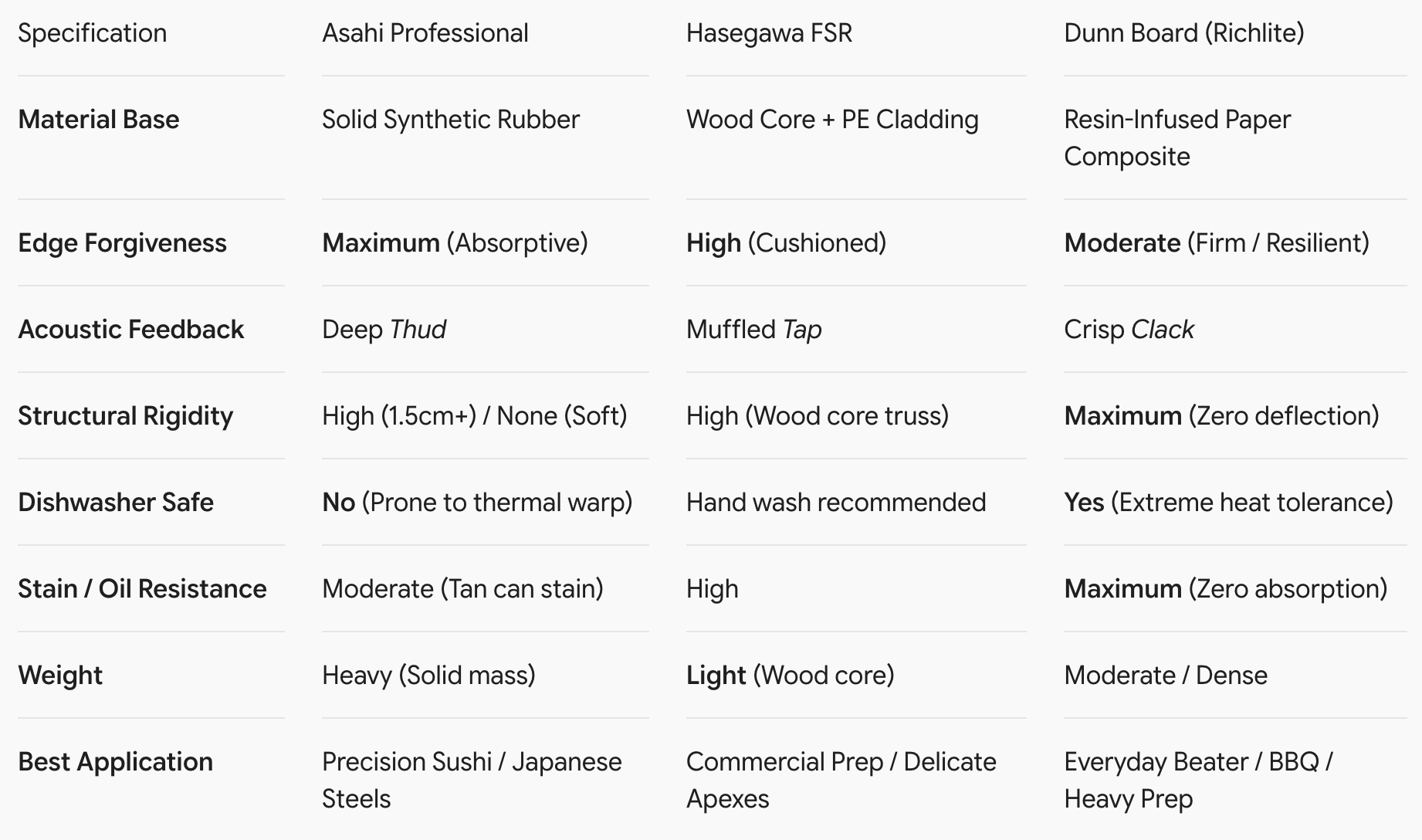
Synthetic Cutting Board comparison
The Verdict: Allocating Board Materials to Your Kitchen
No single cutting board material solves every culinary problem. The optimal setup matches the board’s material properties to your daily cutting tasks:
For the Japanese Cutlery Purist: If you use hand-forged White Steel (Shirogami) or Super Blue (Aogami Super) knives and prioritize ultimate apex preservation above all else, the Asahi Professional (1.5cm or 2.0cm) is unmatched. Skip the overpriced black models and the fragile base consumer line; stick to the standard tan Pro.
For the High-Volume Line Cook: If you want edge cushion combined with a lightweight profile that won't strain your wrists during constant trips to the commercial wash sink, the Hasegawa FSR wood-core board provides the best balance of sanitation, grip, and weight reduction.
For the Daily Workhorse & Outdoor Cook: If you want an indestructible, zero-maintenance board that transitions effortlessly from kitchen prep to the outdoor smoker without warping, staining, or flexing, the Dunn Board Richlite (1/2-inch) is the ultimate utility surface. It delivers generational durability without the maintenance headaches of heavy hardwood.