Gyuto vs. Santoku: Geometry, Profile Dynamics, and Edge Performance
While casual home cooks often view both profiles as interchangeable "everyday chef's knives," any experienced sharpener or restoration enthusiast knows that their bevel grinds, belly curvatures, contact patches, and weight distributions demand entirely different hand mechanics and stone maintenance routines.
Whether you are building out your primary kit, testing custom bevel angles on your whetstones, or evaluating how different blade profiles interact with various wood board densities, understanding the mechanical nuances between the Gyuto and Santoku is paramount.
Profile Geometry and Contact Surface Mechanics
The most immediate technical distinction between a Gyuto and a Santoku lies in the curvature of the profile (the "belly") and how much steel actually contacts the board during a stroke.
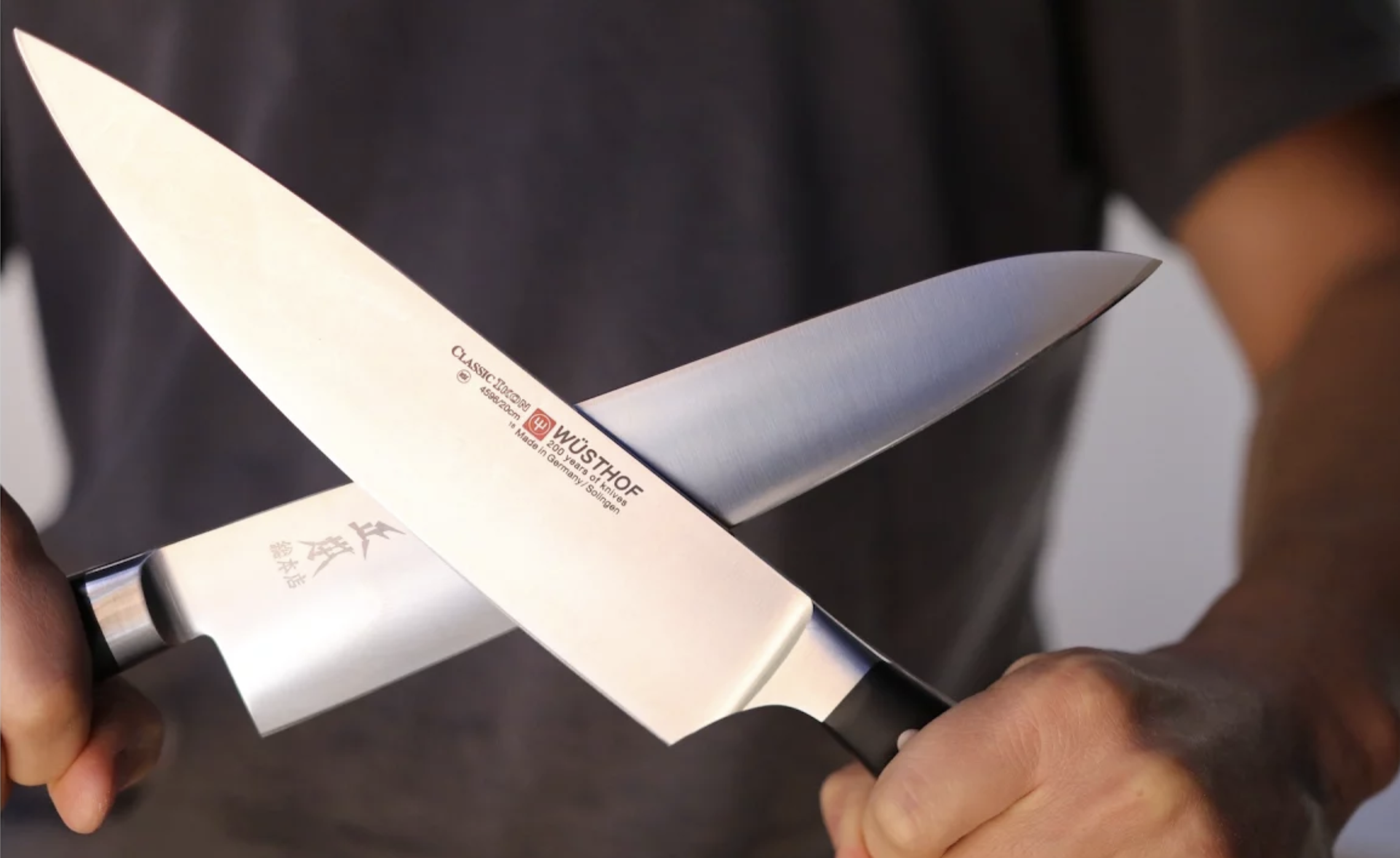
The Gyuto Profile: Continuous Arc & Distal Taper
Profile Curve: A Gyuto features a continuous, sweeping curve along its cutting edge that rises steadily toward a acute, thin tip.
Contact Dynamics: Because of this continuous curvature, a Gyuto maintains a shifting, minimal contact patch with the cutting board throughout the stroke. This makes it ideal for fluid rock-chopping, rolling push-cuts, and long draw-slices.
Distal Taper: Premium Gyutos exhibit a pronounced distal taper—where the spine thins progressively from the heel to a razor-thin, needle-like tip. This allows the tip to enter dense produce like onions with near-zero wedging force.

The Santoku Profile:
Extended Flat Section & Kamagata Tip
Profile Curve: A Santoku features a predominantly flat profile across the middle and rear two-thirds of the blade before curving upward into a "sheep's foot" or Kamagata tip.
Contact Dynamics: The extended flat section creates a wide, simultaneous contact patch with the cutting board. When push-cutting or tap-chopping, the entire flat edge strikes the board evenly, guaranteeing 100% board clearance without leaving accordion-cut produce.
Spine Profile: Santokus typically maintain a more consistent spine thickness further down the length of the blade, dropping off steeply only at the front curve. This provides structural rigidity and mass right above the primary cutting zone.
Length, Leverage, and Balance Calibration
Blade length directly impacts speed, physical leverage, and how weight is distributed across your pinch grip.
Sizing and Mass Distribution
Gyuto (210mm – 270mm): The extra length of a Gyuto shifts the center of gravity slightly forward of the bolster/ferrule. When using a traditional pinch grip directly on the blade's heel (Ago), this forward weight bias works with gravity, allowing the mass of the knife to assist in pulling the steel through dense proteins and large root vegetables.
Santoku (165mm – 180mm): With a shorter length, a Santoku's balance point sits almost directly inside your hand or right at the ferrule junction. This neutral balance profile provides maximum tactile feedback and immediate maneuverability in tight prep spaces or on smaller board setups.

Cutting Motion Mechanics:
Rocking vs. Thrusting
Rock-Chopping: The Gyuto’s sweeping belly acts as a continuous rolling fulcrum. You can maintain constant board contact with the front portion of the edge while feeding herbs or aromatics underneath. Attempting to rock-chop aggressively with a Santoku will cause the flat section to heel-strike the board, causing high impact shock along the edge.
Push-Cutting & Tap-Chopping: The Santoku excels at pure vertical thrust-cutting. Because of its flat profile, you move the blade forward-and-down in a linear motion. The flat edge cleanly severs fibers across the entire length of the blade simultaneously.
Sharpening Nuances & Whetstone Maintenance
For sharpening enthusiasts, the choice between these two profiles introduces distinct stone work and edge maintenance behaviors.
Maintaining the Flat Section on a Santoku
The Challenge: Sharpening a Santoku requires careful pressure management across the flat profile. If you apply excessive pressure or execute uneven sweeping motions near the middle of the blade, you risk grinding a concave hollow ("recurve") into the edge.
Stone Strategy: Work the flat portion of a Santoku in wide, linear sections across your whetstone (such as a 1000-grit Shapton Pro or Naniwa Chosera), ensuring even stone wear and using a flattening plate regularly to keep your stone dead-flat.
Blending the Radius on a Gyuto
The Challenge: The sweeping belly of a Gyuto requires a smooth, lifting wrist motion as you navigate from the flat heel area up through the belly to the tip.
Stone Strategy: To maintain the factory profile without creating flat spots along the curve, sharpen in overlapping zones. Lift your elbow slightly as you reach the belly section to follow the natural radius of the steel across the stone face.
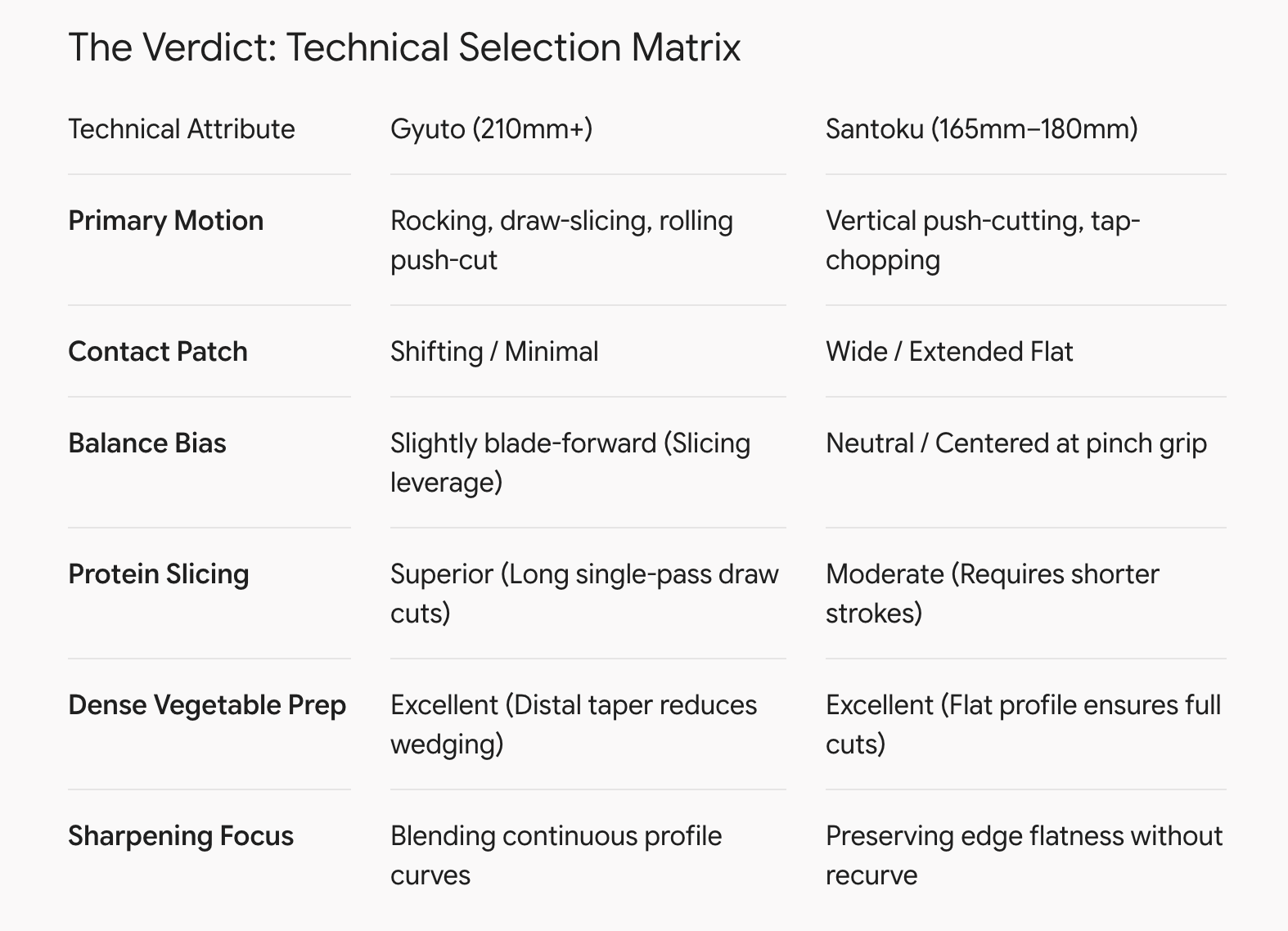
gyuto vs santoku comparison
Final Recommendation
Choose the Gyuto if: You prioritize slicing efficiency, require an acute tip with heavy distal taper for detail work, utilize long draw-strokes on proteins, and prefer a blade-forward weight distribution that rocks smoothly across the board.
Choose the Santoku if: You favor rapid, vertical push-cutting mechanics on vegetables, work on compact cutting boards, want maximum neutral hand maneuverability, and prefer a flat profile that eliminates incomplete cuts.