How to Fix a Bent Knife Blade by Hand (Without Breaking It)
A bent kitchen knife takes two or three minutes to straighten at home. The rule that matters most: lift, never push down.
By Ryky TranOctober 2, 2021Updated November 25, 20263 min read
This article contains affiliate links: I may earn a commission if you buy through them, at no extra cost to you. How this works
The short version
- Find the bend on a flat table: lay the blade on each side with the handle off the edge and look for the gap.
- Lift, never push down: small lifts of a few millimeters, moving in half-inch steps around the bend, correct it without kinking the steel.
- Check alignment by flipping the knife and pressing the tip into the same mark, then save yourself the $20 to $30 a shop would charge.
Finding the bend
You can sight down the blade from the handle, but it's not very accurate (0:00). The easiest way is a flat table: put the blade down with the handle hanging off the edge and see which side lifts (0:23). On my knife, the tip rose two or three millimeters on one side, and on the other side there was a two-millimeter gap just above the middle, so the blade was bent to the right.
If you're new to this, wear cut-resistant gloves to protect against cuts, with latex gloves over them for grip (0:47). I work bare-handed off camera because I've done this for years. Then mark the center of the highest gap with a Sharpie, so you know exactly where to focus (1:07).
Lift, don't push
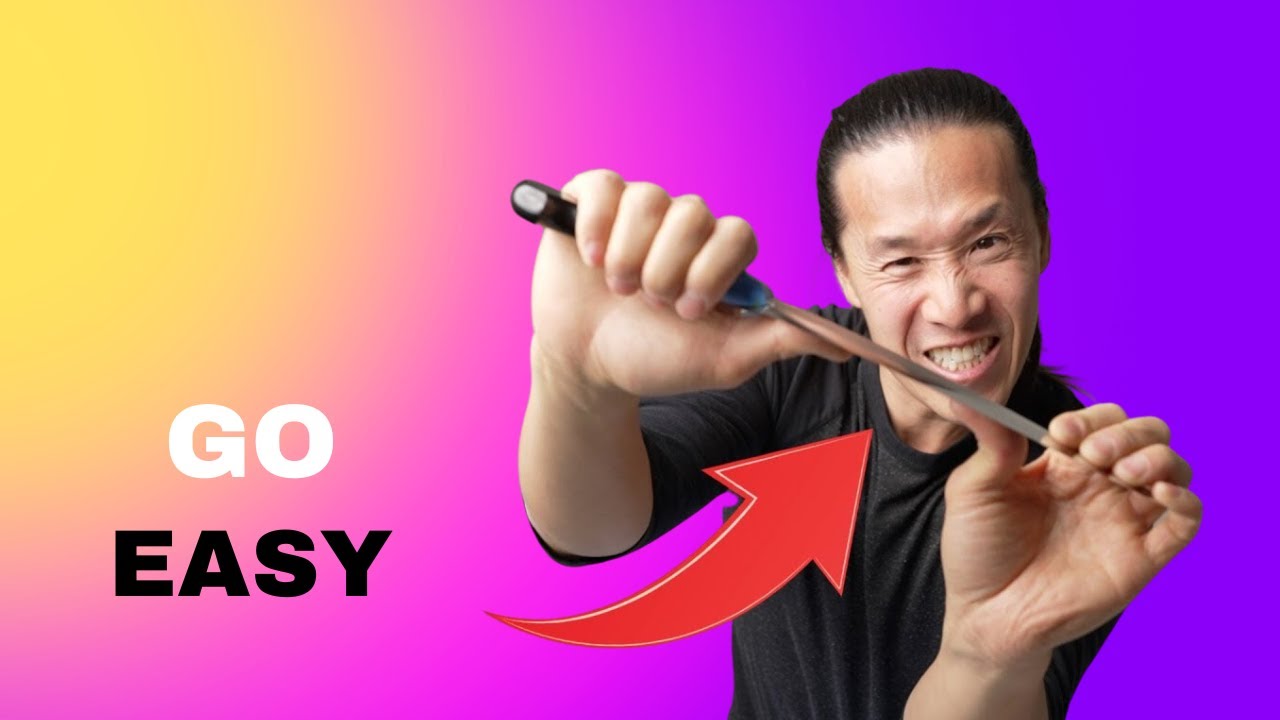
Never push down on the blade (1:33). We're naturally very strong pushing away from ourselves, so pushing down on the handle or blade puts far more force into it than a simple bend needs. Gentle lifts are the safest way (1:58).
Don't just grab the handle and lift with your other hand on the mark either (2:21). My mark was about an inch above the blade's midpoint; lifting from the handle might fix that bend but create a new one near the handle, which is hard to repair. Instead, grip as high as is comfortable, about two or three inches below the mark, so the effort goes into that section (2:42).
Put your palm on the spine, where most of the thickness is, and work from an inch above to an inch below the mark in half-inch increments (3:06). Bend the steel too quickly and you risk damaging it. Then check both sides on the table again (3:29). I lift only half an inch at a time, sometimes just a few millimeters. The whole repair takes two or three minutes (3:51).
Bends near the tip
For a bend in the first inch or two of the blade, I still leave about an inch of the tip exposed past my grip (4:11). That way I don't accidentally bend the very tip, which is really hard to correct by hand and usually needs a hammer (4:37). Placement matters more than grip here: bring the blade close to the edge of the table, not to push down, but so your hand gets the best grip (5:01). Your other hand pins the knife down with your arm straight and close to your body, which gives you far better leverage and control than reaching out over the table (5:28). Then the same tiny lifts, in half-inch steps (5:54).
Checking the alignment
Once the blade lies flat on both sides, check whether it's straight relative to the handle (6:14). This works with any symmetrical handle, Western or wa. Pin the handle flat on the table and press the tip into a foam pad, cardboard or paper to make a mark (6:39). Flip the knife over and do the same. If the tip lands in exactly the same spot, the knife is aligned (7:05). I check every knife this way, especially after a repair or a new handle.
This is a simple repair; you don't need to pay a shop $20 or $30 for a couple of minutes of work (7:27). I like a work surface with a little grip and give, like a rubber mat, but a cutting board or table works too. And if you're nervous about putting your hand on the blade, gloves are the safest option (7:50).
Bottom line
Most bent blades come back in minutes: find the gap on a table, mark it, grip close to it and lift in tiny steps, then check the alignment. Never push down; that's how you crease steel, and there's no undoing a crease. For other home repairs, see how to fix a chipped knife and my restoration blueprint, and to avoid bends in the first place, read kitchen knife safety at home. A non-slip Hasegawa mat makes a good repair surface.
First access
Private drops, new knives and sales
Get them from Burrfection and our retail partners before anyone else. No spam; unsubscribe anytime.
Emails from Burrfection Inc. See privacy.