Switching from a traditional end-grain butcher block to a Japanese synthetic cutting board is rarely motivated by cost. High-end Japanese culinary boards are expensive, precision-engineered tools. The real motivation comes down to kitchen physics: preserving delicate, highly acute blade apexes while eliminating the labor-intensive upkeep of heavy organic timber.
A 2-inch-thick maple or walnut block is an undeniable aesthetic showpiece, but processing wet ingredients, raw poultry, and delicate sashimi exposes its functional limitations. Hauling a 15-pound slab of hardwood to the sink multiple times a day is exhausting, and failing to maintain a strict oiling regimen invites grain splitting and catastrophic board cupping.
Over two years of continuous daily testing across professional prep stations and home counters, synthetic boards have radically shifted our maintenance benchmarks.
trust retailers BurrfectionStore | Gyuto | WasabiKitchen | Amazon
Disclosure: As an Amazon Associate, I earn from qualifying purchases.
Boards available here at BurrfectionStore
Evaluating the engineering behind Hasegawa’s wood-core lineup, Hi-Soft polyvinyl acetate, Asahi synthetic rubber, and dense polyethylene reveals how different contact surfaces actively dictate edge retention.
1. Edge Retention Dynamics: The Micro-Pyramid Effect
The single greatest operational advantage of Japanese soft boards is apex longevity. When a knife edge contacts a standard board, mechanical friction and lateral micro-torque begin dulling the cutting apex immediately.
On traditional end-grain wood, premium steels like Takefu VG-10, SG2 powder metallurgy, and Hitachi White #2 (Shirogami) or Blue #2 (Aogami) typically hold an optimal working edge for two to three months of regular home prep before requiring a waterstone touch-up. High-wear steels like Aogami Super or ZDP-189 stretch that window to roughly three to four months.
On a textured Hasegawa board, those intervals shift significantly:
Edge Life Extended: Aogami Super blades routinely maintain effortless push-cutting performance for up to five continuous months without stone maintenance. Even standard VG-10 holds an aggressive, paper-slicing bite for three to four months.
The Structural Explanation: The secret lies in the surface architecture. Unlike smooth, brushed plastic boards, Hasegawa surfaces feature a dense, embossed grid of miniature inverted micro-pyramids. When the cutting edge lands, the apex settles into these micro-recesses rather than glancing or skidding across a rock-hard flat plane. This dampens lateral deflection, preventing the ultra-thin apex from rolling or chipping under downward force.
2. Decoding the Hasegawa Lineup:
FSR, FRK, FPE, and FSB
Hasegawa manufactures some of the finest culinary surfaces in the world, but their catalog uses an intimidating web of product codes. Stripping away the model numbers reveals two fundamental categories: The Tan Line and The Color-Coded Line.
+--------------------------------------------------------------------------+
| HASEGAWA CORE ARCHITECTURE                                               |
| 1. Top Face: Embossed Antibacterial Polyethylene (Micro-Pyramid Grip)    |
| 2. Stabilizing Truss: Solid Kiln-Dried Integrated Wood Core              |
| 3. Perimeter: Sealed Hygienic Edge Banding (Moisture Barrier)            |
| 4. Bottom Face: Embossed Antibacterial Polyethylene                     |
+--------------------------------------------------------------------------+
The Tan Boards (FSR vs. FRK)
The tan models feature Hasegawa’s softest cutting compound, providing the absolute highest degree of edge cushioning.
Hasegawa FSR (Flagship Commercial): Engineered for professional workstations. The FSR line offers immense surface footprints (up to 35.5 x 18 inches and a full 1-inch thickness) with a solid white perimeter edge band. It is built to remain anchored on large commercial prep counters.
Hasegawa FRK (Home / Prosumer Standard): The FRK uses the exact same wood core and the exact same soft, micro-textured tan cutting face as the high-end FSR. The differences are dimensional: it measures roughly 0.75 inches thick, features a clear/white perimeter edge band, and comes in manageable home kitchen footprints (such as 18 x 10 inches). For residential cooks, the FRK delivers 100% of the FSR's cutting performance at a much more practical size and price point.

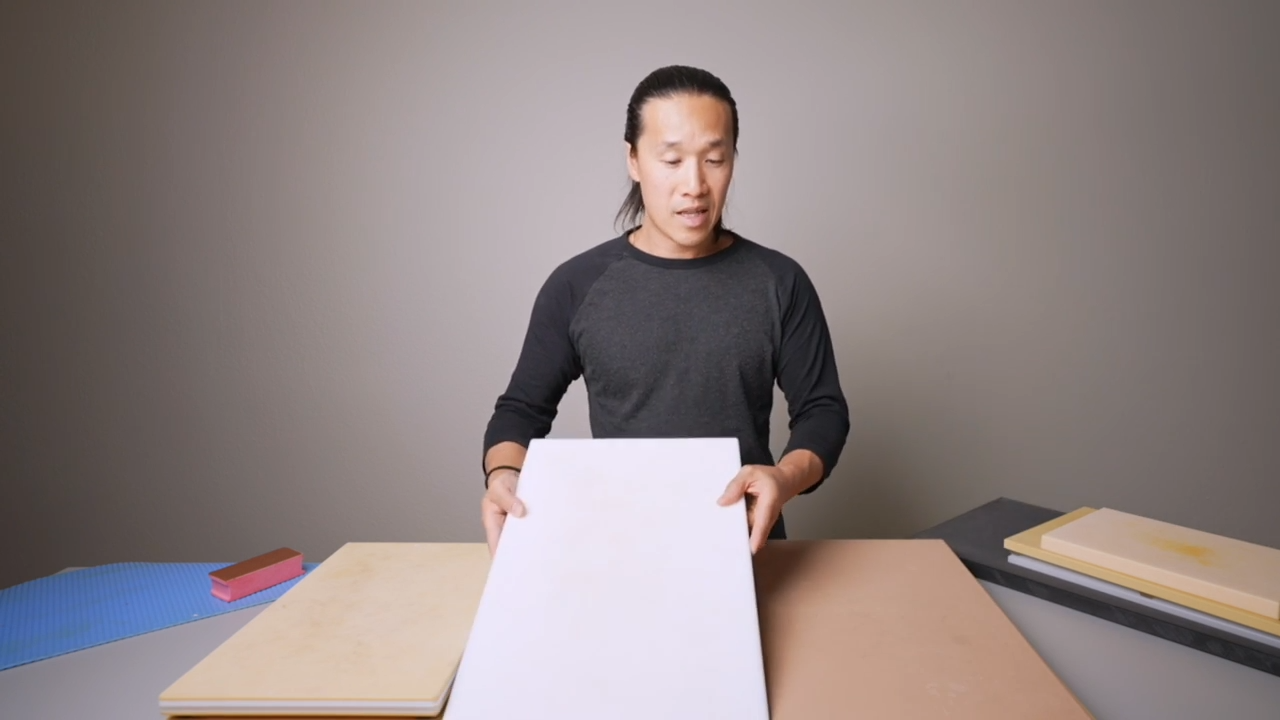
Hasegawa cuttings boards side by side
The Color-Coded Hygiene Boards (FPE White vs. FSB Brown)
The FPE (White) and FSB (Brown) are functionally identical twins designed for commercial HACCP cross-contamination protocols:
Surface Chemistry: Both lines utilize a slightly firmer elastomer formulation than the tan boards. While marginally firmer under the blade, they are substantially more resistant to pigment staining.
Edge Identification: The FPE white board features a blue structural core line; the FSB brown board features a white core line.
The Verdict: If maximum apex softness is your priority, buy the tan FRK or FSR. If you frequently process dark, highly pigmented vegetables (carrots, beets, turmeric) and want easier surface hygiene maintenance, choose the FPE or FSB.
3. Alternative Synthetics: Hi-Soft, Asahi, and Standard Polyethylene
Branching outside Hasegawa introduces vastly different material behaviors under edge impact.
       [HI-SOFT: PVA]              [ASAHI: RUBBER-WOOD]           [POLYETHYLENE]
    Open Scar Retention             Dense Elastic Recovery        Permanent Cupping
Hi-Soft (Polyvinyl Acetate)
Hi-Soft boards are constructed from polyvinyl acetate, an ultra-dense, supple synthetic material.
The Pros: Excellent acoustic deadening and a silky, matte surface that feels premium under an acute Japanese bevel.
The Cons: Hi-Soft exhibits poor elastic recovery. Knife cuts do not close back up; instead, the surface readily collects deep, multi-directional lacerations that trap food oils and pigments. In long-term testing, routine prep with cheeses and roasted carrots left permanent, stubborn stains that resisted even concentrated chlorine bleach. At roughly $50 for a compact footprint, the high maintenance and surface scarring make it difficult to recommend over Hasegawa.
Asahi Synthetic Rubber
Asahi boards are formulated from a solid composite of synthetic rubber impregnated with fine wood particles.
The Pros: High density, completely non-porous, and offering solid heft that anchors firmly to the counter. Because it is a homogenous slab rather than a laminated core, you can mechanically resurface an aged board back to factory-new condition by sanding off the top layers with 400-to-600 grit wet/dry sandpaper.
The Cons: Thin variants (under 15mm) lack sufficient mass to absorb aggressive downward momentum, deflecting vibrational energy back into the user’s hand with a sharp acoustic "clack." To reap the benefits of Asahi, you must invest in their 20mm or 30mm Professional lines.
Standard Polyethylene (PE) Slabs
Whether translucent white or high-density black, unreinforced solid plastic boards suffer from an inescapable mechanical flaw: thermal stress warping.
Even premium, 1-inch-thick black polyethylene boards measuring nearly 30 inches wide will cup over months of washing, lifting the corners 1mm to 2mm off the bench.
Furthermore, black PE surfaces quickly develop cloudy, white stress-blooms across the cut zones as the blade apex tears the plastic fibers, transforming a sleek black surface into a scuffed, chalky eye-sore.

4. Maintenance Protocols and Stability Modifications
Synthetic boards solve the rotting and cracking vulnerabilities of hardwood, but introduce their own operational rules:
Chemical Oxidation vs. Mechanical Scrubbing
Japanese boards will stain. Soft rubber and polyethylene surfaces lack the natural masking ability of dark wood grain.
Mechanical Clearing: Abrasive scrapers equipped with dense, 0.05mm micro-bristles are vital for reaching inside Hasegawa’s micro-pyramid grid to lift out trapped food fibers and proteins. However, scrapers only remove physical debris—they cannot erase chemical discoloration.
The Chemical Reset: To strip away deeply set organic pigments from carrots, peppers, or meat drippings, spray the board with a 50/50 water and chlorine bleach solution. Allow it to dwell for 15 to 20 minutes before thoroughly flushing with cold water. The board will return to its original tone without degrading the underlying polymer matrix.
Eliminating Kinetic Rebound: The Silicone Foot Mod
Because wood-core boards are remarkably lightweight, high-speed tap-chopping can cause light boards to chatter or bounce across dry stone countertops.
Rather than relying on oversized anti-slip waffle mats—which trap stray onion bits and herbs inside their recessed silicone pockets—apply adhesive silicone bumper feet directly to the underside corners of your board.
Vibration Isolation: The silicone pads decouple the board from the stone counter, dampening chopping acoustics and eliminating rebound fatigue in your wrist.
Total Grip: They provide complete lateral stability on wet surfaces without requiring maintenance-heavy secondary mats.
Sink Clearance: Elevating the board provides clean grip access to pick the unit up directly off flat stainless steel prep tables.
Technical Comparison Matrix
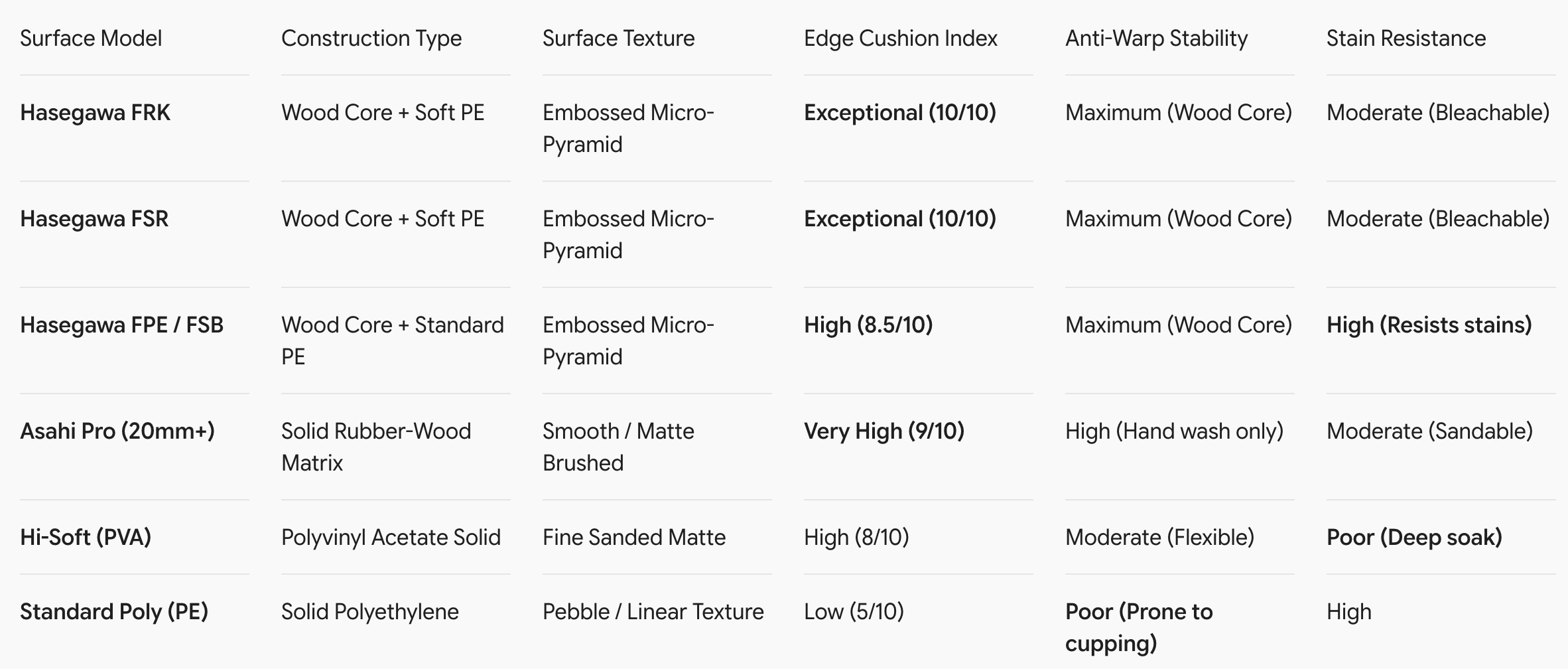
Asahi vs Hasegawa cuttings boards
Allocating the Right Board to Your Bench
If you are tired of oiling massive end-grain blocks and want a cutting surface that actively protects high-hardness Japanese cutlery, the Hasegawa FRK (18 x 10 inches) represents the undisputed sweet spot for residential kitchens.
Its internal wood core keeps the entire unit flat and lightweight, the 2:1 aspect ratio clears standard double-basin sinks effortlessly, and the micro-pyramid grid prevents edge rolling better than any flat plastic on the market.
Pair it with four adhesive silicone feet and a bottle of surface sanitizer, and you will effectively double the working lifespan of your whetstone edges.