Walk down Kappabashi Dougu Street in Tokyo—the historic culinary epicenter for Japan’s professional cooks—and you will notice an undeniable pattern. Peer into the display cases of commercial cutlery shops, and Misono knives populate nearly every single shelf.
trust retailers BurrfectionStore | Gyuto | WasabiKitchen | Amazon
Disclosure: As an Amazon Associate, I earn from qualifying purchases.
Unlike boutique blacksmiths operating out of small regional guilds in Takefu or Sanjo, Misono has spent decades dominating the high-volume, professional restaurant kitchen. They build Western-style Japanese knives (Yo-bocho) engineered specifically for high-stress line work: full tangs, riveted scales, integrated bolsters, and aggressive cutting profiles.
Yet, navigating Misono’s four core catalog pillars—the Molybdenum (Standard), the 440, the flagship UX10, and the Swedish Carbon Steel—often leaves home cooks and professional prep cooks conflicted. Between subtle differences in metallurgy, ergonomics, and pinch-grip geometry, higher price tags do not always equal superior daily utility.
The Signature Misono Blueprint: Geometry and Edge Asymmetry
Before comparing steels, every prospective Misono owner must understand the brand's unique cutting geometry.
Most conventional Western kitchen knives employ a centered 50/50 symmetrical bevel. Misono, by contrast, sharpens their factory edges with an aggressive 70/30 or 80/20 right-hand bias.
The Cutting Dynamics: A right-hand biased edge creates asymmetrical steering. As the blade passes through dense produce like carrots, onions, or daikon, the steeper left face forces food release outward to the right, reducing drag and steering off-axis if pushed too forcefully.
The Profile: Misono gyutos feature a distinctly flatter, more linear belly than typical belly-heavy German cutlery. They excel at push-cutting, thrust-cutting, and rapid line prep rather than exaggerated rocking motions.
Sharpening Implications: While some sharpeners panic over maintaining an exact 70/30 bevel on bench stones, Japanese factory sharpeners don't measure micro-degrees with calipers. When refreshing these edges on a 1,000-grit waterstone, maintain roughly 7 to 8 trailing strokes on the show (right) face for every 2 to 3 deburring passes on the back (left) face to preserve the original geometry.

1. Misono Molybdenum: The Entry-Level Standard
The Molybdenum Series (often dubbed the "Moly" or Standard line) serves as Misono’s entry-level workhorse. In the realm of Japanese cutlery, "entry-level" does not denote cheap hardware—it simply reflects accessible industrial metallurgy.
+-------------------------------------------------------+
| Core Steel: Molybdenum-Vanadium Stainless (AUS-8 Equiv)|
| Hardness: ~57 HRC                                     |
| Bolster: Integrated Stainless Steel                   |
| Finish Rating: 6.5 / 10                               |
+-------------------------------------------------------+
Fit and Finish Bench Check
To test the fit and finish on an industrial knife, perform the fingernail drag test: drag your thumbnail across the seam where the metal bolster meets the handle scales, and along the full tang where the steel meets the composite pakkawood. On the Molybdenum line, the seam transition is remarkably tight and level, without rough steps that catch your nail.
Where the cost-savings appear is on the spine and the choil. The edges of the spine are broken, but not eased or crowned. If you work a four-hour prep shift in a tight pinch grip, the square-cornered choil will begin to cause index finger fatigue.
Edge Performance
At 57 HRC, this steel prioritizes toughness over ultimate edge retention. It takes a rapid, razor-sharp toothy apex on a basic 800–1,000 grit synthetic stone, resists chipping against hard cutting boards, and absorbs accidental impacts that would snap a high-hardness boutique blade.
2. Misono 440: The Ergonomic Sweet Spot

Stepping up from the standard line brings you to the 440 Series. While casual shoppers often bypass this line in their rush to buy the flagship UX10, the 440 is arguably the most complete and balanced knife Misono manufactures.
+-------------------------------------------------------+
| Core Steel: 440-Series Modified Stainless (High Cr/Mo) |
| Hardness: 58–59 HRC                                   |
| Bolster: Fully Polished Stainless Steel               |
| Finish Rating: 7 / 10                                 |
+-------------------------------------------------------+
Refined Fit and Relief
The 440 Series receives substantially more bench time in Seki City before leaving the factory:
Polished Fasteners: The brass handle rivets are buffed completely flush with the scales, eliminating any tactile friction in the palm.
Contoured Scales: The lower edges of the handle feature gentle, rounded chamfers that settle naturally into small-to-medium hands.
Spine and Choil Polishing: While still not hand-crowned like a custom artisan blade, the choil is smoothed sufficiently to earn a solid 7/10 on the bench finish scale.
Board Feel and Dynamics
Heat-treated to roughly 58–59 HRC, the 440 steel yields noticeably longer edge life than the standard Moly without turning brittle. The blade retains a springy, forgiving flex along the lower third of its length.
When speed-prepping celery, dicing shallots, or shredding cabbage, this knife feels exceptionally nimble. It possesses an intuitive center of balance right at the bolster, making it the least fatiguing knife in the lineup for extended kitchen sessions.
3. Misono UX10: The High-Tech Flagship
The UX10 is Misono’s crown jewel, designed with a distinct modern aesthetic. Featuring angular lines, a sweeping nickel-silver bolster, and ultra-clean branding, it has earned a cult-like status among professional Western line cooks.
+-------------------------------------------------------+
| Core Steel: Swedish High-Carbon Stainless (N685 Extra) |
| Hardness: 59–60 HRC                                   |
| Bolster: Polished Nickel-Silver                       |
| Finish Rating: 8.5 / 10                               |
+-------------------------------------------------------+
Metallurgy and Edge Holding
The UX10 utilizes an imported Swedish stainless steel—frequently identified as Uddeholm/Böhler N685 Extra. At 59–60 HRC, it represents the absolute ceiling of hardness in the Misono stainless catalog.
On the cutting board, the blade feels significantly stiffer than the 440. You lose the flexible springiness of the lower series, but in return, the steel maintains its apex bite through boxes of acidic tomatoes and stacks of dense root vegetables without folding over.
The Pinch-Grip Compromise
Despite its premium materials, the UX10 has a notable functional drawback: choil clearance.
The nickel-silver bolster was engineered with aggressive, modern angles that mirror the slant of the blade's choil. While visually striking, that geometry steals less than a single millimeter of critical relief right where your middle finger rests during a traditional pinch grip.
If you choke up high on the blade, your knuckle presses directly against that angular junction. Over an extended prep session, the softer, curved transition of the 440 feels noticeably more comfortable in hand.
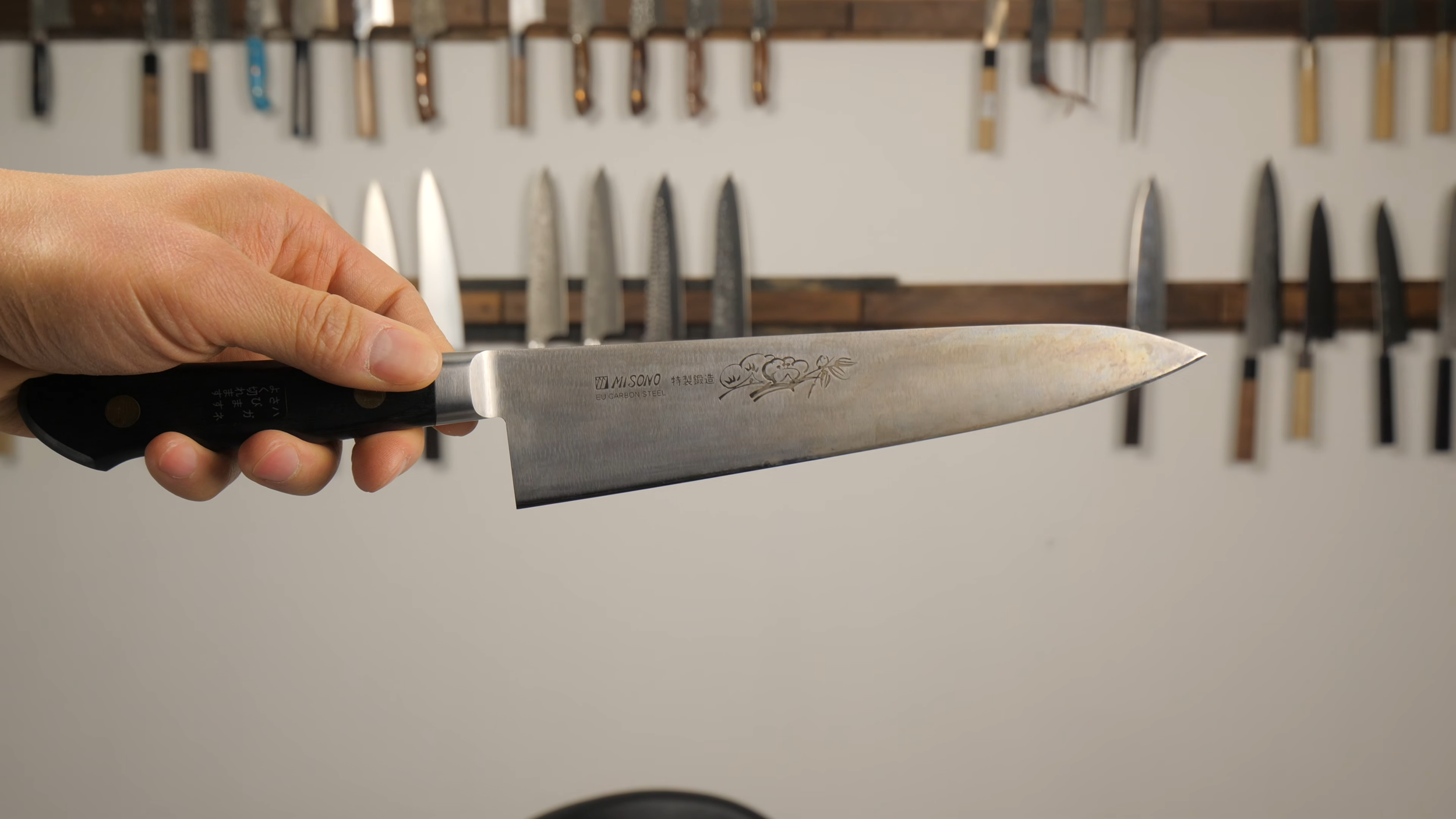
4. Misono Swedish Carbon Steel: Raw Cutting Power
For purists who value acute keenness over rust resistance, Misono offers the Swedish Carbon Steel series. Priced identically to the entry-level Molybdenum line, this series houses an entirely different animal under the hood.
+-------------------------------------------------------+
| Core Steel: Pure Swedish High-Carbon Tool Steel       |
| Hardness: ~60 HRC                                     |
| Bolster: Integrated Stainless Steel                   |
| Finish Rating: 6.5 / 10                               |
+-------------------------------------------------------+
Extreme Reactivity
This is not a mildly reactive semi-stainless blade; it is one of the most hyper-reactive carbon steels available in factory cutlery.
If you leave this knife wet on a cutting board, or walk away to answer a phone call after slicing a lemon, it will develop surface oxidation and flash rust in under thirty minutes. It demands strict kitchen discipline: wipe it down with a damp towel constantly, dry it immediately after use, and store it with a light coat of camellia (tsubaki) oil.
The Performance Payoff
If you are willing to manage the patina, this knife is a sharpening dream:
Deburring Ease: Unlike stainless steels with gummy chromium carbides, this carbon matrix deburrs effortlessly on a 1,000–3,000 grit waterstone, yielding a crisp, screaming-sharp apex in minutes.
Aggressive Bite: The edge grabs food surfaces instantly without requiring ultra-fine diamond progression.
Value: You receive the 60 HRC cutting performance of the flagship UX10 at roughly half the price, provided you can handle the maintenance.
Technical Comparison Matrix
Model LineCore SteelHardnessHandle ErgonomicsReactivityBest ForMolybdenumMo-V Stainless~57 HRCNeutral / StandardFully StainlessHigh-volume kitchen beaters & rough prep440 Series440 Modified58–59 HRCSuperior / Eased contoursFully StainlessEveryday line cooks wanting maximum balance & comfortUX10Swedish N685 Extra59–60 HRCGeometric / Angular choilFully StainlessEnthusiasts wanting maximum edge retention & modern stylingSwedish CarbonSwedish Tool Steel~60 HRCNeutral / StandardHyper-ReactiveCarbon purists who want elite apex feedback and easy sharpening


The Verdict: Which Misono Belongs on Your Bench?
Buying the most expensive knife on the shelf is rarely the smartest move in the kitchen.
If you want the ultimate conversation piece with top-tier edge retention and don't mind a slightly tighter pinch grip, the UX10 remains an icon of modern Japanese cutlery design. If you are a carbon steel devotee who loves watching an edge build a multi-colored patina while chasing mirror-keen apexes on whetstones, the Swedish Carbon delivers unrivaled performance per dollar.
However, for everyday culinary prep—where balance, hand fatigue, blade spring, and speed-cutting efficiency matter more than spec sheets—the Misono 440 Series is the true standout of the lineup. It delivers the best ergonomics, the most comfortable choil pocket, and a steel that is effortlessly restored on any standard 1,000-grit waterstone.