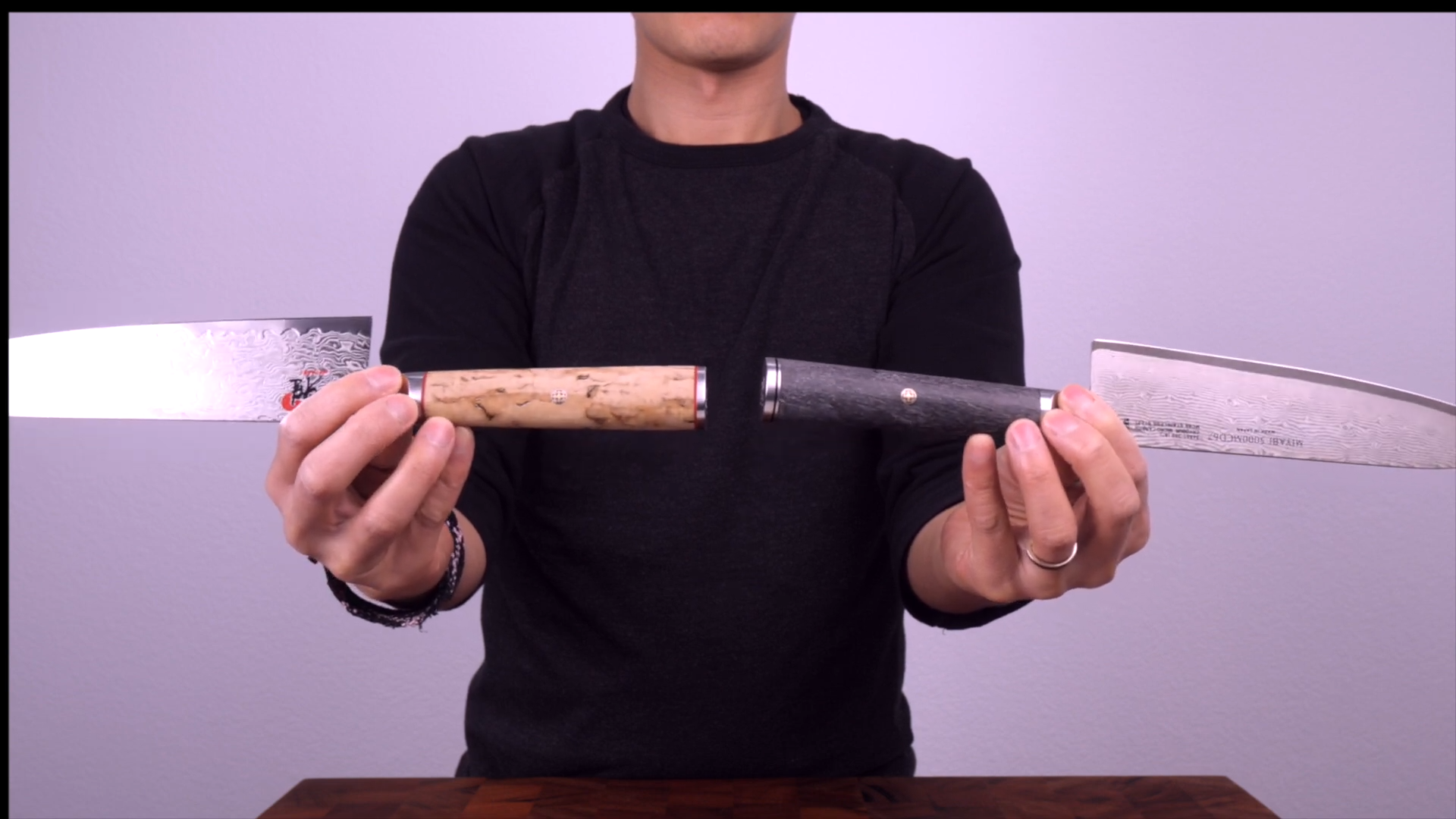
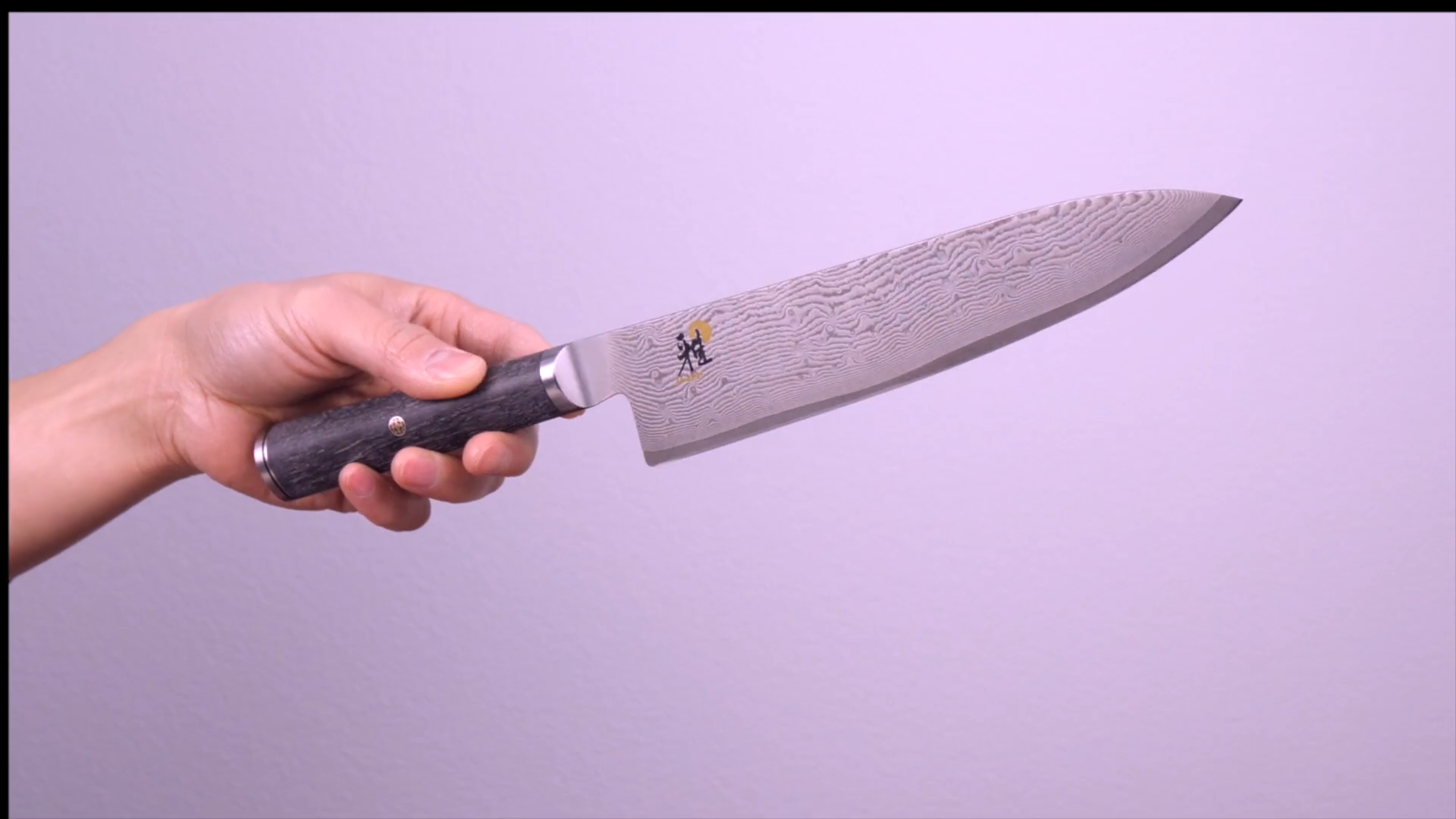
In the sphere of high-end factory cutlery, Zwilling’s Seki-based Miyabi manufacture represents the meeting point between traditional Japanese aesthetics and modern industrial metallurgy. For years, the Miyabi Birchwood (5000MCD) stood as the undisputed flagship of the line—a visual tour de force built around Takefu SG2 micro-carbide powder steel heat-treated to 63 HRC.
Then came the Miyabi Black (5000MCD 67).
Marketed under proprietary branding as "Cryodur MC66," the Black discreetly houses one of the most wear-resistant cutlery steels on earth: Hitachi ZDP-189, taken to an aggressive 66 HRC.
To determine whether the Black’s exotic super-steel justifies its substantial price premium over the Birchwood, both knives were subjected to back-to-back 30-day solitary kitchen rotations. Through continuous meal preparation, starchy root-vegetable profiling, and objective testing on a calibrated BESS (Brubacher Edge Sharpness Scale) digital sensor, the real-world performance differences emerge not just in apex durability, but in surface hydrodynamics and edge recovery.
trust retailers BurrfectionStore | Gyuto | WasabiKitchen | Amazon
Disclosure: As an Amazon Associate, I earn from qualifying purchases.
1. Metallurgical Profiles: SG2 vs. ZDP-189
Understanding the performance divergence between these two blades requires examining the elemental composition of their powdered cores.
+--------------------------------------------------------------------------+
| POWDER METALLURGY MATRIX COMPARISON                                      |
|                                                                          |
| Takefu SG2 / R2 (Birchwood Core)                                         |
| ├── Carbon: ~1.25–1.45%     ├── Hardness: 63 HRC                         |
| ├── Chromium: ~14.0–16.0%   ├── Molybdenum: ~2.8–3.2%                    |
| └── Vanadium: ~1.8–2.2%     └── Micro-carbide grain: Ultra-uniform       |
|                                                                          |
| Hitachi ZDP-189 / "MC66" (Black Core)                                    |
| ├── Carbon: 3.00%           ├── Hardness: 66 HRC                         |
| ├── Chromium: 20.0%         ├── Molybdenum: 1.30%                        |
| └── Tungsten: 1.50%         └── Carbide Volume: ~30% Total Matrix        |
+--------------------------------------------------------------------------+
Takefu SG2: The Balanced Apex
Operating at 63 HRC, SG2 utilizes a finely atomized powder structure that prevents large chromium carbide segregation. This gives the steel two exceptional attributes:
It can take an extremely keen, acute apex (sub-15 degrees per side) without immediate micro-chipping.
It behaves predictably on standard synthetic waterstones, deburring cleanly and taking an aggressive polish.
Hitachi ZDP-189: The Wear-Resistant Super-Steel
At 66 HRC with 3.00% carbon and 20.0% chromium, ZDP-189 is on the boundary between steel and cast carbide alloy.
The sheer density of hard chromium carbides provides wear resistance far beyond conventional kitchen steels.
However, that extreme carbide volume makes the steel less ductile and significantly more stubborn to abrade on conventional aluminum oxide whetstones once the apex finally collapses.

2. Ergonomics, Balance, and Cladding Architecture
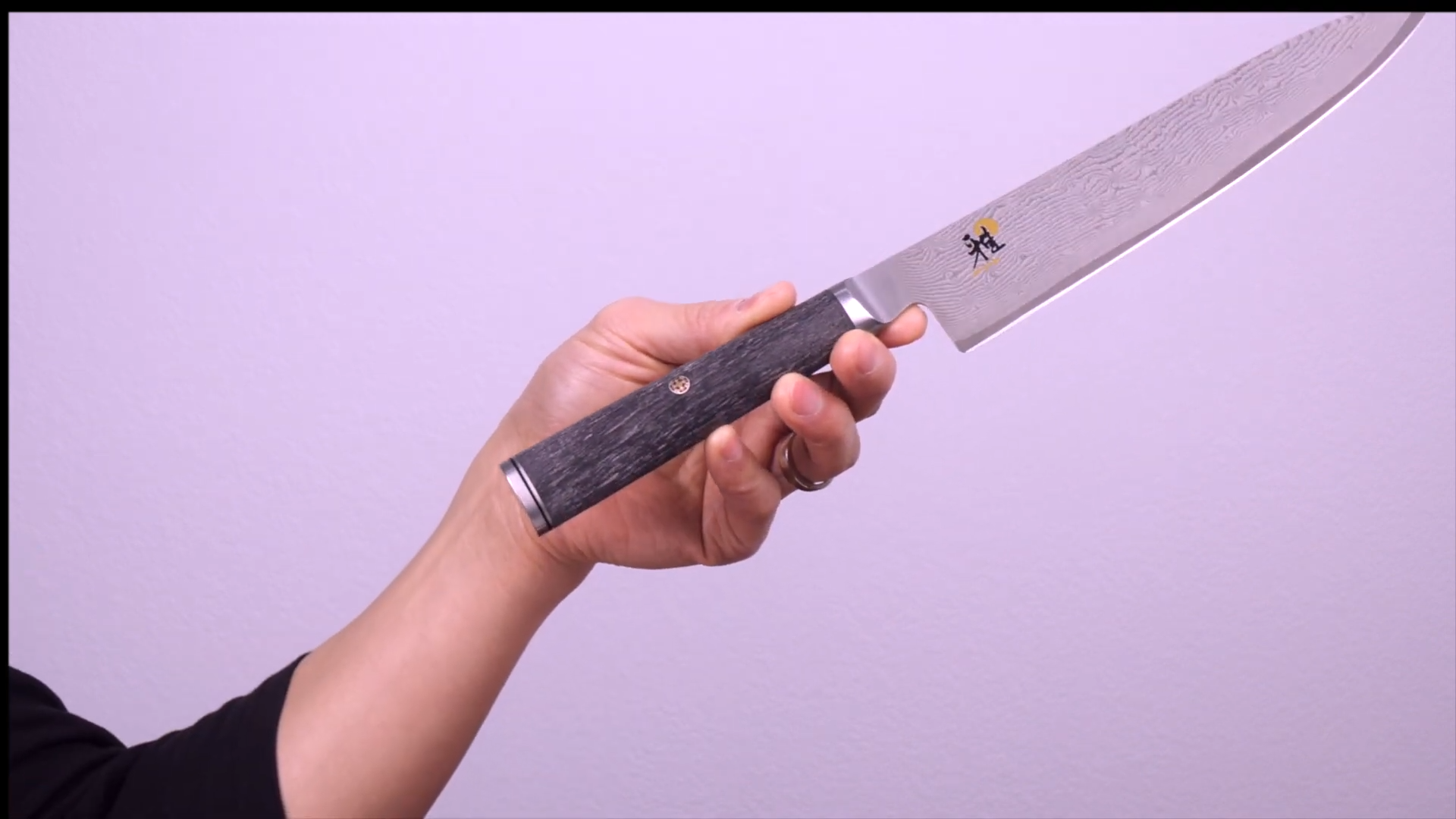
While sharing identical primary silhouettes—including a 44 mm heel-to-spine blade height and an asymmetric Japanese D-shaped handle with a steel end-cap—the two knives diverge noticeably in hand feel and surface finish.


The Handle Geometry: Karelian Birch vs. Black Ash
Birchwood (Karelian Birch): Karelian burls provide naturalChatoyance with variable, three-dimensional figuring. In cross-section, the Birchwood handle is roughly 0.5 mm wider through the palm swell with a slightly softer, more radiused apex on the "D" ridge. It delivers a full, fatigue-free grip for mid-to-large hands.
Black (Black Stained Ash): The scorched ash provides a modern, dark aesthetic with tight structural grain. The wood is physically denser than birch, shifting the overall knife balance slightly further back toward the butt-cap despite the handle having a subtly slimmer cross-sectional profile.
Cladding Physics and Food Sticking
The Damascus outer layers reveal an unexpected operational trade-off:
The Birchwood’s 101-Layer Finish: Utilizing 50 alternating stainless layers per side around the SG2 core, the Birchwood features a soft, undulating Damascus pattern polished to a bright, semi-mirror sheen. It releases low-moisture ingredients with minimal lateral resistance.
The Black’s 133-Layer Finish: With 66 micro-layers per side surrounding the ZDP core, the Damascus runs along a tighter, more linear horizontal plane. To highlight the pattern, Miyabi subjects the blade to a deep acid etch, creating high relief between the alloy layers.
The Starch Drag Factor: On dense, starchy produce—such as large Russet potatoes, sweet yams, dense butternut squash, and melon rounds—the deep etching on the Black creates vacuum friction against the food walls. Much like the Bob Kramer SG2 Damascus, the blade "binds" slightly midway through tall vertical cuts. While this surface friction diminishes as microscopic prep oils and regular washing smooth out the valley floors, the Birchwood is noticeably slicker out of the box.
3. The 30-Day Cutting Test: BESS Sensor Analysis
To remove subjective bias, sharpness was quantified using a calibrated PT-50A BESS (Brubacher Edge Sharpness Scale) sensor. The unit measures the exact downward force (in grams) required to sever a standardized synthetic test filament: lower values indicate a thinner, more acute apex.
BESS Sharpness Degradation & Recovery Timeline
Scores in Grams of Force (Lower = Sharper)

Out of the Box:
Birchwood (SG2)   [121g] ■■■
Black (ZDP-189)   [140g] ■■■■

After 30 Days Prep:
Birchwood (SG2)   [246g] ■■■■■■
Black (ZDP-189)   [297g] ■■■■■■■

Post-Strop Recovery (1 Min @ 9,000 Grit):
Birchwood (SG2)   [187g] ■■■■■ (+55% vs original box sharpness)
Black (ZDP-189)   [151g] ■■■■  (+7% vs original box sharpness)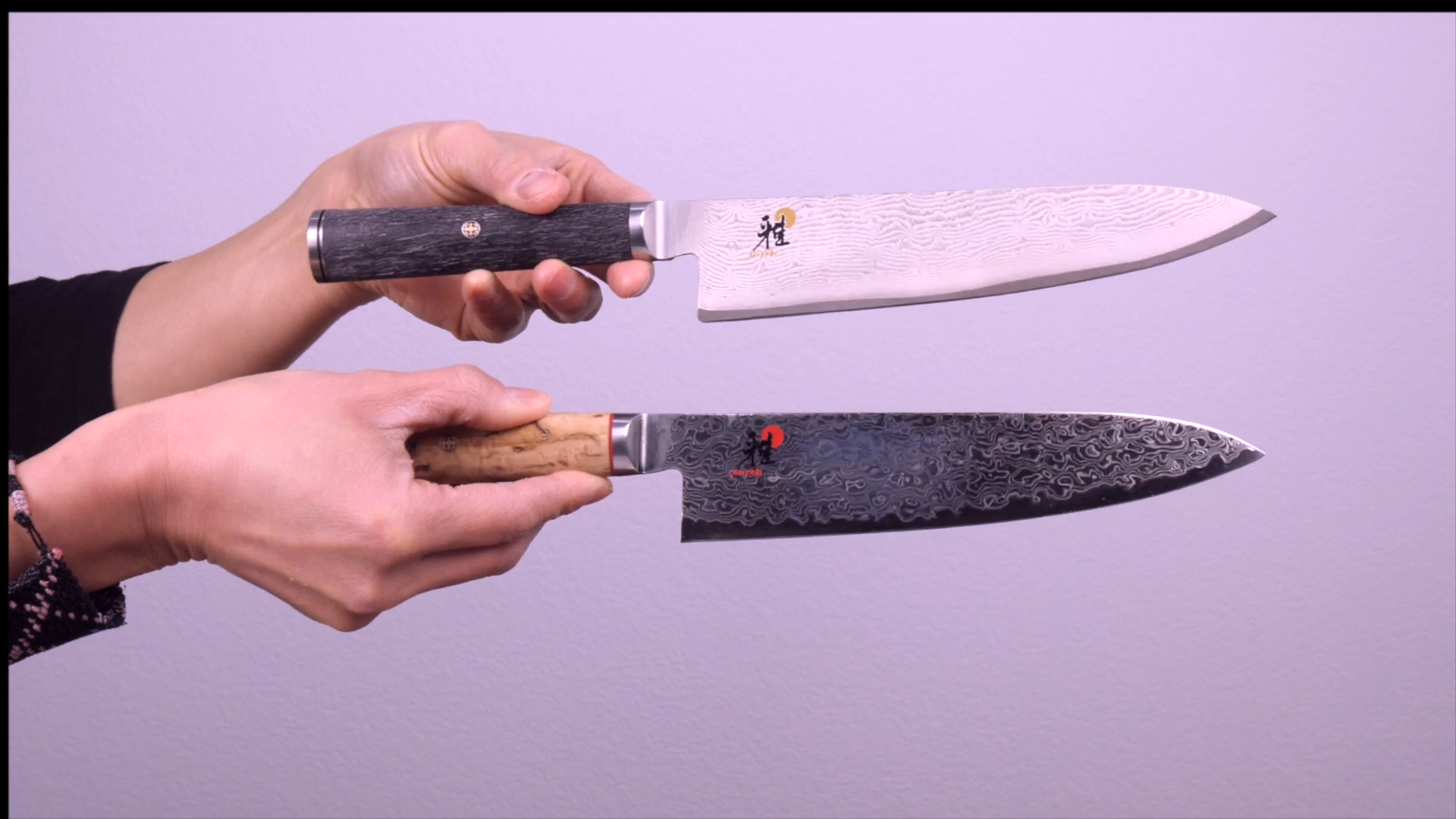
Miyabi Birchwood vs Miyabi Black cutting profile
Phase 1: Factory Edge Calibration
Birchwood: Registered an astonishing 121g, placing it among the sharpest production knives ever tested on our bench.
Black: Registered 140g. Still well within the top tier of factory edges, easily shaving arm hair flush to the skin.
Phase 2: 30 Days of Unmaintained Prep
Both knives were used exclusively for standard kitchen prep—dense root vegetables, alliums, poultry, and proteins—without honing steels, strops, or stones.
Birchwood: Degraded to 246g.
Black: Degraded to 297g.
Subjectively, the Birchwood felt noticeably sharper on the board after four weeks than the Black. This counter-intuitive result stemmed directly from blade-road hydrodynamics: the Birchwood’s polished cladding glided through produce, whereas the Black’s etched Damascus drag compounded the sensation of edge dulling.
Phase 3: The Stropping Response Test
Both blades were given identical maintenance: 60 seconds of light, edge-trailing passes on an old buffalo leather paddle strop loaded with 9,000-grit (1.5 micron) Herold compound.
The resulting BESS measurements revealed the true nature of each steel:
Birchwood (SG2): Dropped from 246g to 187g (a 59-gram improvement). The edge recovered substantial bite, but sat 55% higher in cutting resistance than its factory 121g baseline.
Black (ZDP-189): Dropped from 297g down to 151g (a 146-gram improvement). The ZDP apex bounced back to within 7% of its out-of-the-box sharpness.

Miyabi Birchwood vs Miyabi Black handle profile
The Mechanical Takeaway
At 63 HRC, the SG2 edge experiences fine micro-deformation (slight lateral rolling and microscopic abrasive wear). A loaded strop realigns the apex, but cannot fully restore the sub-micron geometry without a dedicated whetstone progression.
At 66 HRC, ZDP-189's ultra-dense carbide matrix resists deformation entirely. The apex does not roll; it wears down evenly. When burnished on sub-micron compound, the massive carbide volume re-aligns into a screaming, surgical edge almost immediately.
In short: SG2 delivers higher peak absolute sharpness with less initial cutting drag, but ZDP-189 provides extraordinary edge recovery via fast, non-abrasive stropping.
4. Sharpening Nuances: Whetstone Mechanics
When the time comes to step away from the strop and hit the bench stones, sharpening these two cores requires distinct abrasive setups.
+--------------------------------------------------------------------------+
| BENCH SHARPENING GUIDELINES                                              |
|                                                                          |
| Takefu SG2 (Birchwood)                                                   |
| ├── Abrasives: Standard synthetic waterstones (Al₂O₃)                   |
| ├── Stones: Shapton Pro/Glass, Naniwa Chosera/Pro                        |
| ├── Progression: 1,000 grit -> 3,000 grit -> 6,000 grit -> Clean Leather |
| └── Deburring: Clean, predictable burr release under light pressure      |
|                                                                          |
| Hitachi ZDP-189 (Black)                                                  |
| ├── Abrasives: High-density vitrified, Diamond, or Silicon Carbide (SiC) |
| ├── Stones: Shapton Glass, Naniwa Diamond, Venev Resin-Bonded            |
| ├── Progression: 800 grit -> 2,000 grit -> Sub-micron diamond strop      |
| └── Deburring: High fatigue threshold; requires edge-leading microbevel  |
+--------------------------------------------------------------------------+
Sharpening SG2: Standard aluminum oxide stones cut SG2 cleanly. A Naniwa Pro 1,000 followed by a 4,000-grit splash-and-go will yield an exquisite, toothy polish in under 15 minutes.
Sharpening ZDP-189: The 20% chromium content creates hard chromium carbides that glide across traditional Japanese waterstones. To sharpen the Black effectively without rounding the bevel, use hard, fast-cutting stones like Shapton Glass or diamond-impregnated plates. Maintain a strict, steady angle; low ductility means aggressive micro-burrs can be stubborn to strip away if your deburring passes are careless.
Technical Specification Breakdown
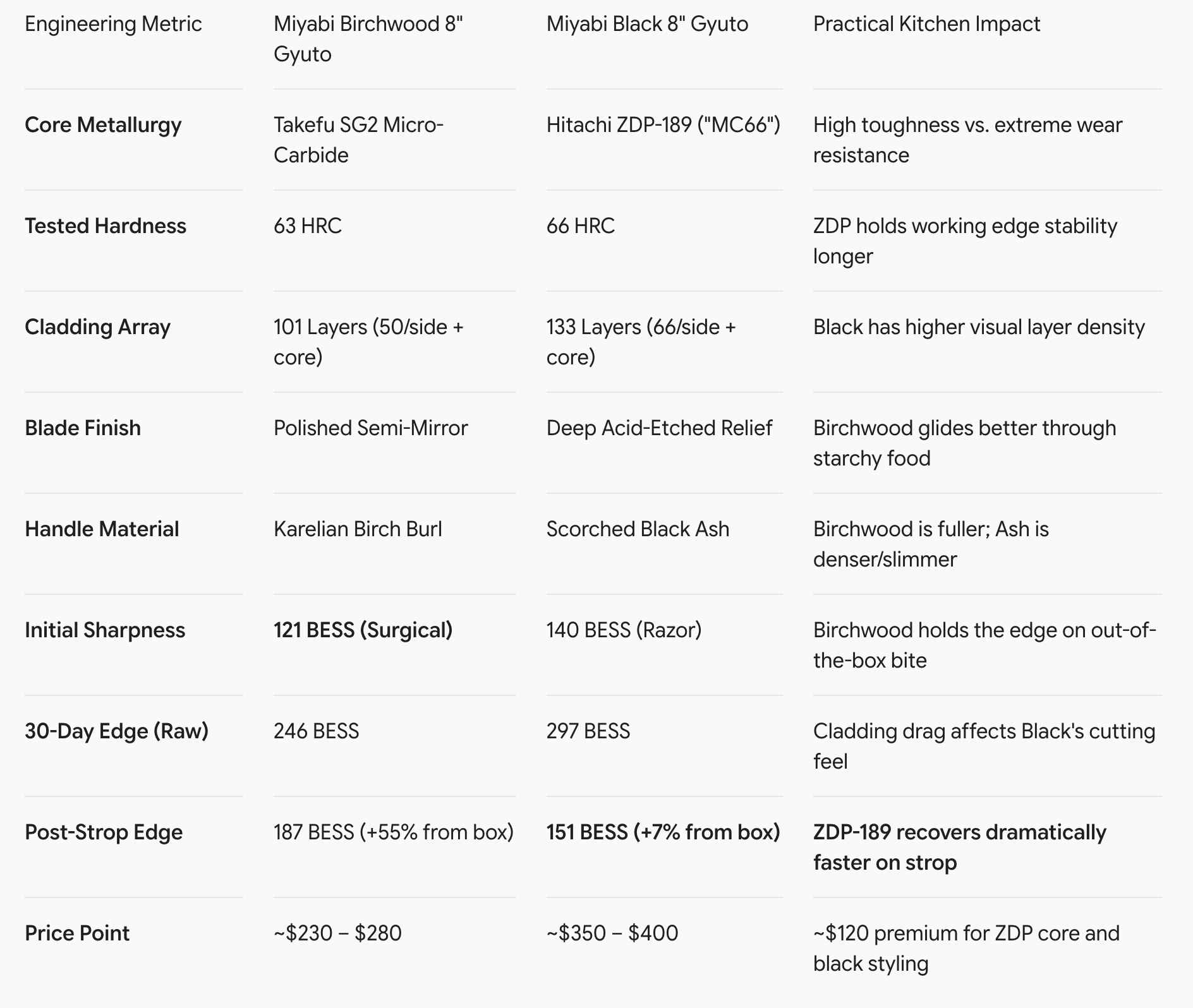
Miyabi Birchwood vs Miyabi Black spec comparison
Choosing Your Steel: The Editorial Verdict
Both knives showcase Japanese factory manufacturing at its apex, but they are built for two different types of kitchen practitioners.
If you are looking for an uncompromising showpiece with a rare, hyper-hard core steel that you can maintain for months using nothing more than a loaded paddle strop, the Miyabi Black is an exceptional tool. It demands diamond or hard ceramic abrasives when it finally hits the stones, and you must tolerate initial surface friction on starchy produce, but 66 HRC ZDP-189 remains an exotic metallurgical achievement.
However, as a pure culinary cutting instrument, the Miyabi Birchwood remains our top recommendation.
At approximately $120 less than the Black, it offers superior through-cut geometry, a fuller and more ergonomic palm feel, and an SG2 core that sharpens effortlessly on standard waterstones. The Birchwood remains the benchmark for modern production Damascus cutlery: balanced, exquisitely finished, and built to perform on the board.