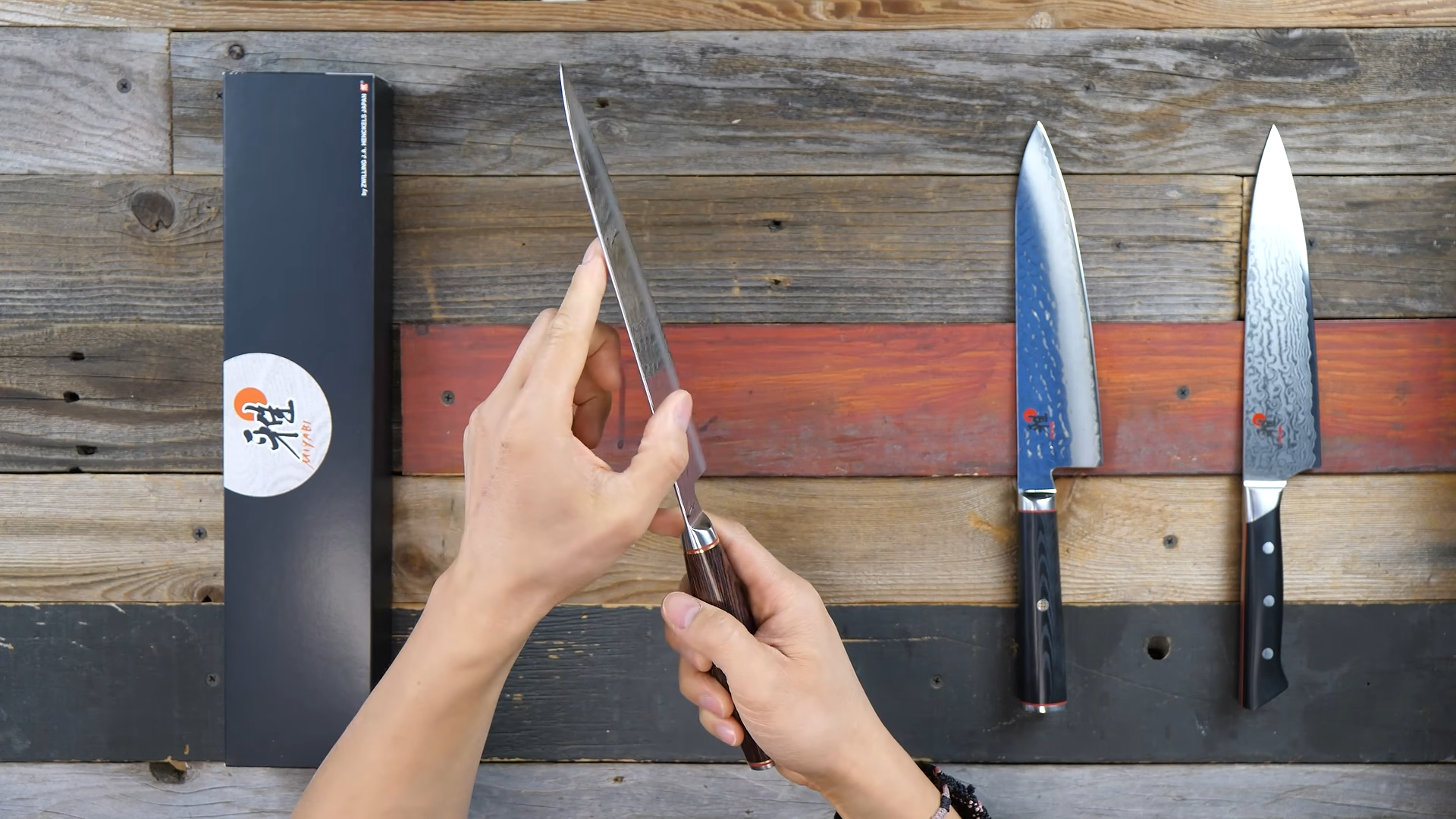
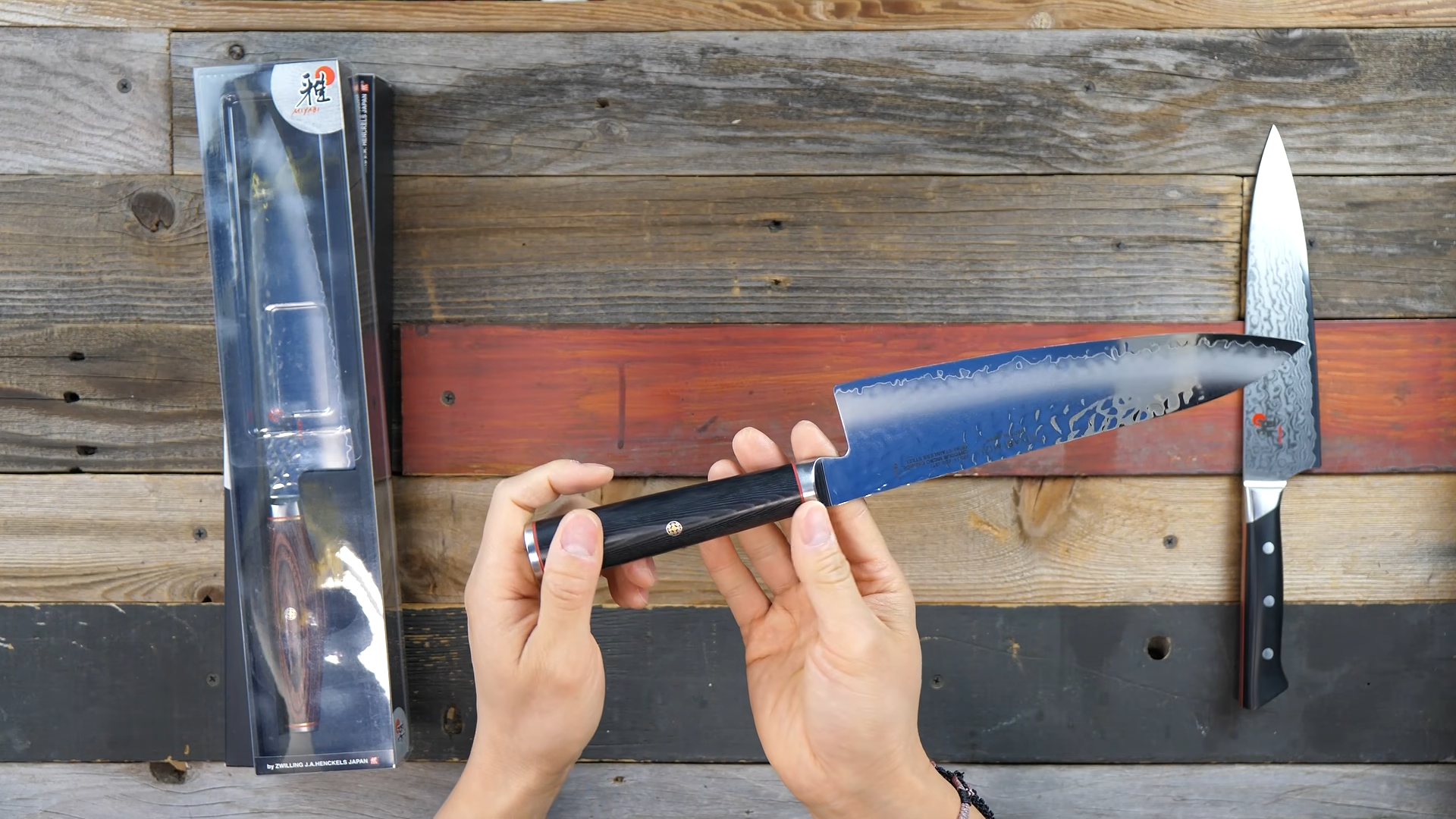
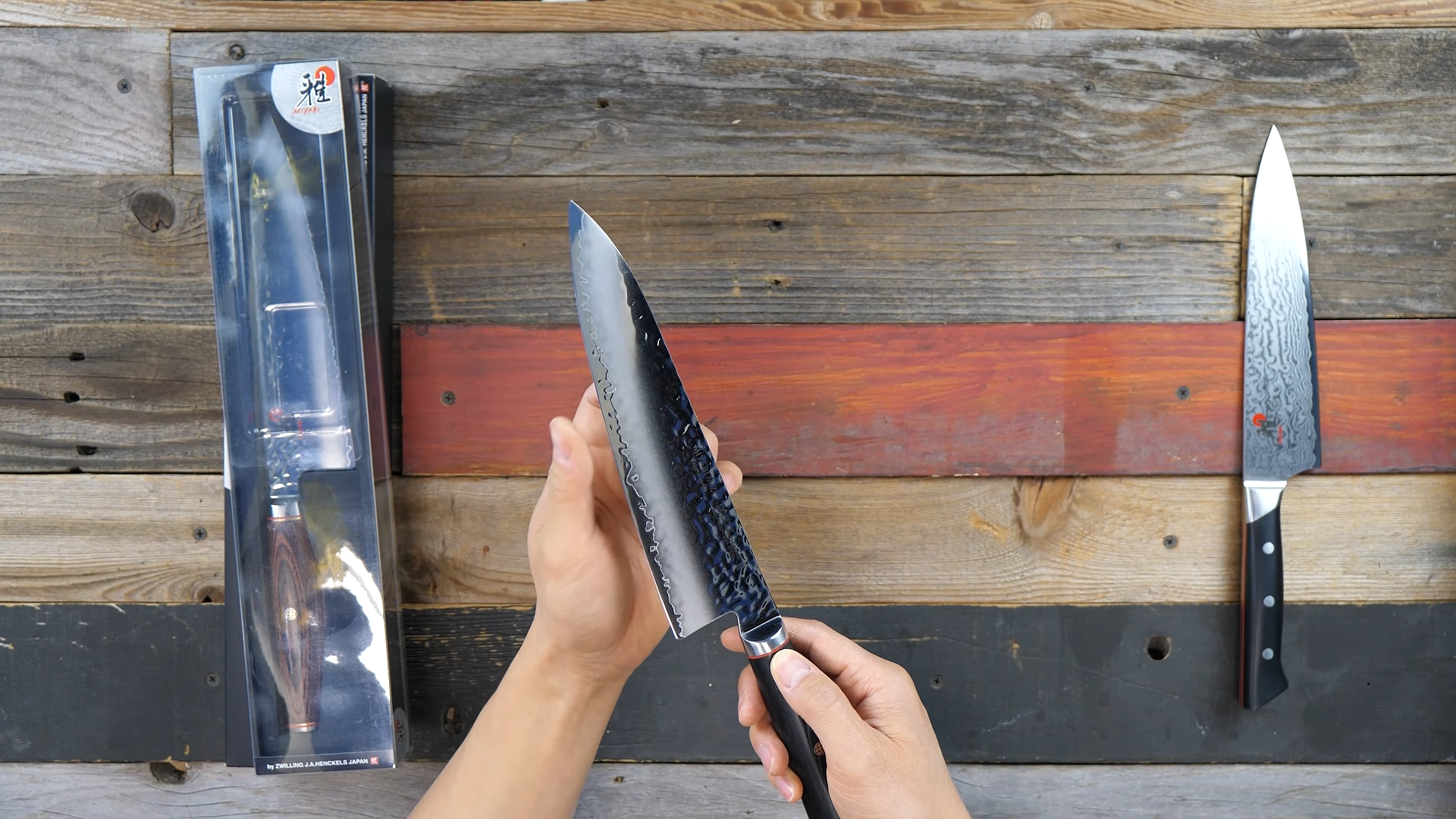
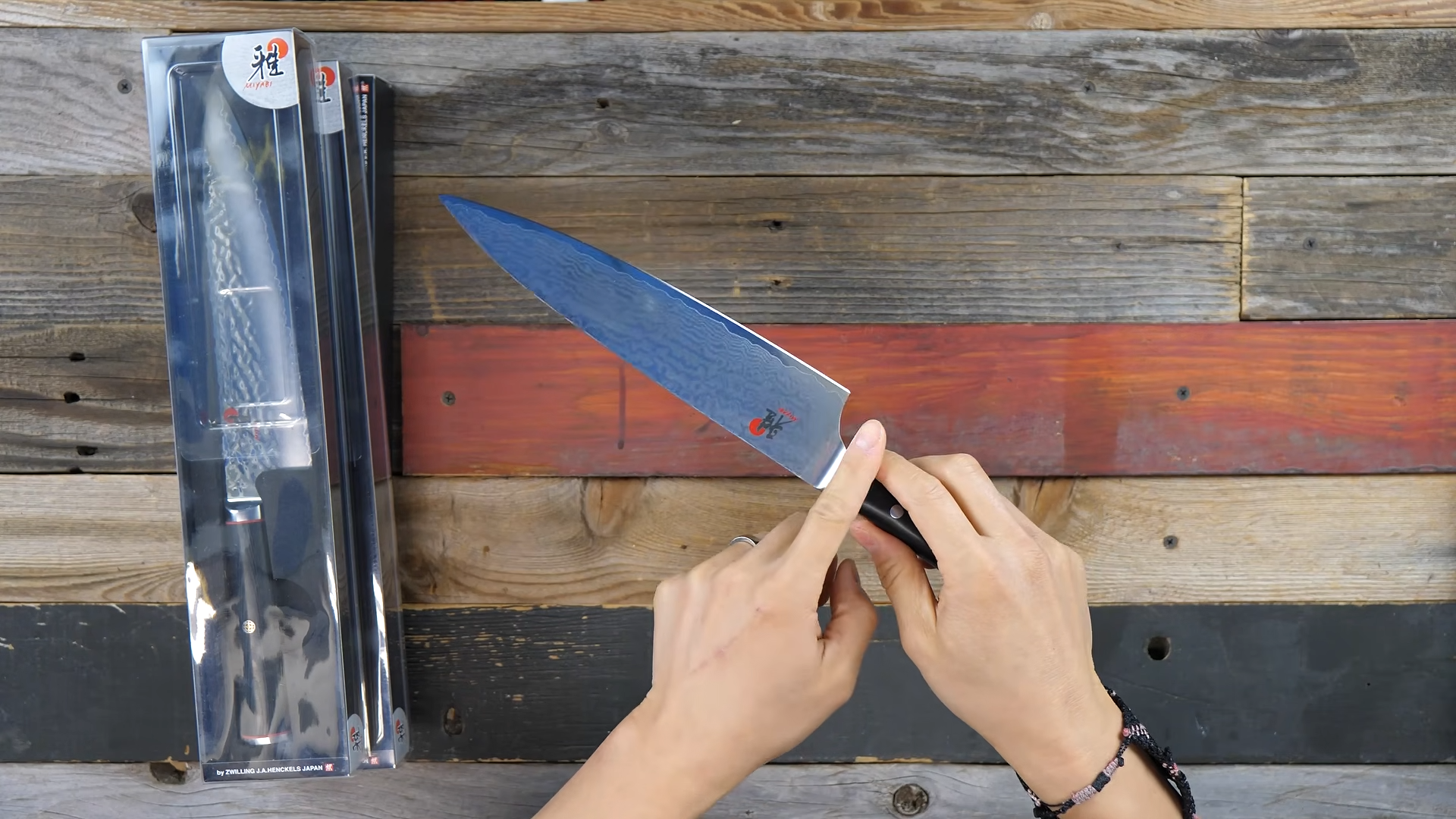
A comprehensive metallurgical and ergonomic analysis of Miyabi’s core cutlery series: the VG-10 Fusion Morimoto, Mizu 5000MCT, Artisan 6000MCT, and Birchwood 5000MCD. We break down Cryodur heat treatments, Honbazuke edge geometry, handle ergonomics, and how these production blades perform on the waterstone bench.
The modern cutlery landscape is defined by the intersection of German industrial consistency and Japanese artisanal geometry. Nowhere is this marriage more apparent than in Seki City, Japan, within the specialized workshops of Miyabi—a division of Zwilling J.A. Henckels.
Rather than producing pure European blades or strictly traditional, high-maintenance carbon wa-knives, Miyabi occupies a distinct middle ground: production culinary tools featuring traditional Japanese core steels, hand-finished spines and choils, and modified handle biomechanics built for high-volume kitchen prep.
Evaluating the Miyabi catalog across four defining milestones—the Fusion Morimoto (600D), the Mizu (5000MCT), the Artisan (6000MCT), and the flagship Birchwood (5000MCD)—reveals how core metallurgy, handle construction, and cross-sectional geometry evolve from entry-level utility to high-end cutlery art.
trusted retailers BurrfectionStore | Gyuto | WasabiKitchen | Amazon
Disclosure: As an Amazon Associate, I earn from qualifying purchases.
[ THE MIYABI LINEAGE: METALLURGY & TARGET PROFILE ]

Miyabi Fusion (600D)      ──► Takefu VG-10 (60 HRC)    │ Western POM Full-Tang Hybrid
Miyabi Mizu (5000MCT)     ──► MicroCarbide SG2 (63 HRC)│ Tsuchime / Linen Micarta Wa-D
Miyabi Artisan (6000MCT)  ──► MicroCarbide SG2 (63 HRC)│ Tsuchime / Cocobolo Pakkawood
Miyabi Birchwood (5000MCD)──► MicroCarbide SG2 (63 HRC)│ 101-Layer Damascus / Masur Birch
1. The Manufacturing DNA: Cryodur and the Honbazuke Bevel
Before evaluating individual models, every Miyabi knife shares a fundamental mechanical framework engineered at the Seki factory.
Cryodur Deep-Freezing: For their powder metallurgy lines, Miyabi utilizes a proprietary multi-stage thermal cycle known as Cryodur. After standard vacuum quenching, the blades undergo cryogenic stabilization at -321°F (-196°C) in liquid nitrogen. This forces retained austenite to convert fully into crystalline martensite, optimizing hardness (63 HRC) and structural wear resistance while reducing micro-brittleness.
The Honbazuke Honing Method: Rather than running blades through rapid automated dry belts, each knife is finished through a three-stage sharpening process:
Primary coarse vertical rotating waterstone grinding.
Fine horizontal rotating waterstone refinement.
Mirror-polishing on a leather stropping wheel.
Acute Factory Bevels: The result of the Honbazuke process is a factory edge set between 9° and 12° per side. By comparison, standard European knives are ground to 18°–20° per side. While this acute profile provides frictionless cutting separation, it demands cutting-board discipline—chopping through bone or twisting against hard seeds will micro-chip an apex this acute.
Spine and Choil Radiusing: High-volume line cooks frequently suffer calluses along the index finger from unpolished 90-degree spine edges. Miyabi crowns and polishes the spine and softens the choil neck across every tier, allowing for an aggressive, forward pinch grip without pressure points.
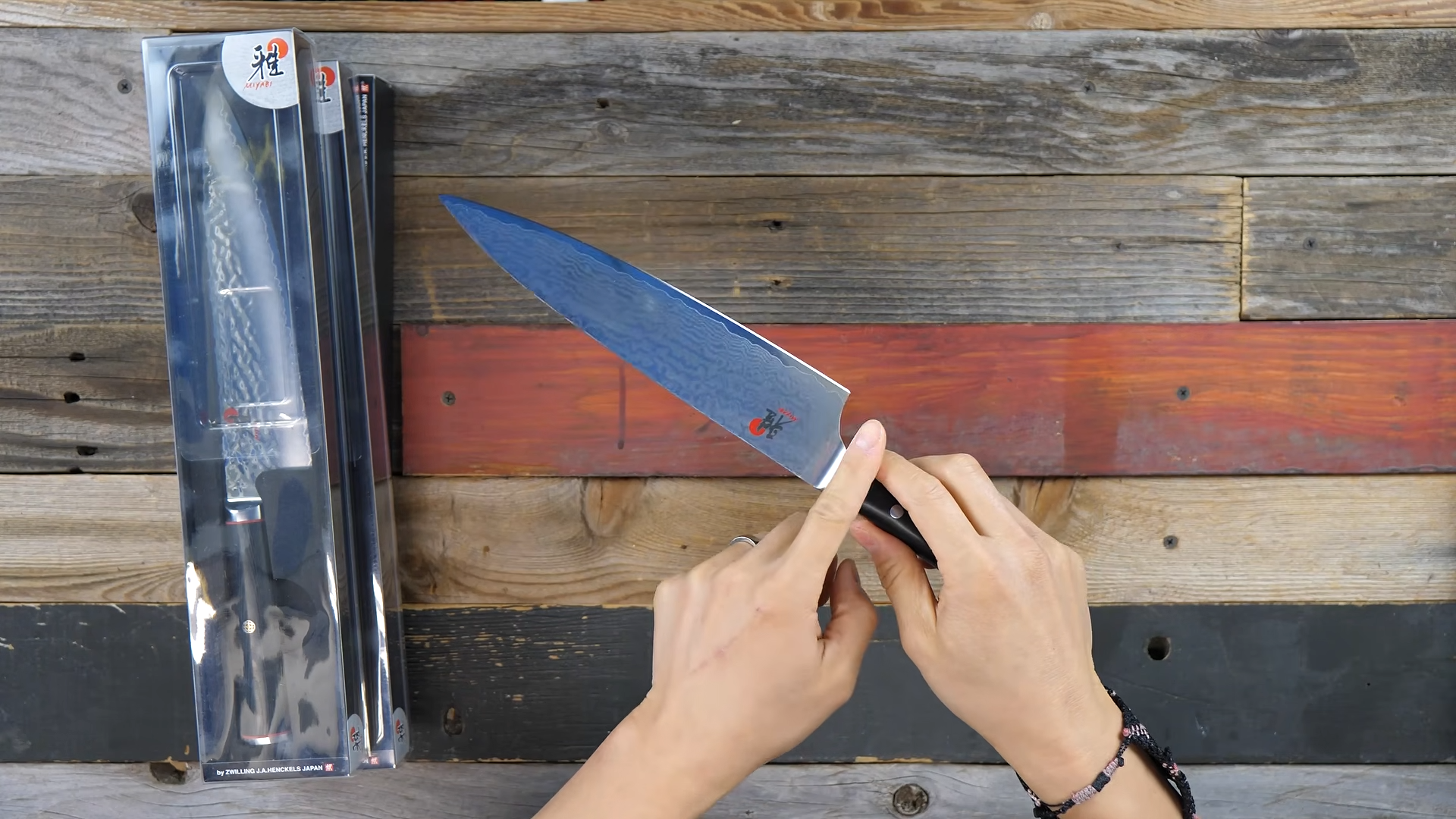
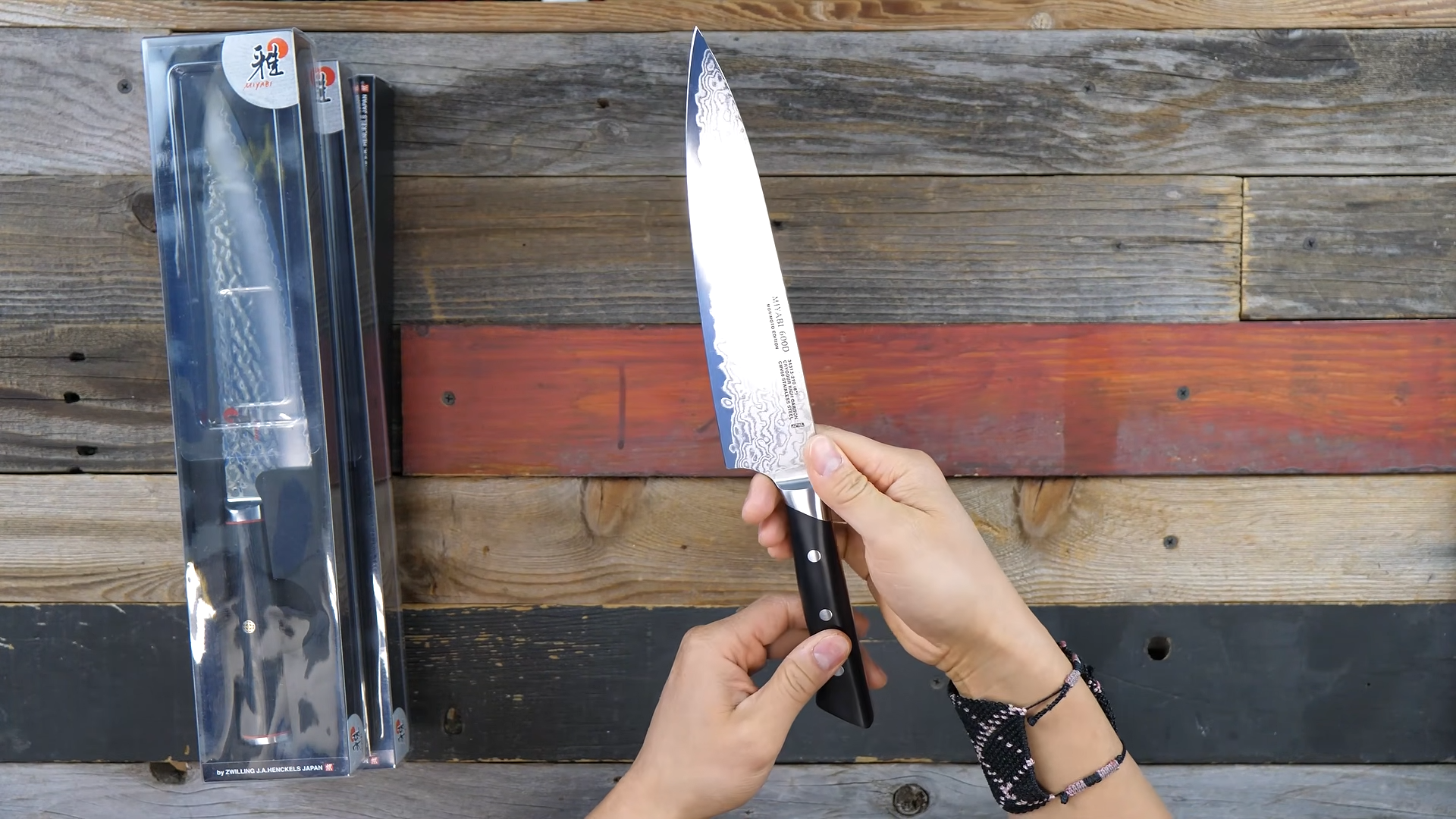
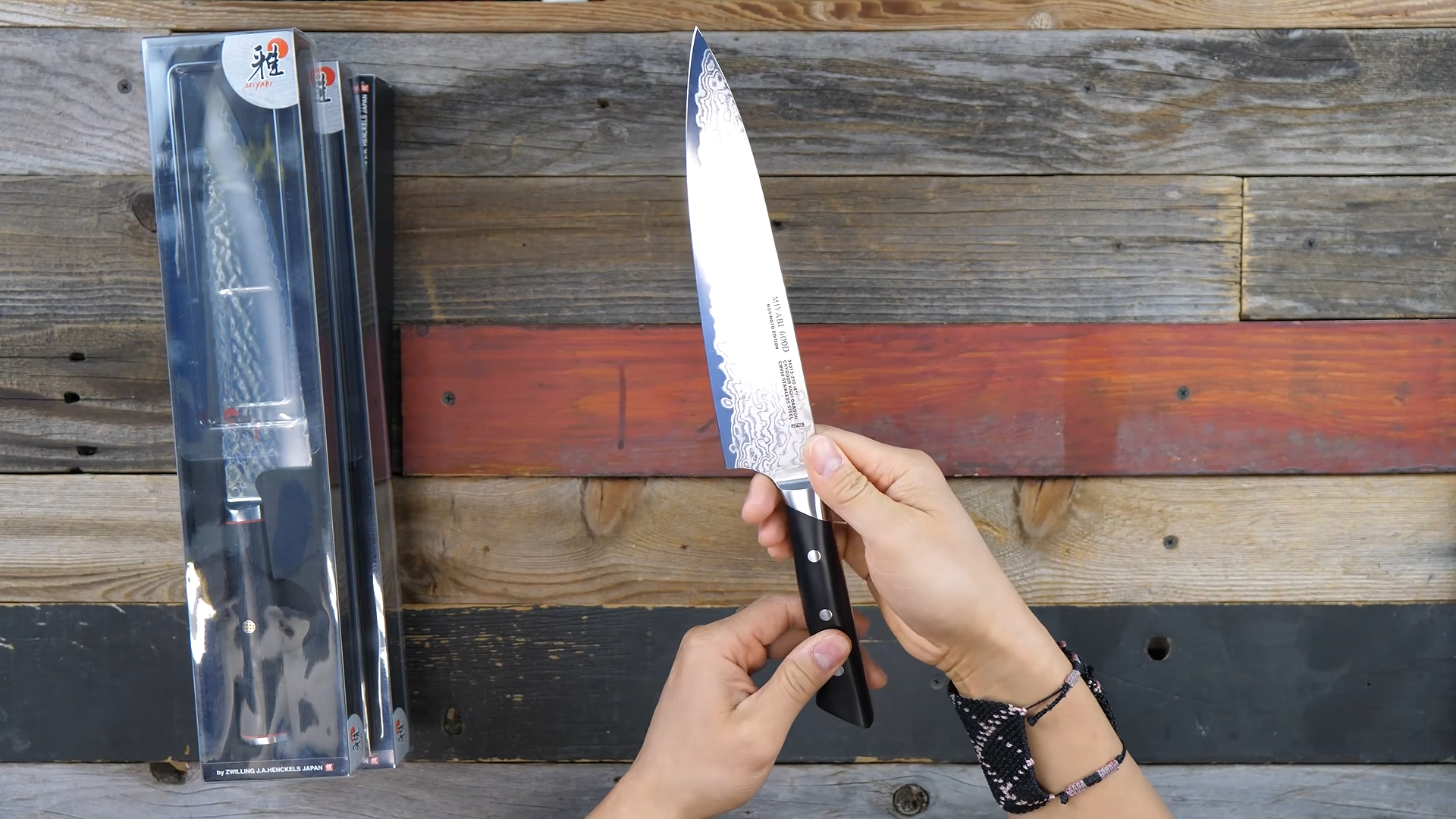
2. Miyabi Fusion Morimoto Edition (600D): The Resilient Western Hybrid
Designed in collaboration with Iron Chef Masaharu Morimoto, the Fusion 600D represents the most Western-biased knife in the catalog, bridging European durability with Japanese edge angles.
[ MIYABI FUSION CROSS-SECTION & BALANCE ]

Spine: ~2.0mm ──► Subtle Distal Taper ──► Clean Slicing Profile
Tang:  Full Exposed Tang with Triple-Rivet Architecture
Steel: Takefu VG-10 Core (60 HRC) Jacketed in 64-Layer Floral Damascus
Handle: Polyoxymethylene (POM) with Red Accent Spacers
Metallurgy & Blade Profile
The Fusion utilizes a Takefu VG-10 core hardened to 60 HRC, wrapped in a 64-layer floral Damascus pattern. At 60 HRC, the edge holds keenness substantially longer than standard German DIN 1.4116 steel (56–58 HRC) while maintaining enough structural ductility to prevent chipping during fast, high-volume prep.
The cutting profile is notably flat from the heel through the mid-blade, functioning as an agile slicer and push-cutter rather than an aggressive rocker.
Ergonomics & Balance
The handle is constructed from polyoxymethylene (POM)—a high-density, dimensionally stable polymer that is completely impervious to water expansion, animal fats, and commercial sanitizers.
Unlike traditional Japanese wa-handles, the Fusion uses an exposed full-tang construction secured by three flush rivets.
The rear of the handle terminates in a pronounced butt flare (stop), preventing hand slippage when wet.
Because of the dense POM scales and full steel tang, the balance point is biased slightly rearward toward the handle, creating a nimble feel in the hand that reduces wrist fatigue during repetitive dicing.
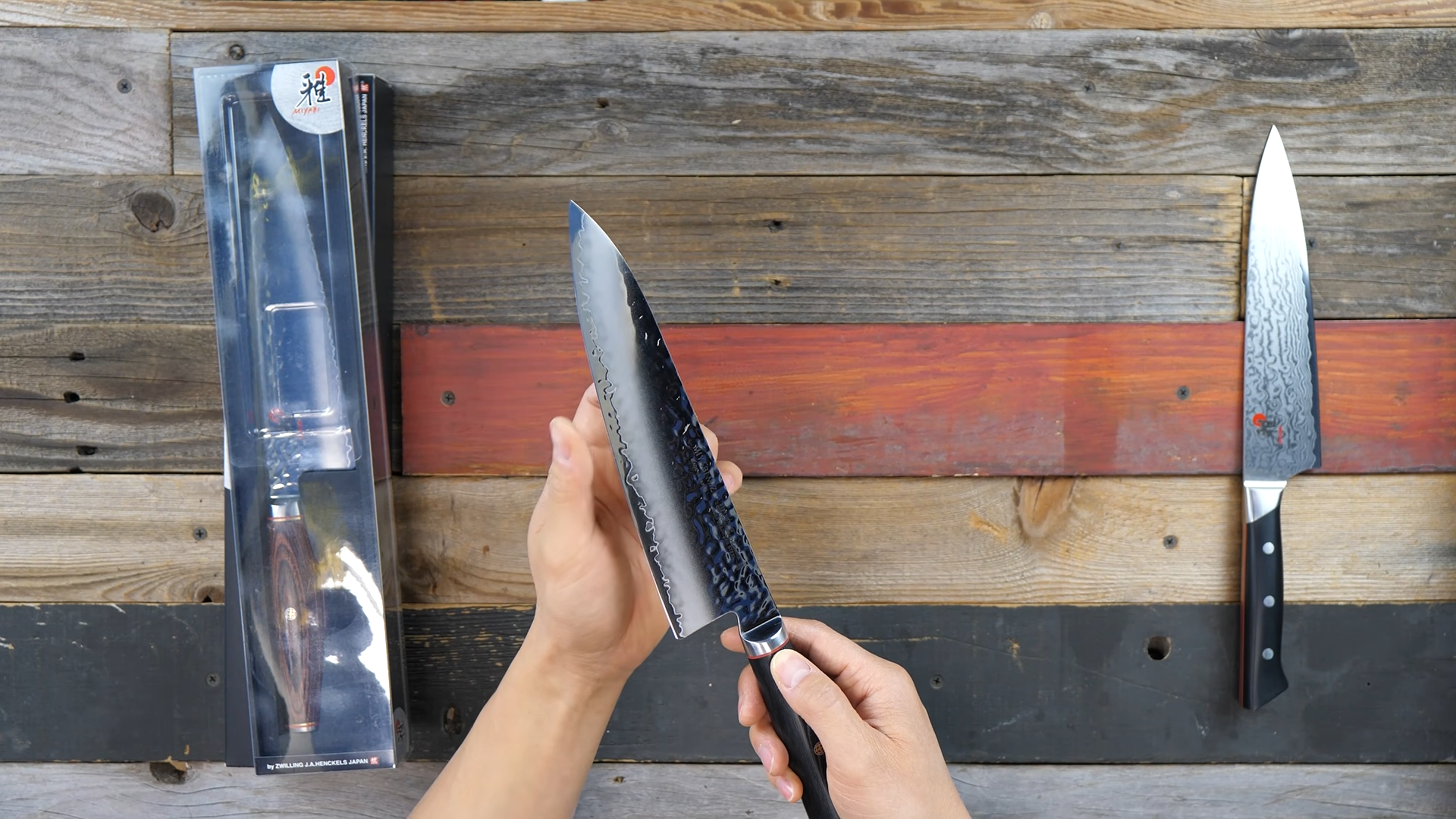
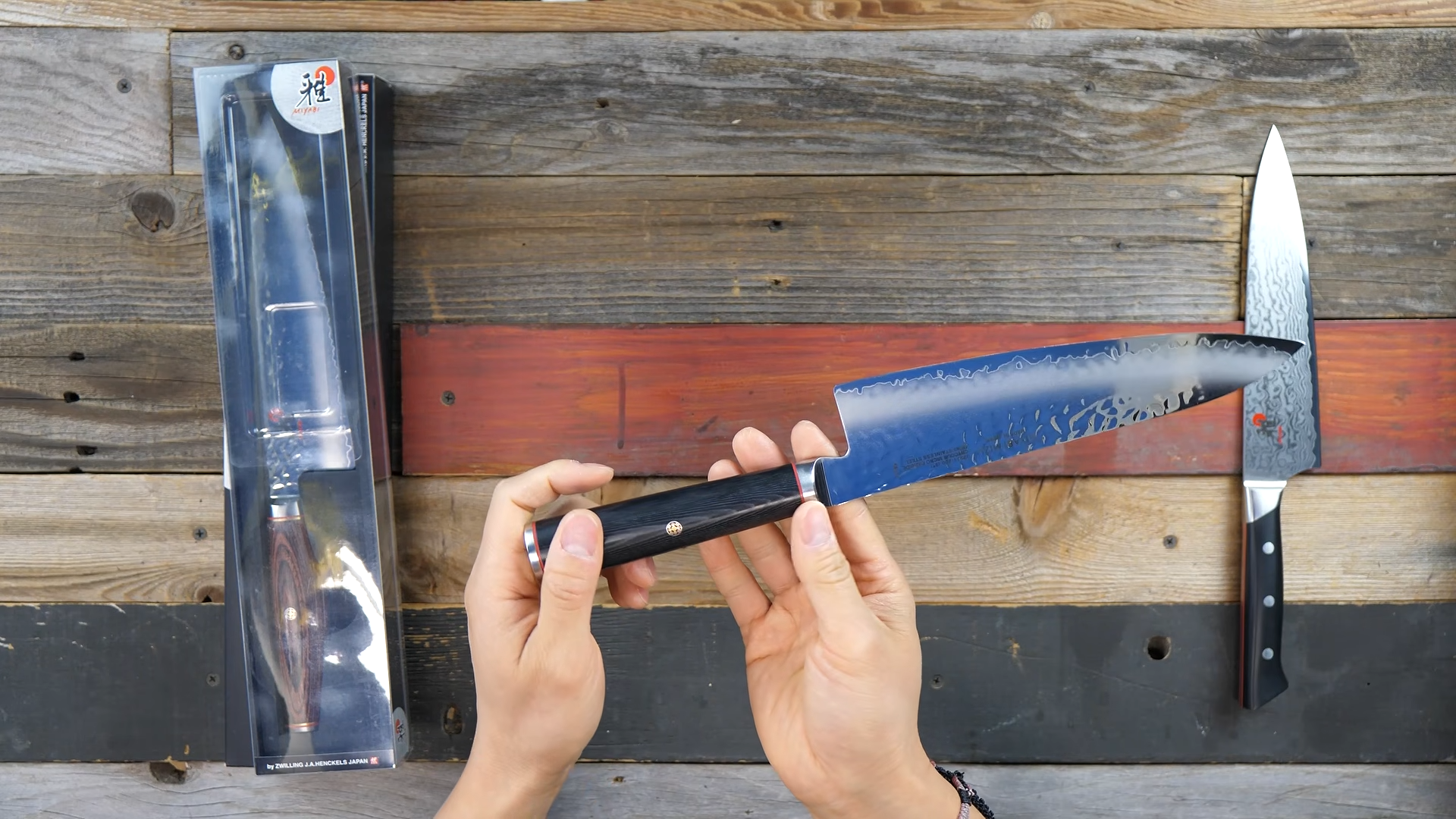
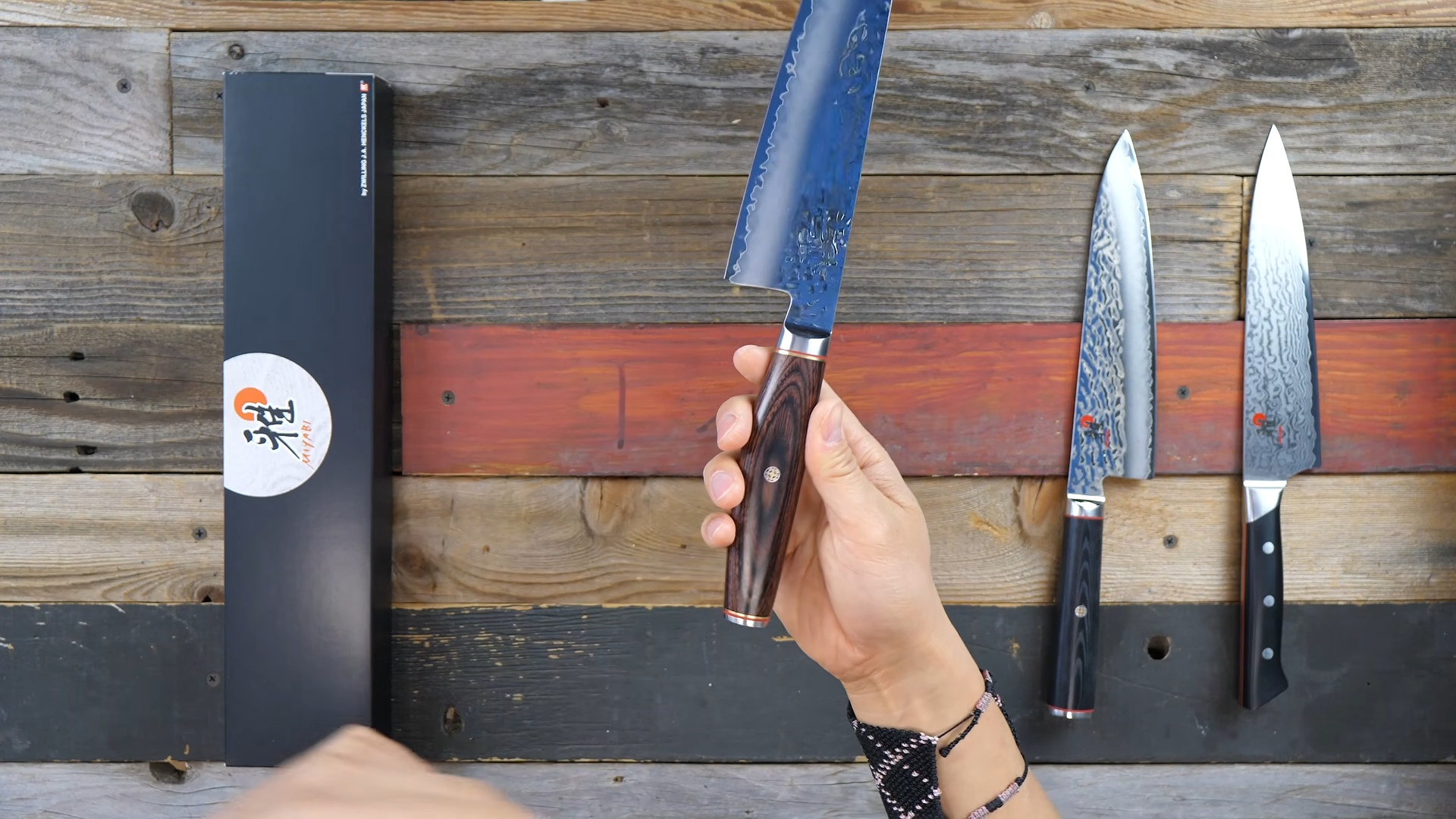
3. Miyabi Mizu (5000MCT): Industrial SG2 Meets Linen Micarta
The Mizu represents the transition into powder metallurgy super-steels, combining a rustic Japanese aesthetic with industrial-grade handle synthetics.
BLADE TOPOGRAPHY: TSUCHIME TO KASUMI

Spine ──► [ Hand-Hammered Tsuchime Finish ] ──► Air pocket release
           ─────────────────────────────────
Mid   ──► [ Frosted Matte / Kasumi Haze   ] ──► Low-drag separation
           ─────────────────────────────────
Apex  ──► [ Mirror-Polished Honbazuke     ] ──► 9°–12° Razor Keenness
Metallurgy & Topography
The Mizu is built around an atomized MicroCarbide SG2 (R2) powder steel core hardened to 63 HRC.
The blade face features a tripartite surface finish:
Upper Blade: A deep Tsuchime (hammered) pattern that introduces microscopic air pockets, preventing vacuum adhesion against high-moisture vegetables like cucumbers and potatoes.
Transition Line: A sand-blasted, frosted kasumi haze that dampens reflections and highlights the core steel exposure line.
Primary Bevel: A mirror-polished Honbazuke cutting apex that rings with a distinct high-frequency acoustic ping when flicked.
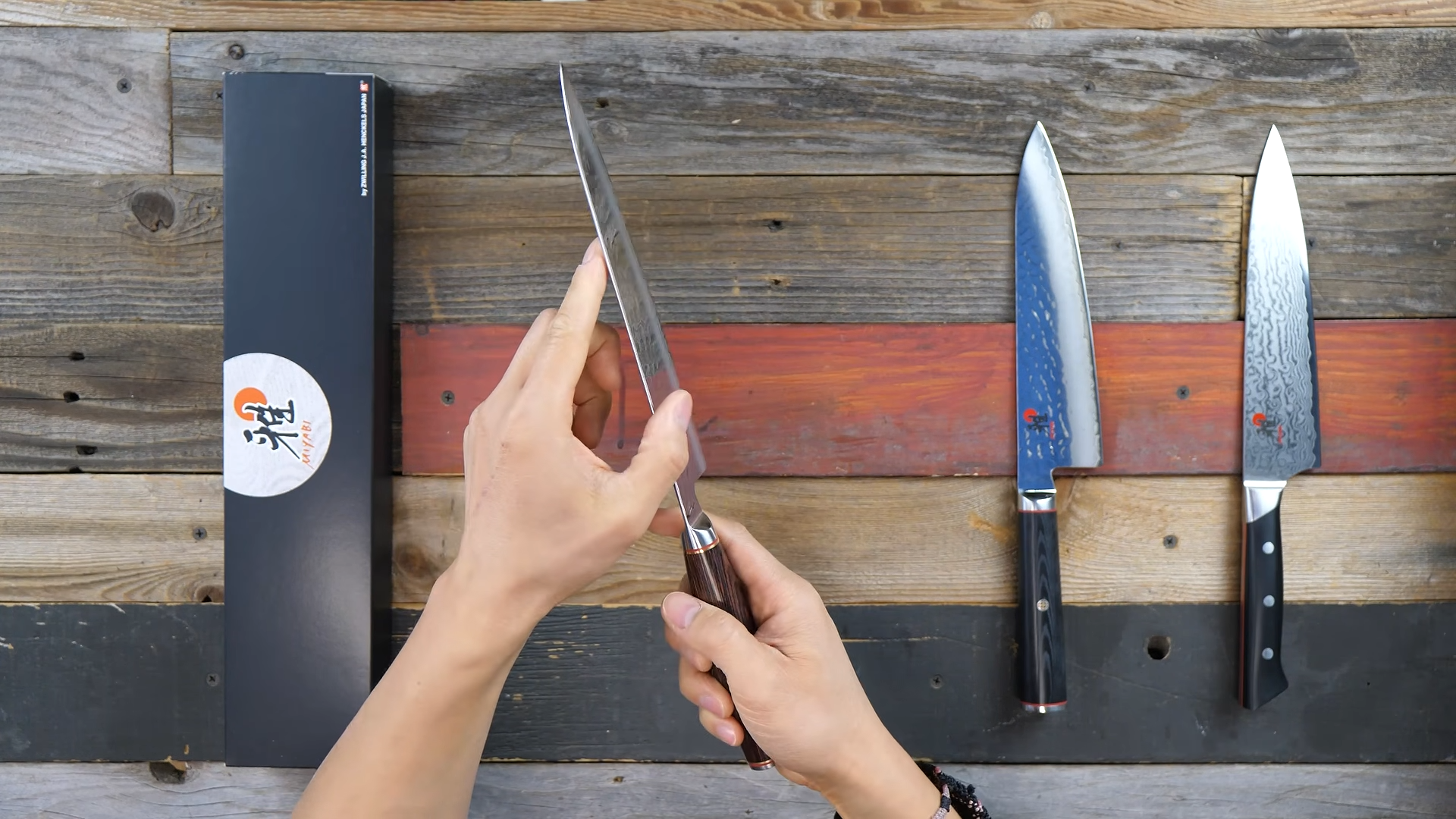
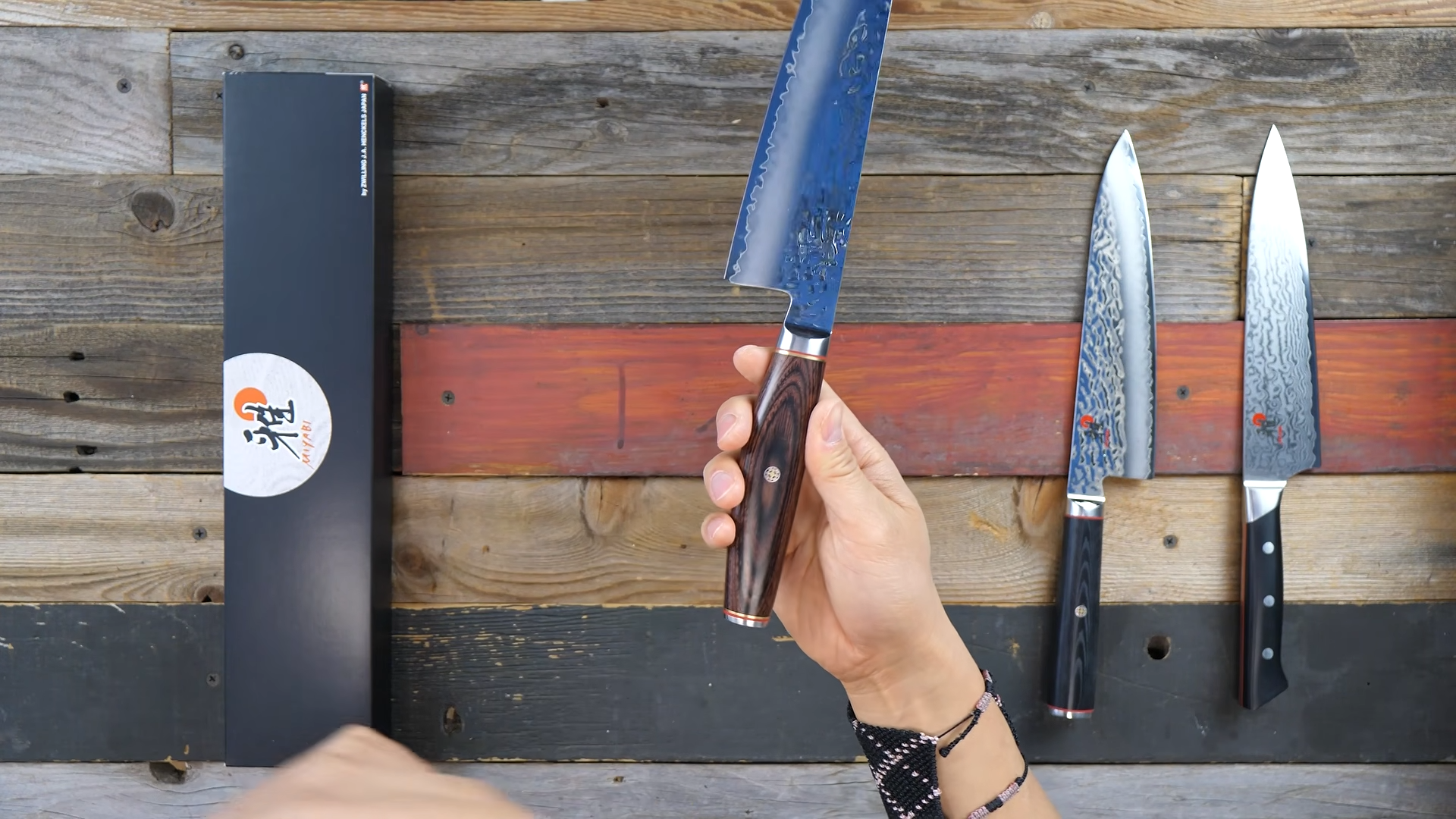
The Modified Linen Micarta D-Handle
Moving away from Western rivets, the Mizu adopts a modified Japanese D-shaped handle constructed from resin-stabilized black linen Micarta:
The Asymmetrical Ridge: On traditional Japanese D-handles, the right-hand ridge can feel sharp and blocky to Western cooks. Miyabi rounds and ovalizes this transition, creating a tactile index line for right-handed users that remains comfortable in the left hand.
Accents & Weight: The handle is finished with a steel end-cap, red spacer rings, and a handcrafted Japanese Mosaic Pin consisting of copper rods arranged inside a central brass square.
The steel end-cap acts as a counterweight to the 2.0mm blade, centering the knife's balance directly over the rounded choil.
4. Miyabi Artisan (6000MCT): Ergonomic Redirection & Cocobolo Pakkawood
Sharing identical blade metallurgy with the Mizu, the Artisan 6000MCT redirects its engineering focus toward organic grip ergonomics and handle contouring.
[ THE ARTISAN HYBRID PALM SWELL ]

          Top View: Contour Profile
   Narrow Neck        Pronounced Center Swell         Tapered Butt
  ┌───────────────┐  ┌───────────────────────┐  ┌───────────────┐
  │   Ferrule     │──│   Palm Palm Swell     │──│   End Cap     │
  └───────────────┘  └───────────────────────┘  └───────────────┘
The Hybrid Swell Architecture
Standard oval or octagonal wa-handles maintain a straight linear taper. The Artisan introduces a sculpted center belly (palm swell) paired with an asymmetrical D-profile:
Most knives with bulbous center handles feel clumsy—like holding a wooden dowel. The Artisan circumvents this by keeping the neck narrow where the index finger wraps the choil, expanding into a palm swell in the center, and tapering down before the end-cap.
This contour provides exceptional mechanical security for smaller hands, anchoring the knife securely without requiring tight grip pressure.
Premium Pakkawood Aesthetics
The handle is carved from Cocobolo Rosewood Pakkawood—natural hardwood veneers saturated under high pressure with phenolic thermosetting resins.
The handle displays deep, rich reddish-brown wood grain while remaining moisture-proof and dimensionally stable.
The joint where the ferrule meets the wood is accented by dual brass-and-red spacers, and the choil exhibits an even higher level of rounded polish than the Mizu, making the pinch grip seamless.
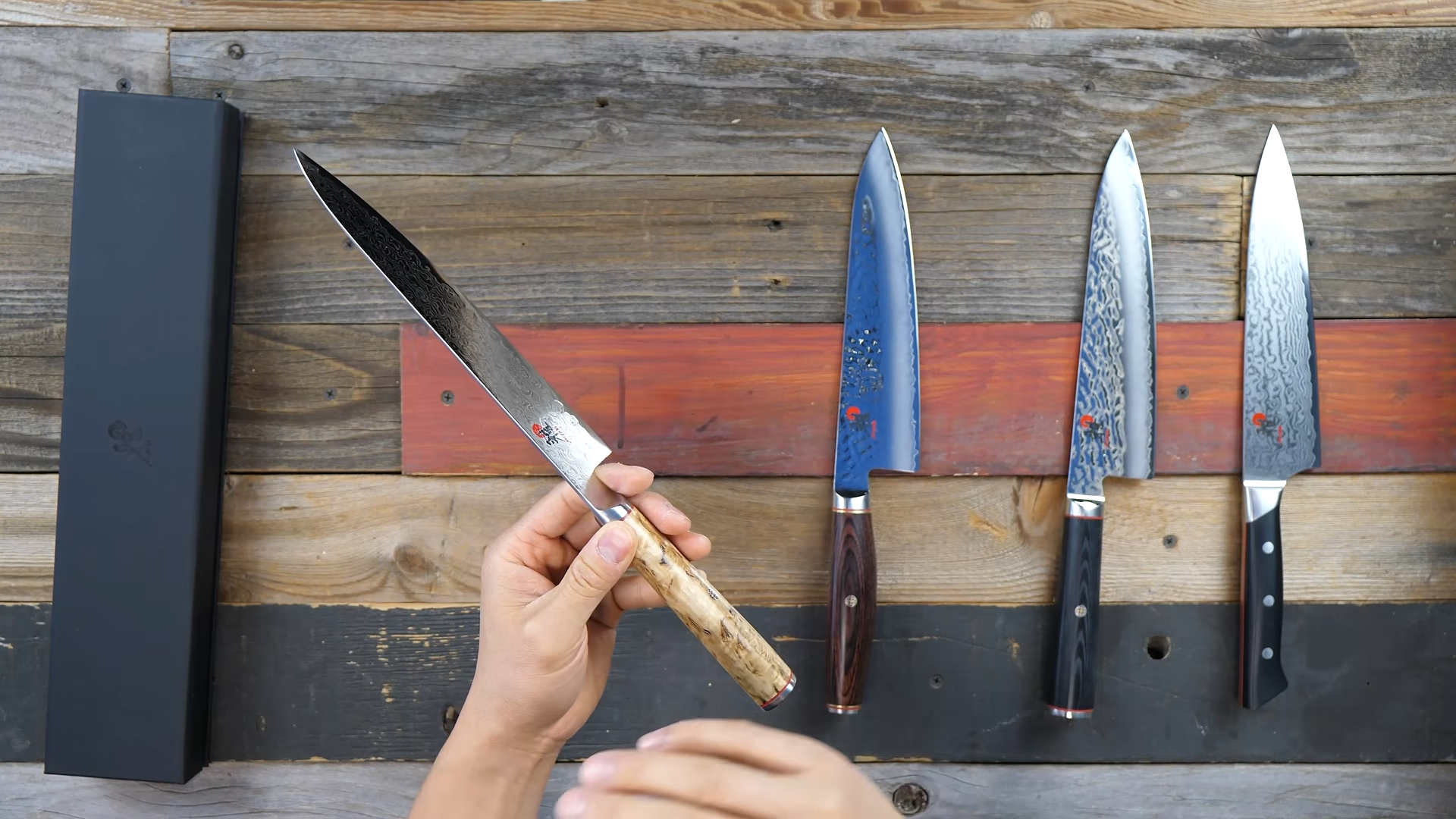
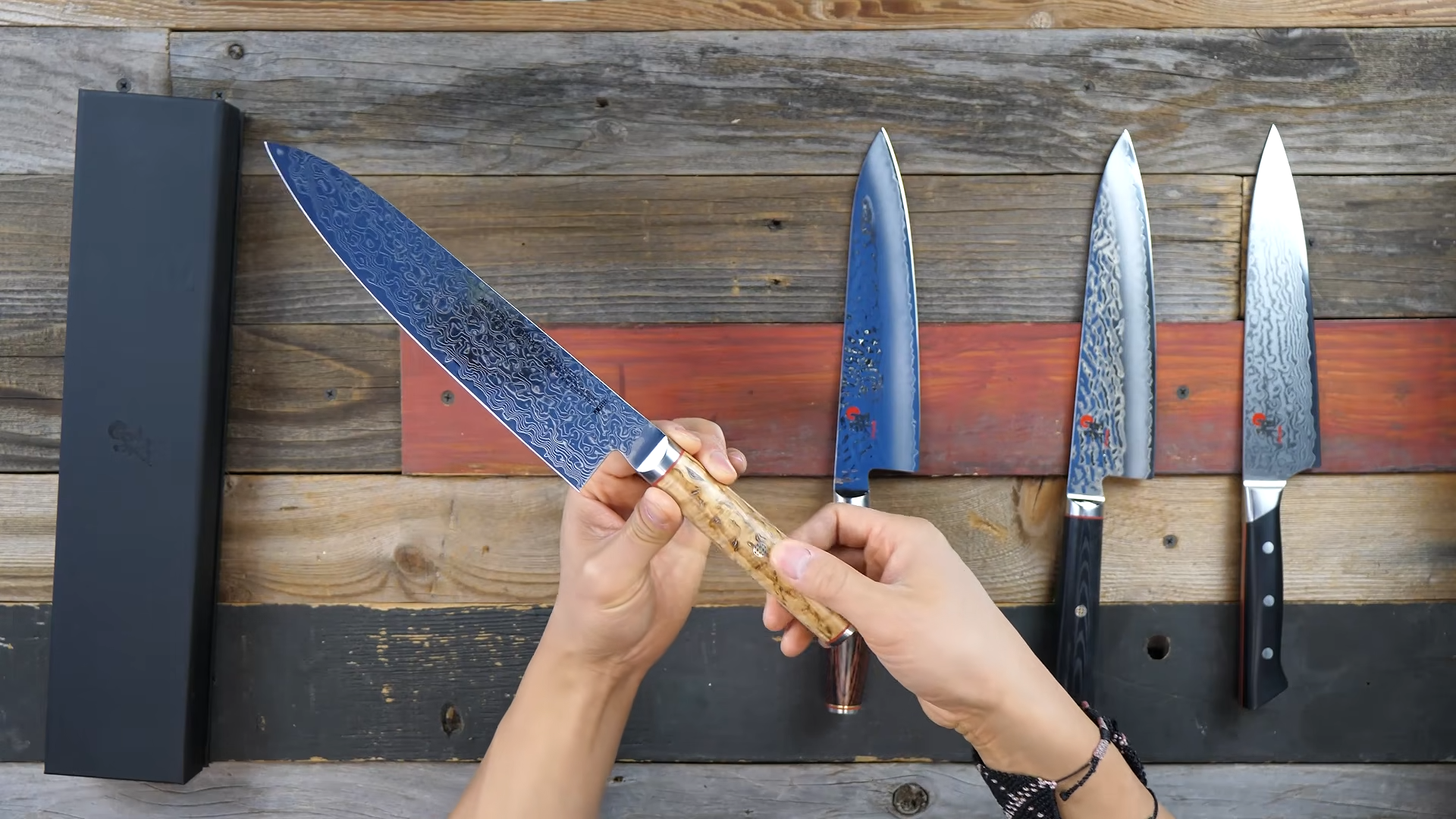
5. Miyabi Birchwood (5000MCD): The 101-Layer Flagship
The Birchwood 5000MCD represents the absolute peak of Miyabi's production portfolio. It strips away industrial synthetic materials in favor of natural heirloom wood and high-density pattern-welded damascus.
THE 101-LAYER DAMASCUS ARCHITECTURE

   [ Soft Stainless Steel Cladding Layers (50 Layers) ]
  ──────────────────────────────────────────────────────
   [ MicroCarbide SG2 Core Matrix @ 63 HRC (Cryodur)  ]
  ──────────────────────────────────────────────────────
   [ Soft Stainless Steel Cladding Layers (50 Layers) ]
Blade Finish: Floral Damascus vs. Surface Friction
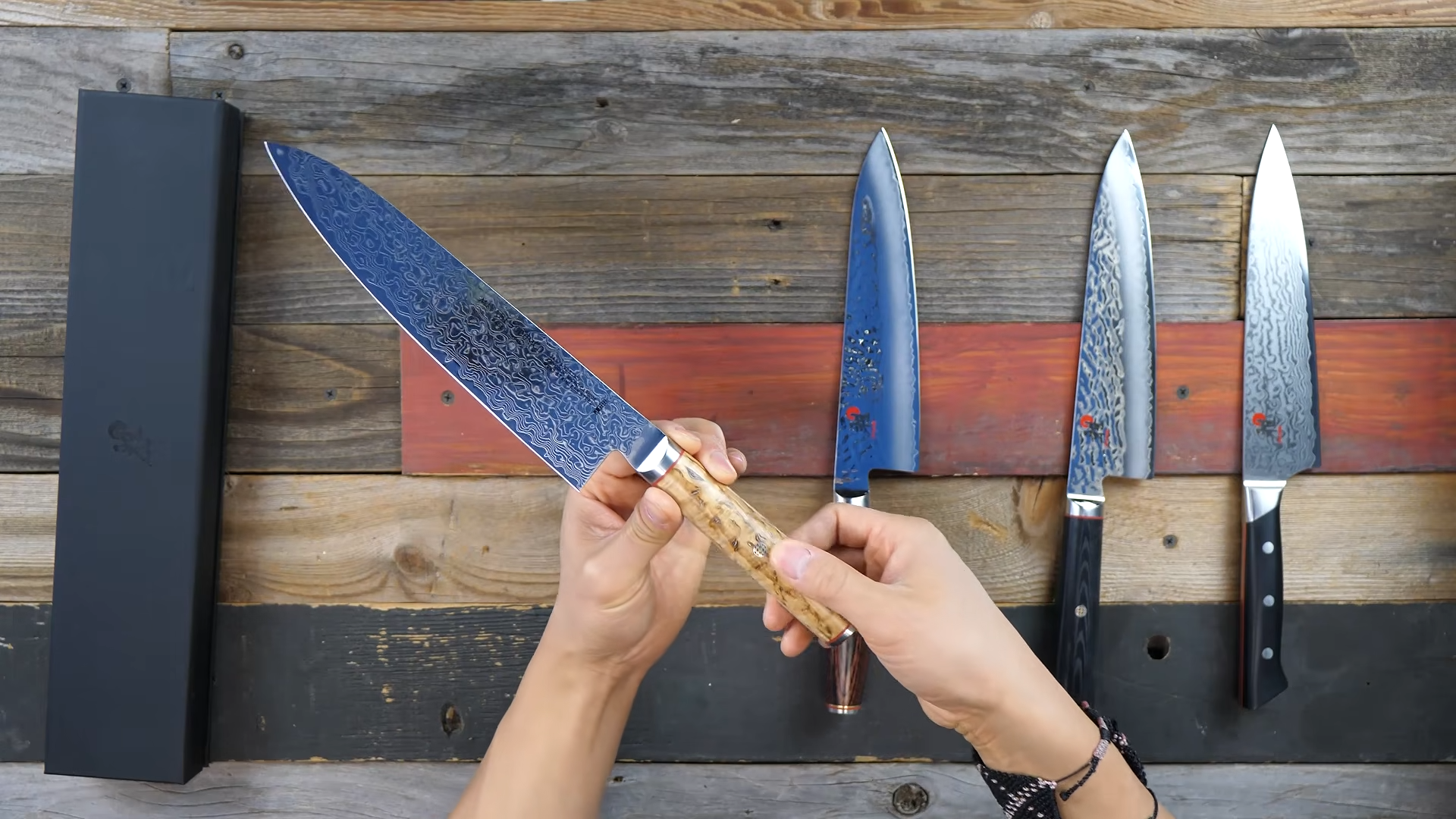
While the Mizu and Artisan use a three-layer san-mai construction with a hammered top, the Birchwood surrounds its SG2 core with 100 alternating layers of nickel and stainless steel (yielding 101 total layers).
The floral Damascus is polished to a liquid-smooth satin sheen.
Unlike coarse acid-etched Damascus finishes that create dragging friction through dense produce, the Birchwood's low-relief polish glides through root vegetables with minimal lateral resistance.
The blade is ground remarkably thin behind the edge, tapering down to a sub-2.0mm spine that enters proteins with virtually zero wedging.
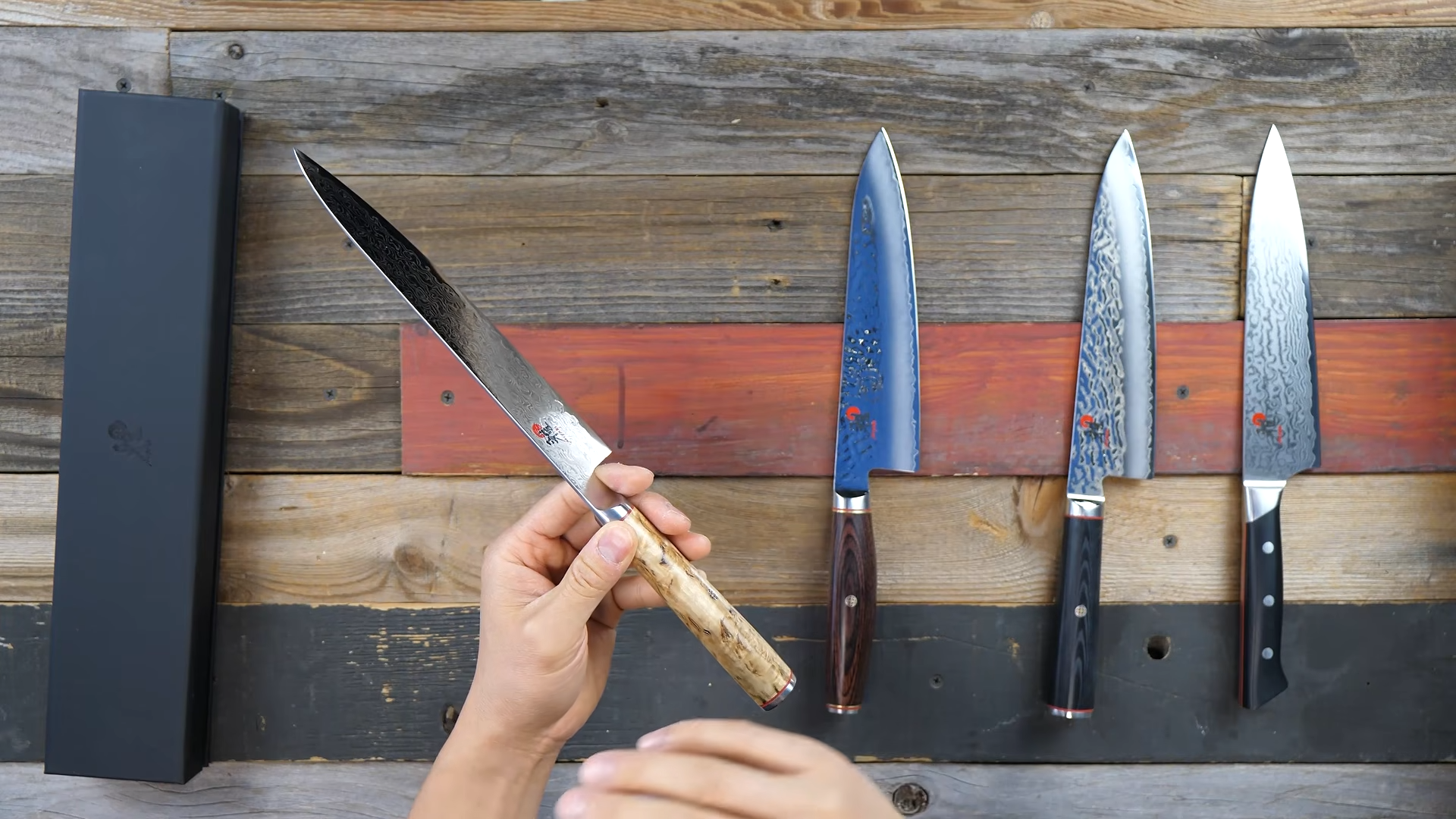
Karelian (Masur) Birch: The Tactile Wa-Handle
The defining hallmark of the 5000MCD is its traditional D-shaped handle carved from Karelian Birch burl (sourced from Northern Europe):
Chatoyancy & Texture: Unlike Pakkawood or Micarta which feel like resin, the Birchwood handle is finished with an ultra-fine, open-pore treatment. You can feel the organic grain and natural ridges of the wood. The curling, marbled grain exhibits deep visual chatoyancy under light.
Elevated D-Ridge: The asymmetrical ridge along the right side of the handle is positioned higher up the profile than standard Japanese handles. This places the flat facet directly beneath the first knuckle of the index finger during a pinch grip, providing exceptional rotational stability.
Technical Comparison Matrix
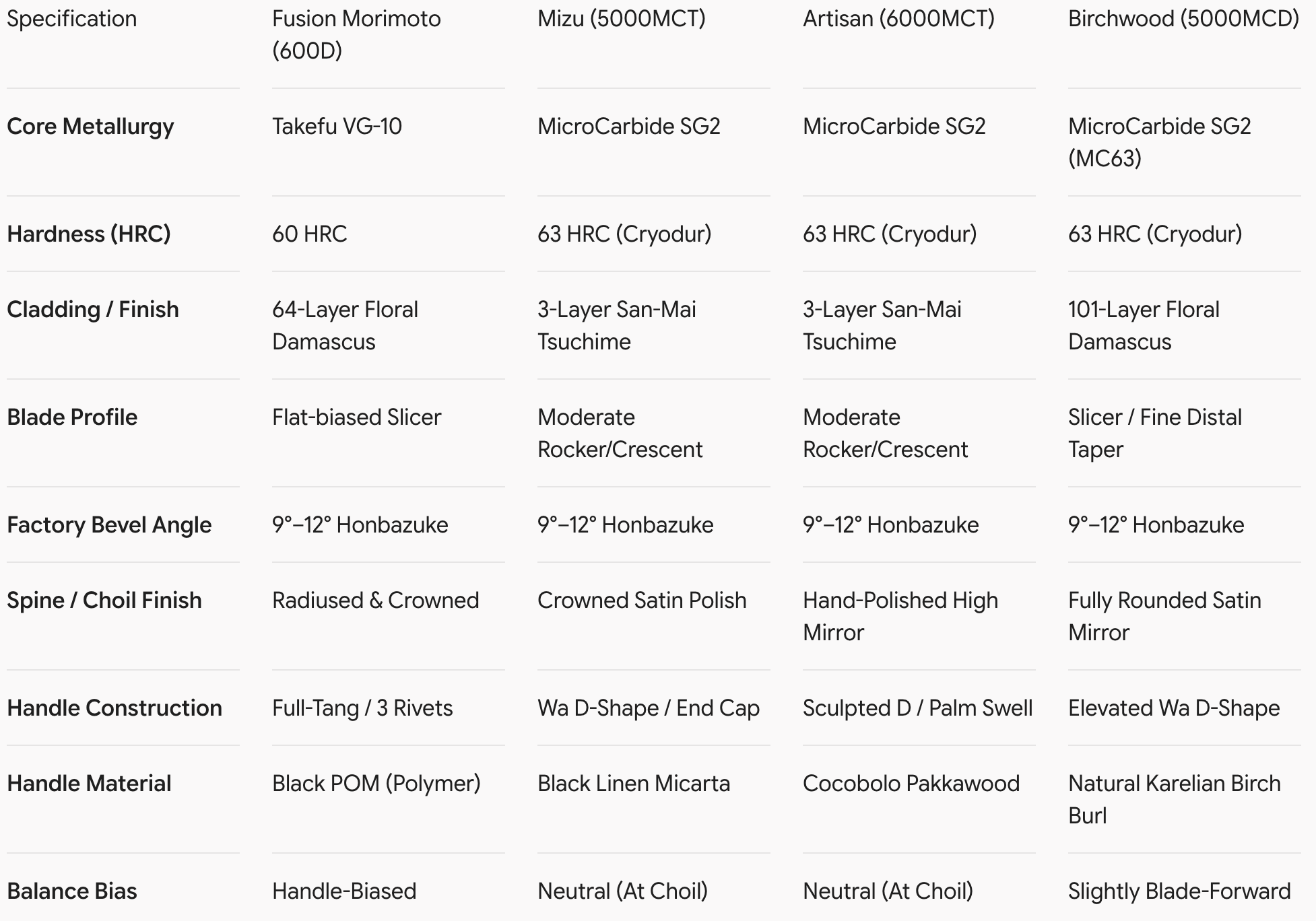
6. Sharpening Dynamics: Maintaining VG-10 vs. SG2 Cryodur
Maintaining a Miyabi edge requires abandoning pull-through electric sharpeners and steel honing rods entirely. An acute 9° to 12° bevel at 63 HRC will chip instantly if scraped against a ribbed steel rod. Freehand waterstones are mandatory.
[ WATERSTONE BENCH PROTOCOLS ]

Miyabi Fusion (VG-10 @ 60 HRC):
  Medium (1000 Grit) ──► Fast cutting, but produces a ductile, gummy wire burr.
  Deburring          ──► Requires intentional alternating passes; strip on leather strop.

Miyabi SG2 Lines (Mizu / Artisan / Birchwood @ 63 HRC):
  Coarse/Medium      ──► Demands hard synthetic media (Naniwa Chosera / Shapton Glass).
  Micro-Carbide Apex ──► Crisp, brittle micro-burr detaches instantly on 3000–6000 grit.
Working the Fusion’s VG-10 Core
At 60 HRC, VG-10 is an alloy that sharpens quickly but requires disciplined deburring. On a 1,000-grit synthetic waterstone, the steel yields an obvious burr in two to three passes. However, because of its ductility, the burr tends to roll back and forth across the apex.
Avoid aggressive pressure on your finishing passes.
Lighten your stroke significantly on a 3,000 to 5,000-grit stone, finishing with 10 to 15 edge-trailing passes on a smooth leather strop loaded with 1-micron diamond paste to strip the remaining wire foil.
Working the SG2 Powder Steel (Mizu, Artisan, Birchwood)
Sharpening Miyabi’s Cryodur-treated SG2 at 63 HRC is an entirely different experience. Because the powdered steel matrix possesses ultra-fine, evenly dispersed carbide structures, the apex behaves with extreme rigidity.
Abrasive Selection: Soft soaking waterstones will dish out quickly against SG2. Hard, dense splash-and-go stones (such as the Naniwa Chosera 800/3000 or Shapton Pro/Glass 1000/4000) cut this steel cleanly without gouging.
Burr Mechanics: Unlike VG-10, SG2 does not produce a gummy burr. It forms a crisp, microscopic wire burr that snaps cleanly off the edge during light alternating trailing strokes on a 3,000-grit stone.
Apex Refinement: SG2 can support a mirror polish up to 8,000 grit without losing its cutting bite. Because the carbides are microscopic, the edge retains a toothy, aggressive slicing capability even when polished to a reflective shine.
The Editorial Verdict: Selecting Your Benchmark
Miyabi has succeeded where many heritage manufacturers have failed: they have created high-performance production cutlery that respects traditional Japanese metallurgical standards while engineering out the ergonomic compromises of traditional rustic handles.
Choose the Fusion Morimoto 600D if you work in high-volume, chaotic commercial kitchens where non-porous POM handles, full-tang balance, and the forgiving toughness of 60 HRC VG-10 are practical assets.
Choose the Mizu 5000MCT if you want the extreme edge retention of SG2 powder steel paired with a low-maintenance, indestructible linen Micarta handle and food-releasing Tsuchime cladding.
Choose the Artisan 6000MCT if palm-filling ergonomics and fatigue reduction are your primary concerns; its sculpted Cocobolo swell provides the most secure grip in the lineup.
Choose the Birchwood 5000MCD if you are seeking a culinary heirloom. The pairing of 101-layer floral Damascus with organic Karelian Birch offers unmatched cutting smoothness, refined distal geometry, and aesthetic perfection on the prep board.