

Naniwa Pro 3000 Review: The Ultimate "Sweet Spot" Whetstone
Disclosure: As an Amazon Associate, I earn from qualifying purchases.
For decades, the standard entry route into Japanese knife sharpening has followed a rigid binary: purchase a 1,000-grit whetstone to set your apex, followed by a 6,000-grit stone for fine polishing. It is solid advice for beginners, but for sharpeners balancing busy personal schedules, that two-stone progression often introduces unnecessary friction and bench time.
Enter the Naniwa Pro 3000 (formerly known as the Naniwa Chosera 3K).
Occupying the exact golden ratio between coarse metal removal and refined mirror polishing, this stone offers a rare balance: it cuts nearly as fast as a medium-grit workhorse, resists dishing like a ceramic brick, and leaves a sticky, low-gloss satin edge that bites through tomato skins and proteins with effortless aggression.
Technical Performance Benchmarks
Cutting Speed: 8 / 10 (Near 1,000-grit velocity)
Tactile Feedback: 10 / 10 (Class-leading edge communication)
Wear & Dishing Resistance: 8 / 10 (Ultra-dense, splash-and-go matrix)
Overall Rating: 9 / 10 (The single best one-and-done finishing stone)
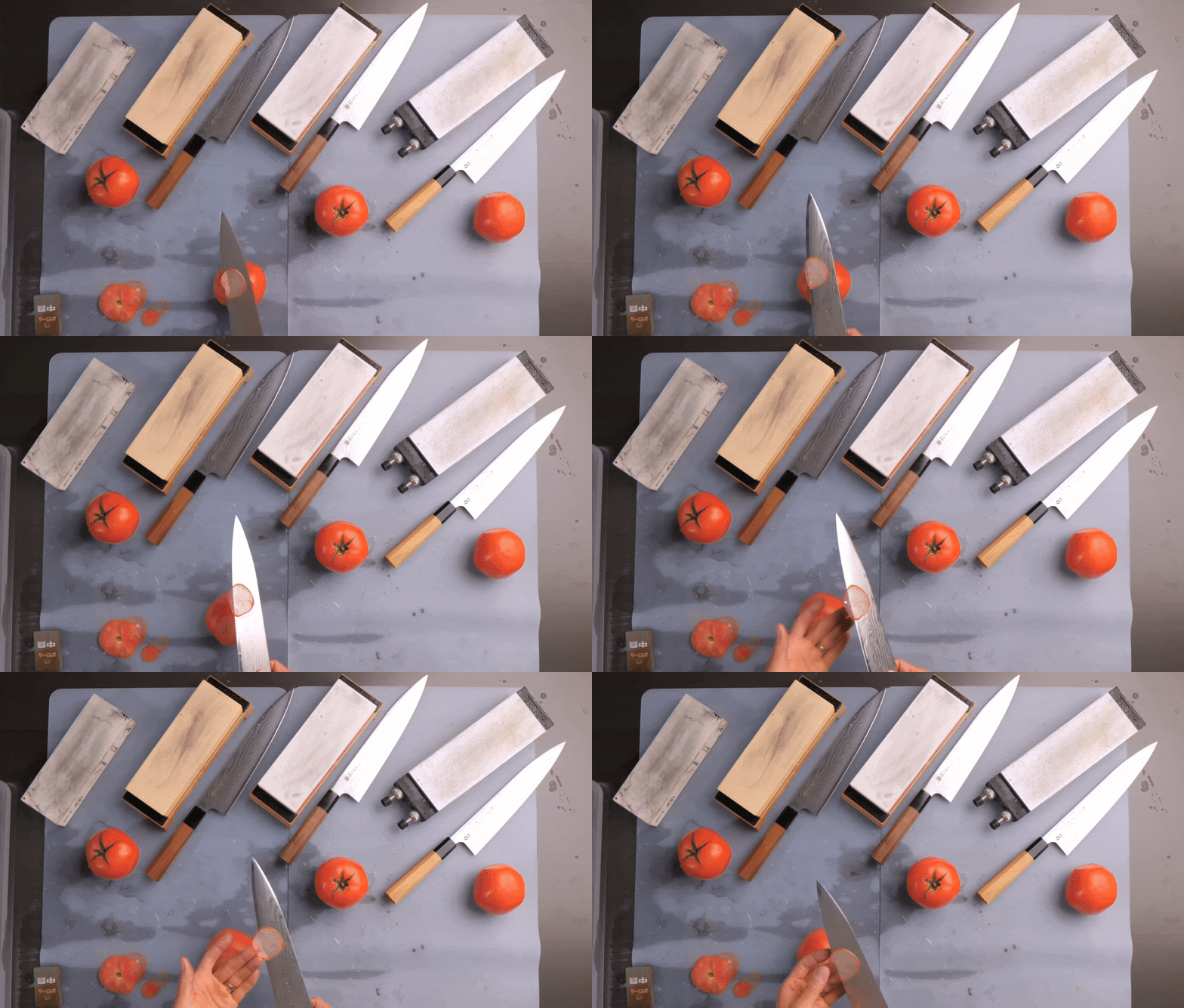
tomato cut test
1. The 3,000-Grit Sweet Spot vs. The 1K/6K Dogma
While a 1,000-grit edge provides raw, toothy bite and a 6,000-grit edge provides screaming push-cut refinement, a high-grade 3,000-grit edge offers the best of both worlds for daily culinary use.
A 3,000-grit edge retains enough microscopic aggression to anchor into slippery vegetable skins, yet refines the apex sufficiently to slice delicate proteins without tearing. For ninety percent of kitchen tasks, stepping beyond 3,000 grit yields rapidly diminishing returns.
2. Cutting Speed & Real-World Efficiency
When bench time is limited, cutting speed becomes a primary consideration. A stone that requires 20 minutes of grinding to raise a burr quickly becomes a chore.
The Naniwa Pro 3K cuts with astonishing efficiency for a fine-finishing stone:
On a dulled kitchen blade, ultra-fast medium stones like the Naniwa Pro 800 or Suehiro Cerax 1000 form a micro-burr in roughly 2 to 3 passes per section.
The Naniwa Pro 3000 achieves a clean micro-burr in just 3 to 4 passes on the exact same blade.
This speed allows you to execute a full routine—from dull edge to refined satin finish—in under five minutes.

3. Unrivaled Tactile Feedback
Where the Naniwa Pro 3000 completely sets itself apart from competitors is in its haptic response.
Soft soaking stones generate heavy mud that smothers feedback, while ultra-hard natural or glass-backed ceramics can feel glassy and uncontrolled. The Pro 3000 strikes a perfect balance: its firm ceramic surface provides a velvety resistance that instantly alerts your hands if your angle strays by even a single degree.
While a 1,000-grit edge provides raw, toothy bite and a 6,000-grit edge provides screaming push-cut refinement, a high-grade 3,000-grit edge offers the best of both worlds for daily culinary use.
4. Dishing Resistance: The 48-Blade Bench Test
Because stone flattening requires extra gear and setup time, wear resistance is critical. As a Magnesite-bonded splash-and-go stone, the Pro 3000 requires zero advance soaking and absorbs virtually no surface water.
In real-world testing spanning 3 to 4 dozen kitchen blades without a single flattening pass, the stone exhibited near-zero structural dishing. In blind cutting tests comparing a knife sharpened on a freshly flattened side versus one sharpened on the heavily used surface, cutting performance was functionally identical.
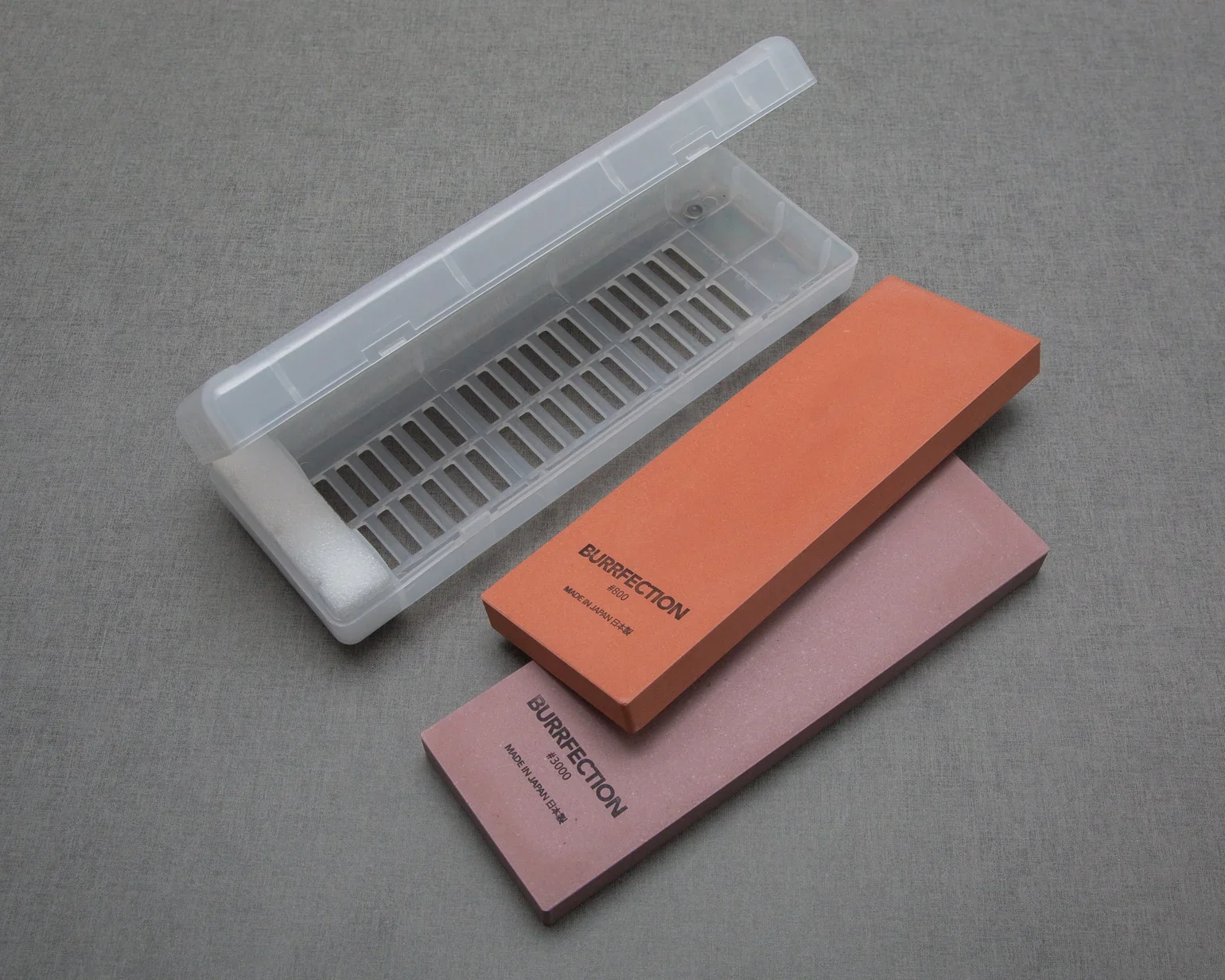
naniwa pro burrfection 800 and 3000 edition
The Verdict
The Naniwa Pro 3000 is an extraordinary achievement in stone formulation. It cuts fast enough to eliminate the need for a intermediate stone, wears slowly enough to make flattening a rare occasion, and delivers unmatched tactile feedback.
While its price tag places it outside the budget tier, it is a true investment piece: buy it once, and it will likely be the last 3,000-grit stone you ever need.