When a massive shipment of roughly one hundred customer-returned knives arrives from a major retailer like Cutlery and More, it provides a rare forensic look into the culinary market.
Inside these crates sits an assortment of bent spines, shattered tips, gouged cutting edges, and fractured heels. While a handful represent minor buyer’s remorse—blades returned with nothing more than a faint micro-burr or scuffed packaging—the vast majority tell a violent story of mechanical misuse.
Examining these damaged knives exposes the sharp divide between consumer expectations and metallurgical reality. Understanding why these failures occur—and how to resurrect the steel on the bench—is the ultimate study in knife geometry and restorative hand-sharpening.
trust retailers BurrfectionStore | Gyuto | WasabiKitchen | Amazon
Disclosure: As an Amazon Associate, I earn from qualifying purchases.
1. The Anatomy of Cutlery Failure: How Users Destroy Fine Steel
A kitchen knife is engineered strictly as a shearing instrument, designed to separate soft organic matter through linear slicing or controlled push-cutting. It is not a wedge, a pry bar, or an axe. Yet inspecting returned blades reveals that users routinely subject delicate edges to extreme torsional and impact forces.
[ MODES OF KNIFE FAILURE ON THE PREP BOARD ]

1. Lateral Torsion (Twisting) ──► Fractured Heels & Massive Edge Chips
   (e.g., Prying open glass jar lids or twisting through squash rind)

2. Direct Impact (Chopping)   ──► Deep Gouges & Chipped Serrations
   (e.g., Striking beef bones, frozen proteins, or hard stone surfaces)

3. Dropping / Tip-First Floor ──► Snapped Tips & Bent Distal Tapers
   (e.g., Dropping off prep tables or violent sink collisions)
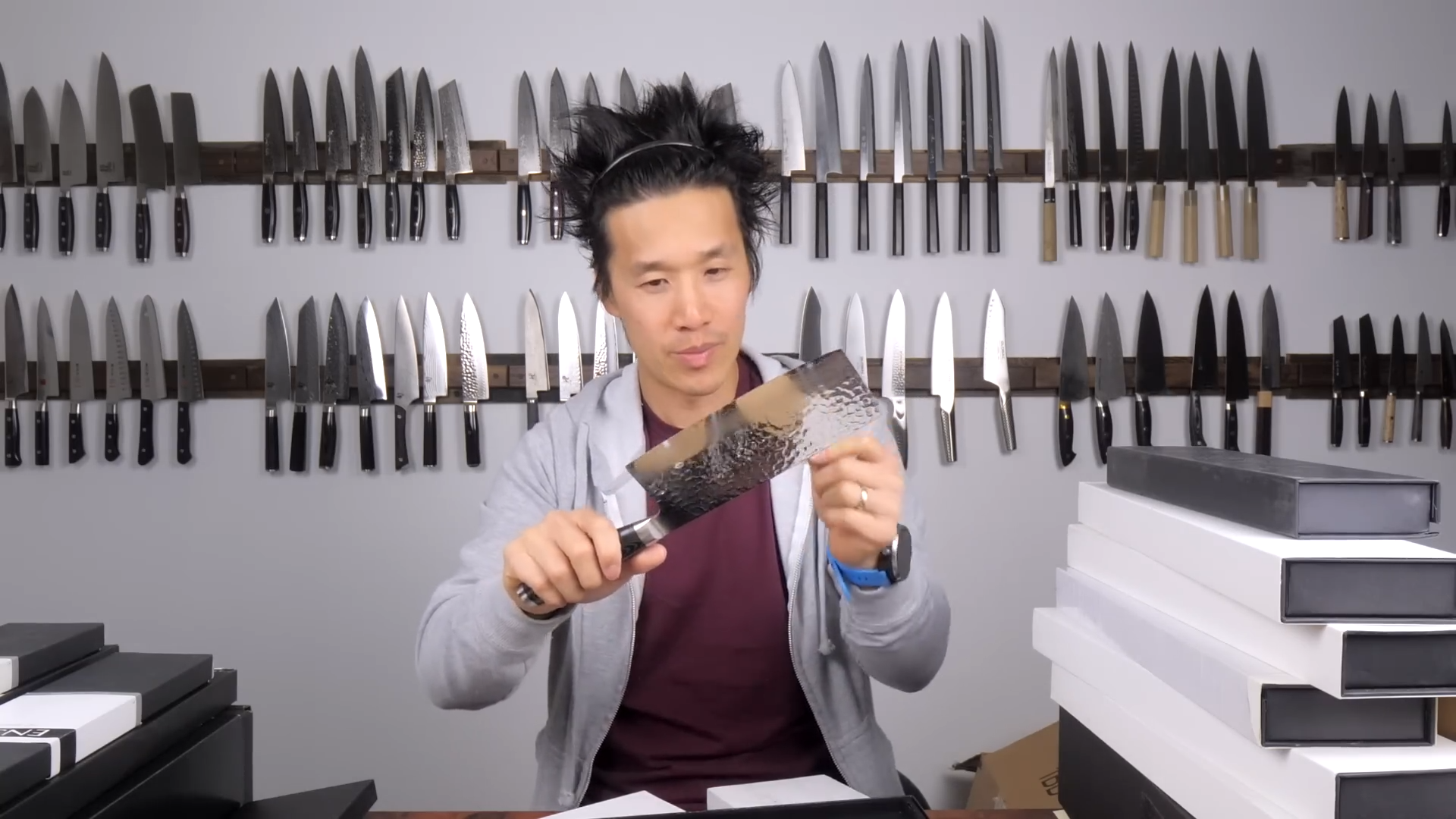
The Heel Fracture: The "Jar Lid" Phenomenon
One of the most alarming injuries repeatedly found in returned inventory is a massive chunk missing directly at the heel of a Japanese santoku or gyuto.
This specific failure almost always stems from a single habit: using the sharp corner of the heel as a lever to pop the vacuum seal on a pickle or tomato sauce jar. While a soft, ductile German knife (56 HRC) might survive this abuse with a minor roll or dent, a Japanese blade hardened to 60–61 HRC possesses high tensile strength but very little lateral elasticity. Applying twisting torque against a glass jar edge instantly shears a half-inch crescent of steel straight out of the heel.
Shattered Tips and Dropped Distal Tapers
Fine Japanese cutlery features a pronounced distal taper, narrowing gradually from the handle to a needle-thin tip designed for precision work around poultry joints and delicate allium cuts.
Dropping a distal-tapered blade onto a tile floor or tossing it carelessly into a stainless steel commercial sink instantly snaps the first two to five millimeters of the tip.
The Mystery of Chipped Serrations
Serrated utility and bread knives are often viewed by casual cooks as indestructible "saws." However, scalloped edges are ground exceptionally thin at the tips of each gullet. Forcing a scalloped utility knife through partially frozen food or hacking against dense bones concentrates enormous pressure on individual tooth apexes, resulting in broken teeth and jagged edge gaps that can no longer slice bread cleanly.
2. The "Shun Effect": Market Dominance vs. Metallurgical Misunderstanding
A disproportionate percentage of returned, chipped cutlery bears the Shun logo. This is not an indictment of Shun’s manufacturing quality; it is a direct consequence of market share and cultural placement.
THE SHUN CONSUMER PIPELINE

Food Network / Celebrity Chef Sponsorships
        │  (High visibility to casual home cooks)
        ▼
Mass-Market Adoption (50–60% of US Japanese Cutlery Sales)
        │  (Untrained users upgrading directly from $20 block sets)
        ▼
Mismatched Cutting Mechanics
        │  (Applying aggressive German rocking/twisting to thin Japanese steel)
        ▼
Catastrophic Edge Chipping & High Return Rates
Volume and Market Share: Shun accounts for an estimated 50% to 60% of all Japanese-style cutlery sold in the United States. Pure statistical probability dictates that the brand with the highest unit volume will produce the highest raw return volume.
The Celebrity Endorsement Gap: Shun invests heavily in television sponsorships, celebrity chef endorsements, and mainstream retail distribution. As a result, home cooks frequently purchase Shun as their first "serious" knife after years of using soft, stamped European blades.
The Mechanical Clash: European knives (crafted from alloys like DIN 1.4116 at 56–58 HRC) are thick behind the edge and ductile. When a cook twists a German knife while rocking through a butternut squash, the steel rolls or folds—a condition easily corrected with a honing steel.
When that same cook applies an aggressive rocking and twisting motion to a Shun ground from VG-MAX at 61 HRC, the acute 16-degree edge cannot flex. Instead of rolling, the micro-carbide matrix suffers brittle catastrophic fracture, blowing out large chips along the belly.
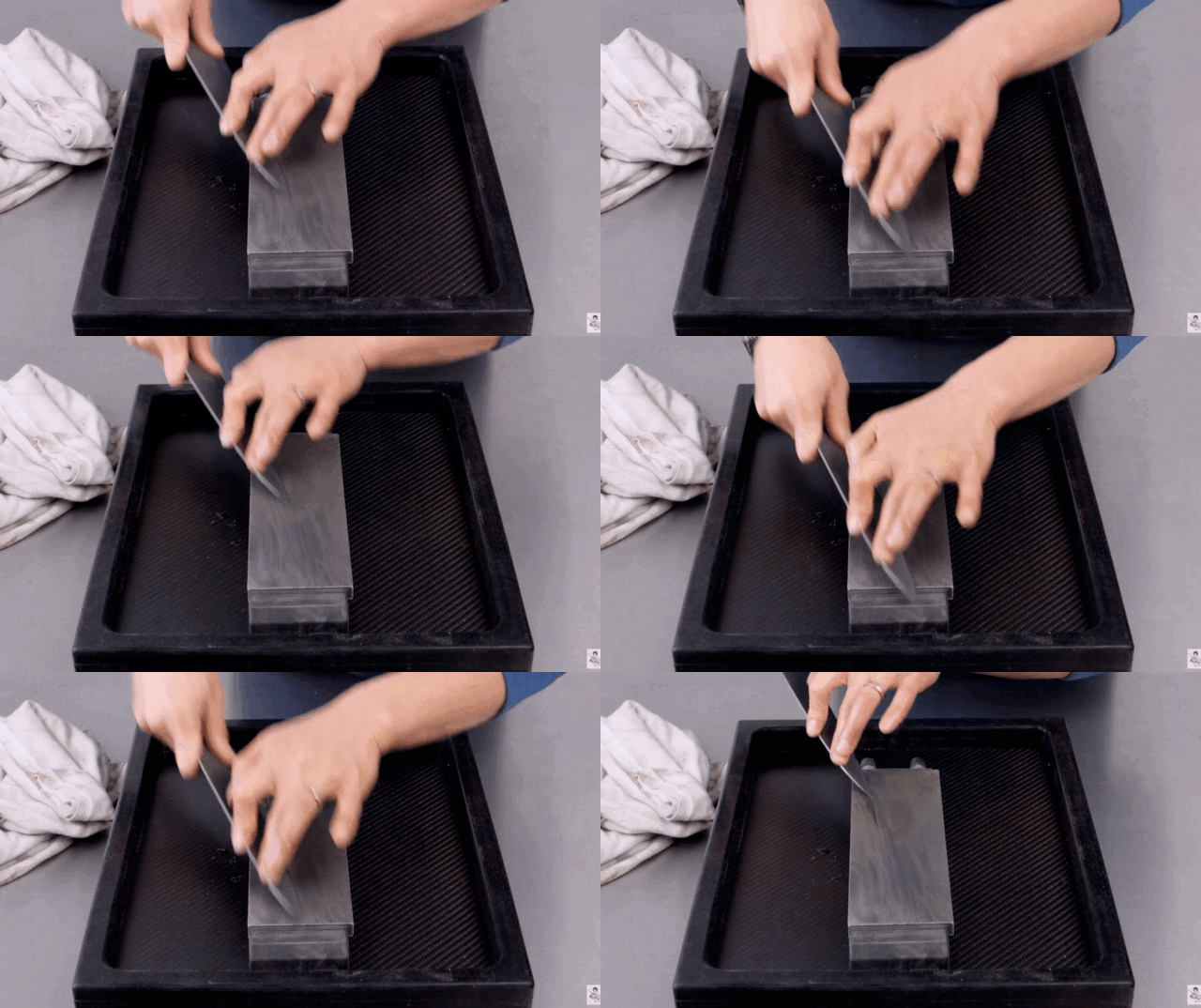
3. Bench Restoration Protocols: Resurrecting Damaged Blades
Repairing dozens of severely compromised knives is an intensive, methodical process. It demands coarse abrasive media, disciplined angle control, and a comprehensive understanding of cross-sectional geometry.
BENCH PROTOCOL: REMOVING A 2MM EDGE CHIP

Step 1: Hogging Back the Edge (Flattening the Profile)
  [Atoma 140 or Shapton 120] ──► Grind perpendicularly into stone until chip disappears.
                                 *Never heat steel on dry motorized grinding belts.

Step 2: Thinning the Primary Bevels (Crucial Step)
  [220–500 Grit Waterstone]  ──► Lay blade flat; relieve the thick shoulders behind the edge.
                                 *Skipping this step turns the knife into an unusable wedge.

Step 3: Establishing the Secondary Bevel
  [1000 Grit Synthetic]      ──► Set a fresh, uniform apex angle (15° per side).

Step 4: Refinement and Deburring
  [3000–5000 Grit + Strop]   ──► Polish bevel, strip micro-burr, establish push-cutting sharpness.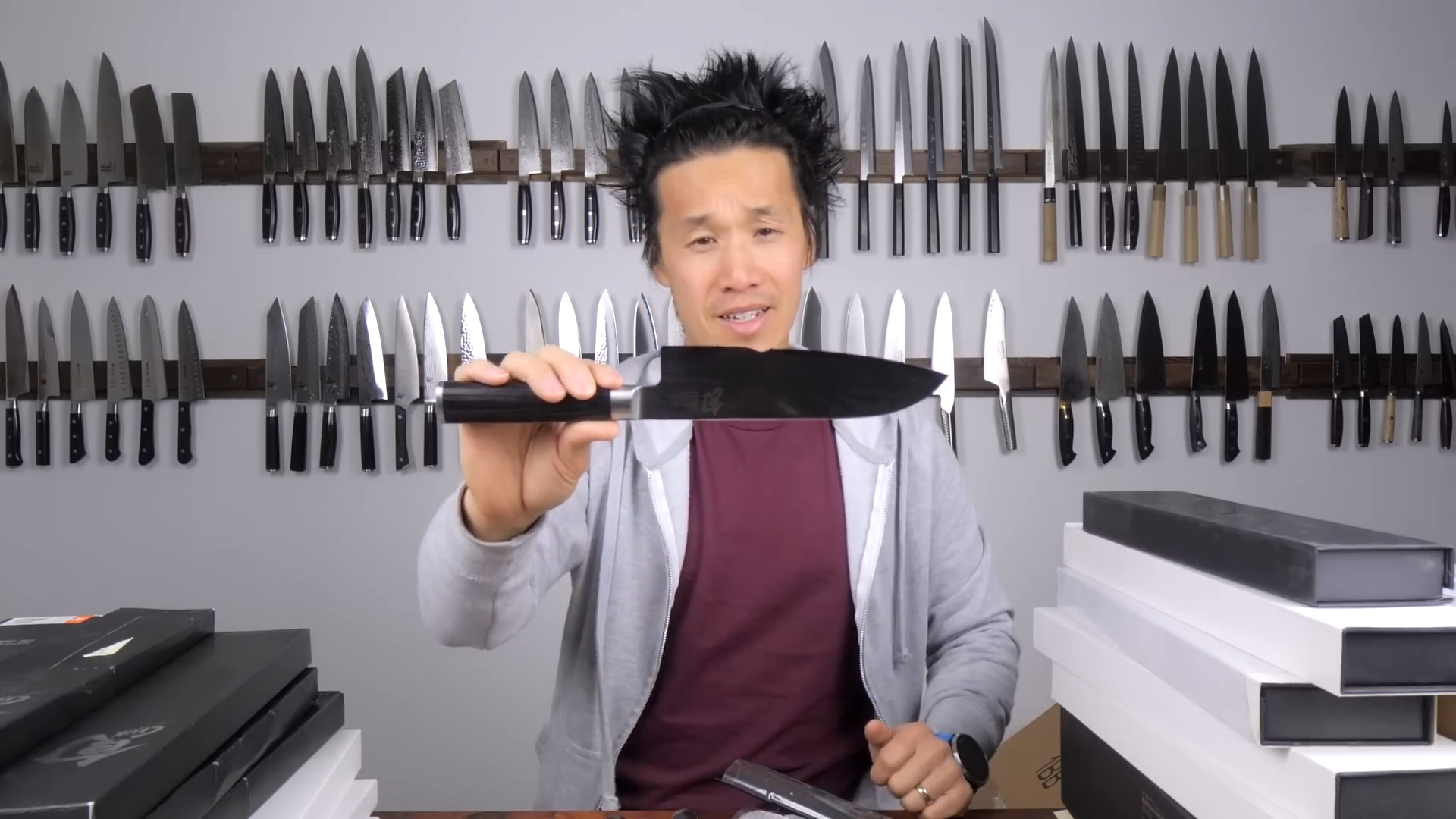
Protocol A: Correcting Snapped Tips (Spine Drop vs. Edge Grind)
When a knife loses its tip, amateur sharpeners often make the fatal mistake of grinding the edge upward to meet the broken point. This flattens the forward belly, drastically shortening the blade's usable cutting length and ruining its slicing sweep.
The Professional Fix: Always grind the spine down to meet the edge.
Using a coarse diamond plate (such as an Atoma 140) or a low-grit waterstone, work the top spine in a gradual convex curve down toward the unbroken cutting edge.
This preserves the original belly profile, keeps the cutting path flat against the board, and restores the acute point without sacrificing steel life.
Protocol B: Removing Catastrophic Chips
When an edge has a two-millimeter gouge, simply sharpening the knife at a normal 15-degree angle will take hours and produce an uneven, wavy bevel.
Sacrifice the Edge: Grind the knife edge directly into a coarse 120-grit stone at a 90-degree angle, cutting straight across until the floor of the chip is reached. The knife now has a completely flat, blunt edge.
Re-establishing the Profile: Blend the flat spot into the natural curve of the belly and heel so the blade makes uniform contact with the cutting board.
Thinning Behind the Edge (The Non-Negotiable Step): Because you have ground deep into the blade blank, the steel at the new edge is significantly thicker than the original factory grind. If you simply sharpen this edge, the knife will wedge aggressively in hard vegetables. You must lay the blade nearly flat on a 220-to-400 grit stone and thin the primary face, restoring the distal taper and convex geometry before setting the final apex.
Damage Analysis and Restoration Matrix
Damage TypePrimary Root CauseMetallurgical FactorBench Restoration SolutionHeel BlowoutPrying jars, twisting on boardsHigh hardness (61+ HRC), zero lateral ductilityRecurve heel blend; grind flat section rearwardSnapped TipDrops onto tile, sink impactsThin distal taper, high stress concentration pointSpine-drop reprofiling; preserve the cutting bellyBelly ChippingRock-chopping bones, frozen foodAcute edge angle (15°), brittle micro-carbidesJointing the edge flat, extensive blade thinningChipped SerrationsSlicing frozen proteins, bone strikesUltra-thin scalloped points, asymmetric strainIndividual slipstone grinding or convert to flat edgeBent Edge/SpineHeavy mechanical pryingDuctile failure in softer stainless claddingsWood-block lever straightening prior to benchwork
4. The "$1 Knife" Community Initiative: Putting Steel to Work
Rescuing one hundred damaged knives creates a logistical bottleneck. A comprehensive tip repair, edge reprofiling, and thinning session can easily consume an hour of meticulous handwork per blade.
Rather than letting these blades sit idle in crates or dumping them into landfills, this recovery project serves as an engine for community support.
Rethinking the "Giveaway" Model
Historically, organizing free community giveaways creates friction over terminology and international shipping costs. To eliminate ambiguity, this initiative transitions to a symbolic "$1 Adoption Model":
Every restored knife—as well as blades needing repairs that community members want to tackle themselves—is offered for a symbolic single dollar, plus actual shipping costs.
The knives are directed to where they can make an immediate, tangible impact: volunteer soup kitchens, community pantries, and underpaid commercial line cooks who work tireless shifts without the budget for performance cutlery.
A portion of the damaged blades are also channeled to enthusiasts and sharpeners within our community as a restoration challenge: take a neglected, broken piece of Japanese steel, document the transformation on the stones, and bring a functional tool back to life.
Every piece of high-grade cutlery represents skilled labor, energy, and mined steel. When users break fine knives through ignorance, the answer isn't to throw the steel away.
With coarse abrasives, proper geometry, and a willingness to put in the bench time, even the most catastrophic factory returns can be resurrected into surgical kitchen tools.