The Burrfection Knife by Sakai Takayuki: How My First Gyuto Was Made
A year of samples, two steels and one 240mm Sabatier-style profile: the story and specs of my first knife, made by one of Sakai's most famous makers.
By Ryky TranApril 20, 2019Updated November 24, 20266 min read
This article contains affiliate links: I may earn a commission if you buy through them, at no extra cost to you. How this works

The short version
- My first knife, made by Sakai Takayuki: a 240mm wa-gyuto with a Sabatier-style profile, offered in AUS8 stainless and Blue #2 carbon.
- Thin and sharp out of the box: just over 2mm at the spine, 47.3mm tall, and it scored 160 to 222 on my sharpness tester, well under the 300 most high-end knives come in at.
- The details I fought for: a polished, chamfered spine and choil, and an octagonal handle that's slightly taller on two sides.
Why it took almost a year
This knife was the result of nearly a year of work (0:00). A few earlier projects fell through, not because the knives were bad, but because most of the offers were licensing deals: put my name and picture on a box and sell it (0:21). I wanted to stay in the creative process, in the making and design of the knife, not just the selling. That's why it took so long.
I chose Sakai Takayuki, one of the most famous knife makers in all of Japan (3:05). Japanese knives come in roughly three classes: manufactured, handmade and artisan (3:26). A manufactured knife, even one touched by hand, can pass through 50 or 60 people; a handmade or artisan knife is made by three or four people, sometimes one. I wanted a knife made by a small handful of people, and I'd had samples from other makers where something got lost in translation. This one came out right.
Why 240mm, and the KS comparison
Next to my Masamoto KS, the profile is very similar (4:30). The KS is rated at 240mm but always measures about 250 (4:52). For someone moving up from a 6- or 7-inch santoku or an 8-inch chef's knife, 250mm can feel intimidating, so I made mine a true 240mm (5:13). The spine is about 2.3mm, and 240 has always been my favorite size (7:40); a 210mm version is harder to design with this profile, and I was already working on it (8:01).
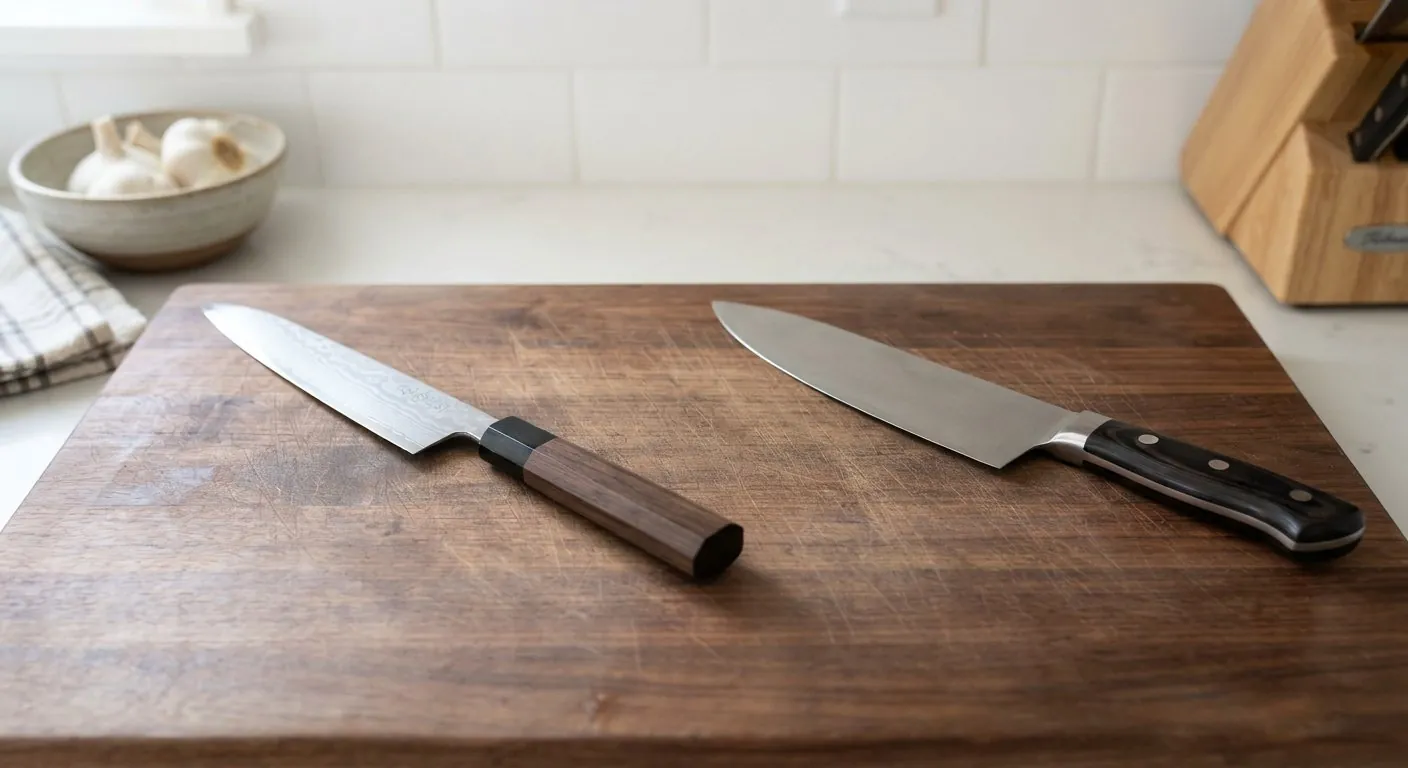
My design brief was simple and hard at the same time: a 240mm gyuto with a Sabatier-style profile and a custom octagonal wa handle, all under $200 (8:44). There's no such thing as a perfect knife, but within those limits I think we got very close.
Two steels, one blade
The first run was 200 knives: 100 in AUS8 stainless at 58 to 59 HRC and 100 in Blue #2 carbon at 62 to 63, with exactly the same shape and size (6:36). I paid for the knives myself instead of running a Kickstarter, because I've seen too many campaigns not deliver (6:15). And I didn't put them in retail stores, where they'd have cost $60 to $70 more (6:57). Making one profile in two steels costs more, but it serves more people than forcing everyone into one choice (9:25). If you're torn between them, my article on sharpening stainless vs. carbon steel covers how they behave on the stones.
Handles: walnut or teak
There were two handle options, black walnut and teak, both with black buffalo ferrules (2:23). Walnut gives a two-tone dark brown and black look; teak is more neutral and has a high natural oil content, so it tends to be antimicrobial and doesn't warp the way maple or even walnut can (2:43). Ebony would have been beautiful, but it would have added $30 to $40 to the price for the handle alone.
The production knife: measured and tested
When the production knives arrived, I measured the launch-edition AUS8 with walnut (2:33): just over 2mm thick, 47.3mm tall and exactly 240mm (9.5 inches) long (2:54). The AUS8 is heat-treated to 58 HRC (3:17).
The detail I cared most about was the spine. Most knives at this price have flat, sharp-cornered spines; this one has chamfered corners, almost an octagonal spine, plus a polished choil, so it's comfortable in a pinch grip with your middle finger against the choil (3:38). The octagonal handle is slightly taller on two sides; I've found that more comfortable than a handle with all sides equal (4:24).
Then a quick, unscientific sharpness test (5:07). On my tester, lower is sharper: about 300 is where most high-end knives come out of the box, and 200 is a utility razor blade. Near the heel it scored 160 (5:29), the center 199 (6:33) and the belly 222 (7:15). All three were well under 300. The launch-edition knives differ from the regular ones only in the logo: same blade, same handle, same performance (9:23).
| AUS8 version | Blue #2 version | |
|---|---|---|
| Steel | AUS8 stainless | Blue #2 (Aogami #2) carbon |
| Hardness | 58–59 HRC | 62–63 HRC |
| Length | 240mm | 240mm |
| Profile and handle | Same | Same |
| Care | Low maintenance | Wipe dry; it patinas |
| Where to buy | Burrfection Store | Burrfection Store |
The next knife: VG-10 by Ryusen
My second knife came from Ryusen in Echizen (0:41). Months before my 2019 trip to Japan, I'd bought a batch of Ryusen knives and kept two in my kitchen for about six months, a VG-10 Damascus and an SG2; I fell in love with them (1:01). Ryusen is technically a factory, but it's staffed by artisans working in small teams (1:44). Its founder, Hiroshi Masutani, was the son of Hitoshi Masutani, who was recognized in 1948 as the best knife polisher in Japan; Hiroshi founded Ryusen in 1953 and sharpened knives there for 67 years until he passed away in 2016 (2:05).
One phone call got me a meeting, and over tea they offered to make 100 knives for me (3:10). That polishing lineage shows in their fit and finish: rounded spines, seamless bolsters, a tang polished all the way around (4:14). They were phasing out a two-piece bolster design on their VG-10 series, and I wanted to keep that look (4:36). Skipping the mirror polish also kept the price down: a current Ryusen 210mm VG-10 started around $300, and we kept all the classic fit and finish for under $130 (5:18).
The VG-10 redesign by Tojiro
The third design started on the same trip, with Tojiro, one of the first Japanese knife makers I ever bought from; the Tojiro DP was the knife everyone bought first (0:22). Tojiro got the same specs as Sakai Takayuki, but VG-10 was delayed for months because steel mills were busy with construction for the Tokyo Olympics (2:09). Rather than wait, we kept refining the samples through three or four design rounds (3:11), and the final production sample arrived in spring 2020 with the rounded choil and polished spine I asked for (3:54).
Side by side with the Blue #2 Sakai Takayuki, the two look similar but are different knives (4:34). The VG-10 version is 240mm long, 49mm tall, with a 2.5mm spine, a VG-10 core at 60 to 61 HRC with stainless Damascus cladding, and about 160 grams, roughly 15 grams heavier (4:55). Where the Blue #2 is flat from heel to mid-blade with a gentle belly and a very thin tip, the VG-10 has a gentle curve along the whole edge with virtually no flat spots, and I increased the spine from 2.2 to 2.5mm (5:38). Three inches back from the tip, it's about 3mm taller, which shifts the balance to a neutral feel that's less tiring in long sessions (6:19). Purists will prefer the more aggressive Blue #2; most home and professional cooks will find the VG-10 easier to manage (7:21). Handles came in teak, wenge and ebony, my favorite octagonal handle material because it's dense, virtually watertight and needs no maintenance (8:02). Both of these runs sold out; today, Tojiro's VG-10 knives like the Tojiro Supreme Damascus gyuto are at the Burrfection Store.
Bottom line
Having one of Japan's most famous makers build a knife to my design was a dream come true. It's a thin, light 240mm gyuto with a Sabatier-style profile, the spine and handle details I care about, and a choice of easy-care stainless or harder carbon steel. Both versions are listed at the Burrfection Store; for more Sakai Takayuki knives, browse the Burrfection Store's gyutos or Gyuto.com.
First access
Private drops, new knives and sales
Get them from Burrfection and our retail partners before anyone else. No spam; unsubscribe anytime.
Emails from Burrfection Inc. See privacy.