Gihei HAP40 Gyuto Review: A 66 HRC Knife That Barely Notices the Stone
My first 65–66 HRC knife: a HAP40 blade with a semi-custom octagonal handle that was still sharp after a month of daily use, and felt like it was barely being sharpened on a 120-grit stone.
By Burrfection EditorialDecember 2, 2016Updated November 21, 20264 min read
This article contains affiliate links: I may earn a commission if you buy through them, at no extra cost to you. How this works

The short version
- The Gihei HAP40 gyuto is hardened to 65–66 HRC, yet it was relatively affordable at around $200 to $250, with craftsmanship to match. For similar hard-steel gyutos, browse the Burrfection Store and Gyuto.com.
- Edge retention is the real story. After a month of daily use it still sliced newspaper cleanly, and even 25 strokes on a brick couldn't fully dull it.
- Watch the height. At about 41mm tall it's a short gyuto, so check your knuckle clearance on the board before you buy.
A HAP40 blade with a proper handle
The knife came in a box from Mark Richmond and his team at Chef Knives To Go, and right away it has a really nice weight to it (0:00). What's interesting is that even though it's treated to 65 to 66 on the Rockwell scale, it's relatively affordable, and the craftsmanship is quite nice.
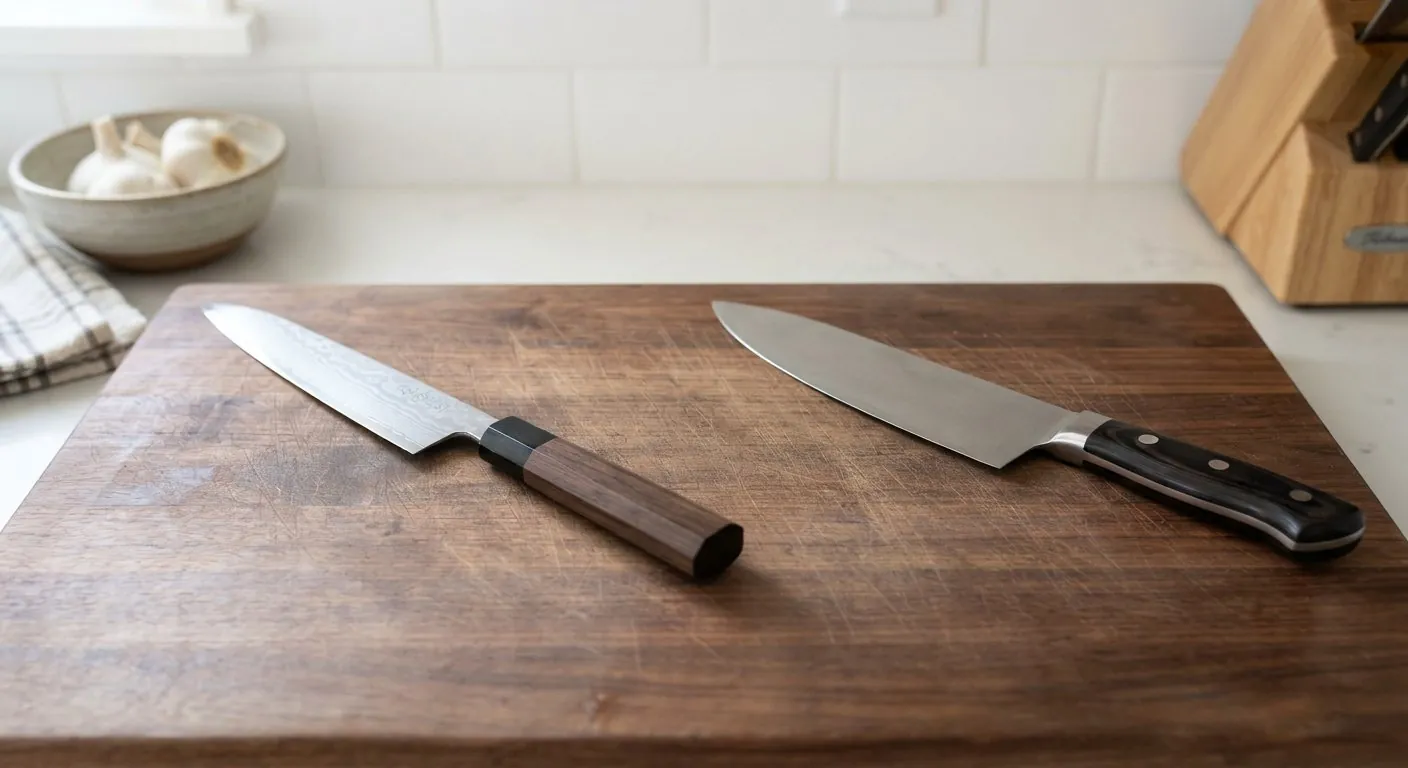
What I think matters most is that this maker seems to make only blades, not complete knives (0:44). One of my biggest complaints about Japanese knives is that makers put so much time and effort into beautiful blades, then fit handles that are just bad. Bought straight from Japan, this knife would probably come with a cheap D-handle made of porous, soft wood that drags down the value of the whole knife. Instead, it has a semi-custom octagonal handle, which is so much better than any D-handle you can buy.
You can't judge hardness by bending a knife
You can't tell how hard a knife is by sitting there flexing it; that's just silly (1:27). You have to use it in the kitchen and see how it holds up, or sharpen it and feel how the steel responds on the stone. I did both.
Short blade, nice profile
Holding it on the board, my knuckles sit at the same height as the edge, or even lower, so I suspected knuckle clearance issues (1:48). I measured the blade height at 40.97mm. It's a very short knife, something I didn't bother to check in the specs and something I'd have to get used to in daily use.
Other than that, it's a beautiful, well-crafted knife (2:30). The profile suits rocking, with a very short flat spot and a nice pronounced belly, and the distal taper gets razor thin toward the tip. The choil and neck are nicely rounded on both sides, there are no sharp edges except the edge itself, the spine is nicely polished, and the blade has a satin finish. The logo is engraved, a nice touch: kanji with a horse, and "HAP" for the HAP40 steel. When you're spending $200 to $250 or more, you want a knife that performs and is well made on the handle side too, and this one is.
A month later: still sharp
After about a month of daily use, the knife was still very sharp and very clean (0:00). I can see why so many people love HAP40. I'd been cleaning it about once a week with a rust eraser, because I personally don't love patina. Even so, a patina had started to develop deep in the metal, and getting all of it off would take very fine sandpaper or steel wool. On damp newspaper it still made a really clean cut (1:47).
The brick test and the 120-grit stone
To test a Shapton Glass 120 on a 65–66 HRC steel, I dulled the knife on my brick: 20 strokes, then five more (2:29). Painful with an edge this well maintained. Afterward it was duller but still sharper than most knives have felt after the brick, though it wouldn't cut me anymore. My rough guess is that 20 strokes on the brick equals about six to eight weeks of normal kitchen use (4:17).
On the stone, this knife feels like nothing else: it feels like it's barely being sharpened (6:52). I could see material coming off but could hardly feel it. HAP40 is by far the hardest steel I've used in my kitchen. Yet it's an easy steel to sharpen. After about four passes per side I had a micro-burr from tip to tip, cleaned it up with a few strokes, and the edge straight off a 120-grit stone could still feather newspaper (18:20). That's not an edge I'd take to the kitchen, but it shows what this steel and a good coarse stone can do.
Lapping a coarse stone: match the grit
People told me I shouldn't flatten the 120 with a 1200 Atoma, because it makes the stone too smooth (4:59). So partway through I lapped it with the Atoma 140 instead. It felt a little rougher, more like a 320 or 400 ceramic, and cut a bit faster, though on steel this hard the difference was small; on a 57 to 62 HRC knife it could matter more (9:44). After a few more passes, the hard steel smoothed the stone back down. My takeaway: lapping a coarse stone with a diamond plate of similar grit helps, and doing it once gives you fairly consistent performance. For how this stone compares with the others, see my Shapton 120 vs. Atoma 140 comparison.
Bottom line
The Gihei HAP40 gyuto pairs a 65–66 HRC blade that holds an edge for weeks with a semi-custom octagonal handle and fit and finish worth the $200 to $250. It's short at about 41mm, so mind your knuckles. For more hard-steel Japanese knives, browse the gyutos at the Burrfection Store and on Gyuto.com.
First access
Private drops, new knives and sales
Get them from Burrfection and our retail partners before anyone else. No spam; unsubscribe anytime.
Emails from Burrfection Inc. See privacy.