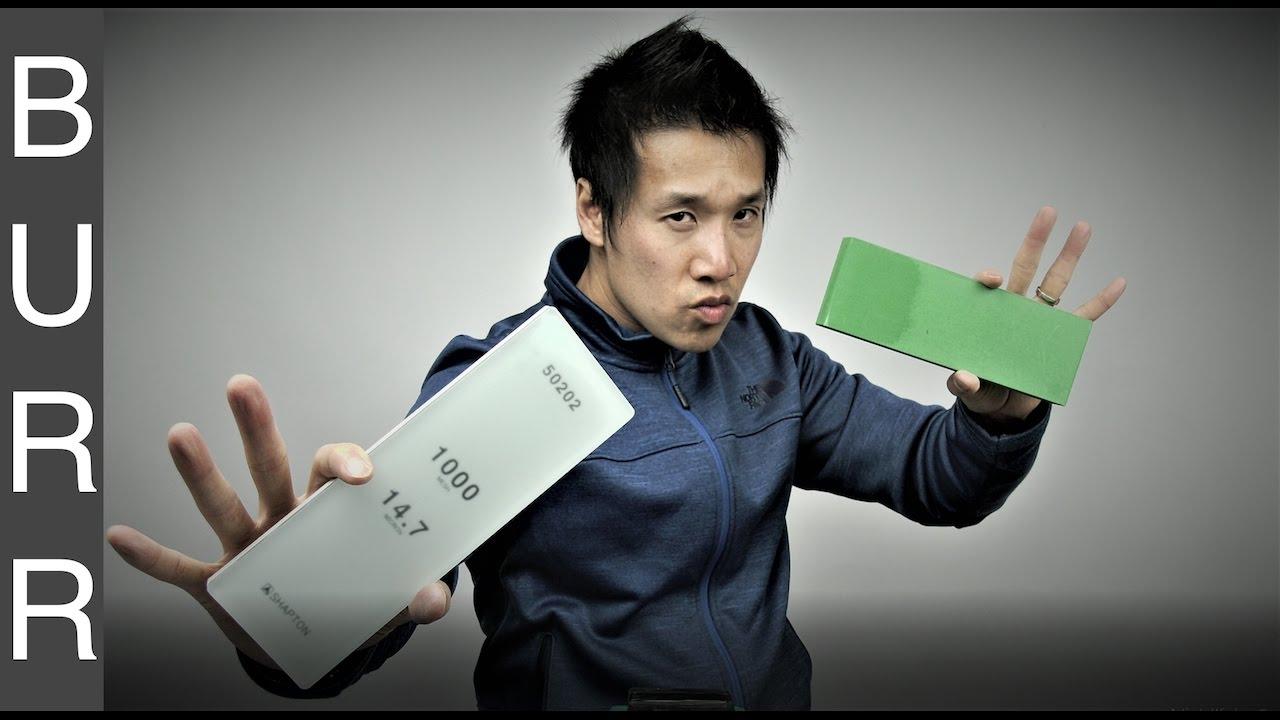
Shapton Pro 120 vs. Shapton Glass 120 vs. Atoma 140: Best Extra-Coarse Stone
Three extra-coarse stones after a dozen sharpenings each, on knives from 55 to 66 HRC. They're similar in grit but made for three very different people.
By Burrfection EditorialJanuary 24, 2017Updated November 21, 20266 min read
This article contains affiliate links: I may earn a commission if you buy through them, at no extra cost to you. How this works

The short version
- Best value and raw performance: the Shapton Pro 120. It's very fast, leaves a clean edge, and is twice as thick as the Glass.
- Best looking and nicest to use: the Shapton Glass 120. It wears slowly but feels finer than a true 120. Buy it if you already collect Shapton Glass.
- Best for flattening other stones: the Atoma 140. It's as fast as the Pro or faster, but knives over about 62 HRC skate on it.
I put each of these extra-coarse stones through at least a dozen sharpenings, on knives from 55 all the way up to 66 HRC, so I had a good feel for how each one behaves (0:00). They sit in the same grit range, but they suit very different people.
Shapton Pro 120: the surprise
The Shapton Pro 120 surprised me most (0:20). It's very fast: most knives raised a burr on the first pass, though I'd do two to make sure the burr ran evenly from tip to heel. It also left every knife with a really clean edge; I could cut paper easily straight off it.
It's a medium-wear stone. You can hear little pops as abrasive comes loose and gets ground between knife and stone, and when you lift the stone you'll see plenty of white and gray abrasive in the swarf underneath (1:05). It's splash-and-go, with no soaking, which is handy when you're in a rush. You won't use a 120 often, so it will last a long time.
Shapton Glass 120: finer than its rating
The Shapton Glass 120 kept up with the other two for speed, but it felt much finer than a 120 (1:46). I first dressed it with the 140 side of my diamond plate, then tried smoothing it with the 1200 side for four or five knives, and went back to the 140 (2:07). Within a pass or two, it felt just as smooth as after the 1200 lapping. To me it's smoother than a 120.
It wears very slowly. There's little slurry, and only the occasional metallic pop (2:49). That matters because it's much thinner: I measured about 7mm of stone on the Glass and 15.6mm on the Pro, roughly twice the thickness (3:10). The Pro also wears at least twice as fast, so I'd expect the two to last about as long overall. The Glass has excellent feel and feedback, it's splash-and-go, it's easy to carry, and a row of them with their glass backs and white ceramic is very nice to look at.
Atoma 140: fast, but not for the hardest steels
The Atoma 140 diamond plate was the only one where knives at about 62 HRC and up felt like they were skidding or hydroplaning (4:14). Both Shapton stones handled everything from 55 to 66 HRC and felt similar throughout; if anything, their feedback improved on harder knives. On the Atoma, harder knives lost feedback, and I lost my sense of what the edge was doing (4:36).
You can feel it on a single knife, too. My Tosa Cutlery Aogami Super gyuto, at 62 HRC, felt slippery on the Atoma, with much less friction than my Shun Kanso or Shun Classic, and the session was louder than with any other knife (1:36). It was still very fast: a burr after two passes on each side. After a countdown of stropping strokes it fine-feathered paper, but it wasn't the cleanest edge, which is fine for a repair plate. I'd move on to a 400 or 1000 from there (12:05).
For speed, it's at least as fast as the other two: clearly faster than the Glass, and maybe 10% faster than the Pro. Diamonds aren't forever, though; these plates wear down too. I'd expect at least five or six years of good use, possibly ten, which is about what I've heard from people using DMT plates (4:57).
| Shapton Pro 120 | Shapton Glass 120 | Atoma 140 | |
|---|---|---|---|
| Speed | Very fast | Fast, a little slower | As fast as the Pro or faster |
| Feel | Clean, true coarse feel | Finer than a 120 | Skates on knives over about 62 HRC |
| Thickness | About 15.6mm | About 7mm | Diamond plate |
| Wear | Medium, about 2x the Glass | Very slow | Diamonds wear down eventually |
| Best for | Everyday coarse work, best value | Shapton Glass collectors | Flattening stones, plus coarse work |
| Where to buy | Amazon | Amazon | Burrfection Store |
On softer German knives
I also ran two Western knives through these coarse stones. A Zwilling Pro utility knife, heat-treated to about 57 HRC and dull from months of cutting chicken, bone and steak, raised a burr on the Shapton Glass 120 in just two or three passes, and was ready for an 800 or 1000 stone after about four per side (6:45). The softer steel loaded the stone up noticeably faster than harder knives like the Shun Kanso had, but never enough to slow it down. I'd worried the Glass might be too hard for soft steel; it wasn't. One tip for this knife: its bolster sticks out past the heel, so when you sharpen the heel, rotate the knife past perpendicular, or work the heel at the bottom edge of the stone, so the bolster doesn't grind into it (8:37). Day to day I just touch these knives up on a ceramic rod, but Western knives absolutely can be sharpened by hand on stones.
On the Shapton Pro 120, a Wüsthof Classic Ikon chef's knife, freshly dulled on my brick, had a fine burr after a single pass with no pressure at all, and was ready to flip after two (5:58). It's so fast that I wouldn't make it anyone's first stone; it's easy to overdo things if you're not careful. After a few stropping strokes on the stone itself (five per side, then three, two and one), the edge sliced paper cleanly, including curved cuts, sharp enough to use in the kitchen even though I'd normally follow it with an 800 or 1000 (13:07). It didn't load up at all.
Which one should you buy?
Even in the same grit range, these cater to different buyers (5:18). The Shapton Pro 120 is for the everyday sharpener who wants something fast, affordable and high-performing. It's the best value of the three. But it removes a lot of metal, and if you're careless you'll wear your blades down too quickly, so I don't recommend it until you have a few months, or a few dozen sharpenings, under your belt.
I really like sharpening on the Shapton Glass 120. It's the best looking, and its wear rate is just right, but it doesn't feel like a 120 (6:20). If you already own a set of Shapton Glass stones, adding its coarse stone makes sense. If this is your first coarse stone, I'd buy the Pro. On raw performance, the Pro wins; on looks and portability, the Glass.
The Atoma 140 is the one to buy if you'll do a lot of lapping and flattening of other stones (7:23). For sharpening alone, go with one of the Shaptons, since the Atoma lacks their range on hard steels. Still, it will never leave my collection, because it can sharpen knives and flatten stones, which the other two can't.
Bottom line
All three are fast, but they're for different jobs. Pick the Shapton Pro 120 for value, the Shapton Glass 120 if you're building a Glass collection, and the Atoma 140 if you also need to flatten stones. For how I use the Atoma to fix chips, read my Atoma 140 review, and for where a coarse stone fits in a full kit, see my whetstone grit guide.
First access
Private drops, new knives and sales
Get them from Burrfection and our retail partners before anyone else. No spam; unsubscribe anytime.
Emails from Burrfection Inc. See privacy.