How a Nigara Copper Damascus Knife Is Made: From Blank to Box
One 210mm gyuto, start to finish at Nigara Hamono: straightening, two grinding wheels, belt polishing, etching and a hand-sharpened edge, done by feel.
By Ryky TranJune 29, 2024Updated November 25, 20263 min read
This article contains affiliate links: I may earn a commission if you buy through them, at no extra cost to you. How this works
The short version
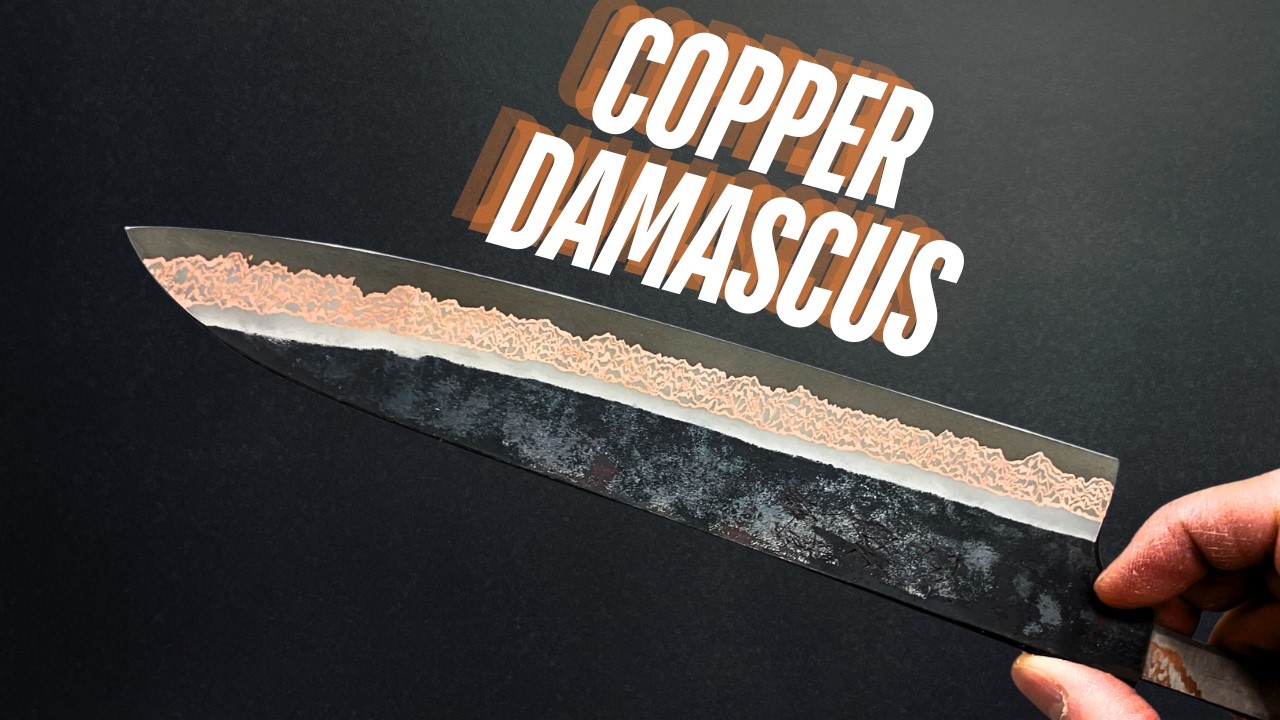
- One knife, start to finish: a 210mm Nigara gyuto with a carbon core, copper-and-stainless Damascus cladding and a kurouchi finish.
- Grinding is done by feel: a coarse wheel shapes the bevel, a four-foot-wide stone refines it, and the smith corrects imperfections the moment he feels them.
- Then belts, etching and oil: etching brings the copper layers to life, and every edge is sharpened heel to tip.
The knife
Burrfection is an authorized Nigara dealer; we buy directly from them (0:20). This was the first time I could show you one knife from start to finish: a Damascus with copper layers (0:41). It's a 210mm (8-inch) gyuto; I believe the core is Blue #2, and the cladding is a copper and stainless Damascus with a kurouchi outer finish, that raw, black, burnt look (1:02).
Straightening the blank
We followed Maruyama-san on day two of my visit, a Saturday morning (1:44). The billet had already been cut and shaped into a blank, and the first job was inspecting it for straightness (2:05). He applied what I'd call lateral torquing to straighten it from spine to edge, which is harder than it sounds on such a narrow piece of steel (2:51). Then he pre-ground the tang and the profile where he'd be holding it (3:22). (For straightening at home, see how to fix a bent knife.)
Two grinding stages
Stage one uses a narrow, very coarse wheel, maybe 80 or 90 grit, and their fastest-spinning one (3:43). Before grinding, he dresses the wheel, which flattens it and also gives it tread, like a tire's grooves, so the knife grips instead of sliding around (4:04). I love that while the water settles, he holds his hand just above the stone, feeling the water flow through his fingers, like an athlete's pre-competition ritual (4:46).
After about ten minutes, he moved to stage two (11:33). This still isn't sharpening: the goal is refining the bevel the first wheel created, on a stone about four feet wide that touches essentially the whole bevel at once (11:56). At one point he felt the knife skip, an imperfection between heel and tip, and corrected it on the spot, purely from the sensation (15:02).
Belts, etching and oil
Next came the belt sanding station, finishing the bevel, not yet the edge; at one point he put his hand right on the belt at full speed (15:23). A second belt, around 4,600 grit, polished further (19:41). Then a thorough washing (23:53) and etching, which is where the color changes and the copper Damascus comes to life (25:21). He finished the blade with an oil very similar to tsubaki oil and checked it for straightness once more (26:31).
Sharpening
For sharpening, he fits a temporary wa handle for control (27:21). On these machines, they always go heel to tip, never tip to heel (28:02). From the grinding stone, he went straight to the polishing stone, the last stone for the edge (29:08), and redid it when he wasn't happy. Then the handle came off, and the blade was ready to be sealed, labeled and packaged for my store (31:19).
Bottom line
Watching a knife go from blank to box shows how much of Japanese knife making is touch: dressing a wheel, feeling a skip, correcting it instantly. Nigara is just a handful of people, and this is why their knives are some of the best-finished I've held. Browse Nigara knives at the Burrfection Store, including the Ryky x Jet Li gyuto, and read more in inside Nigara Hamono's forge.
First access
Private drops, new knives and sales
Get them from Burrfection and our retail partners before anyone else. No spam; unsubscribe anytime.
Emails from Burrfection Inc. See privacy.