Inside the Global Knife Factory: How Japan Makes 100,000 Knives a Month
A five-hour tour with Global's founder: stamped steel, hand-filled sand handles, robot grinders, and the people who still clean, inspect and pack every knife by hand.
By Ryky TranJuly 23, 2026Updated November 25, 20263 min read
This article contains affiliate links: I may earn a commission if you buy through them, at no extra cost to you. How this works

The short version
- Global uses stamped steel and more automation than any maker I've visited, which is the only way to ship about 100,000 knives a month.
- People still matter: welding, filling every hollow handle with sand, some hand sharpening, and all the cleaning, inspection and packing are done by hand.
- Hand sharpening still wins: Global's own testing shows its hand-sharpened knives are about 10 percent sharper than its best machines.
Meeting Mr. Global
The night before the tour, I had dinner with Global's founder and now chairman, Mino-san, whom I call Mr. Global (0:02). He runs one of the largest, most successful Japanese knife companies in the world, and he greeted us with the biggest, warmest smile I've seen in Japan, sat me next to him, and kept refilling my non-alcoholic beer all night (0:23). The next day was a five-hour tour of his factory (1:28).
Stamping, not forging
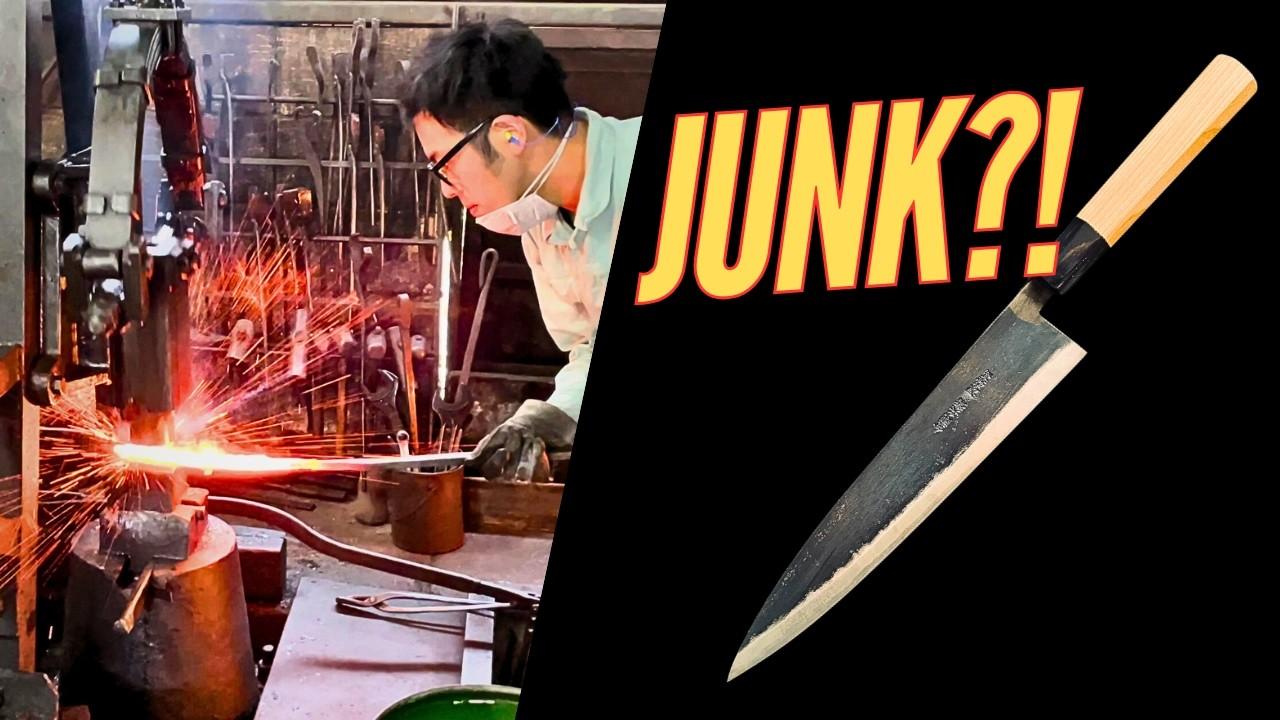
Our first stop was the stamping facility (2:12). Like many Japanese companies, Global farms out stages of production to separate facilities: stamping, heat treatment, grinding and welding (2:34). Global knives are made from stamped steel (2:55). Love it or hate it, that's the only way to supply 100,000 knives a month; all of Japan's hand-forging smiths combined couldn't do it (3:18). And no company I've visited uses more machine automation (3:41).
The handles are stamped in stages, each press adding a detail, more dimples or a change in curvature (4:03). It takes longer, but you get a much more reliable product, and the leftover steel is melted, re-rolled and pressed again (4:23).
Hands at every step
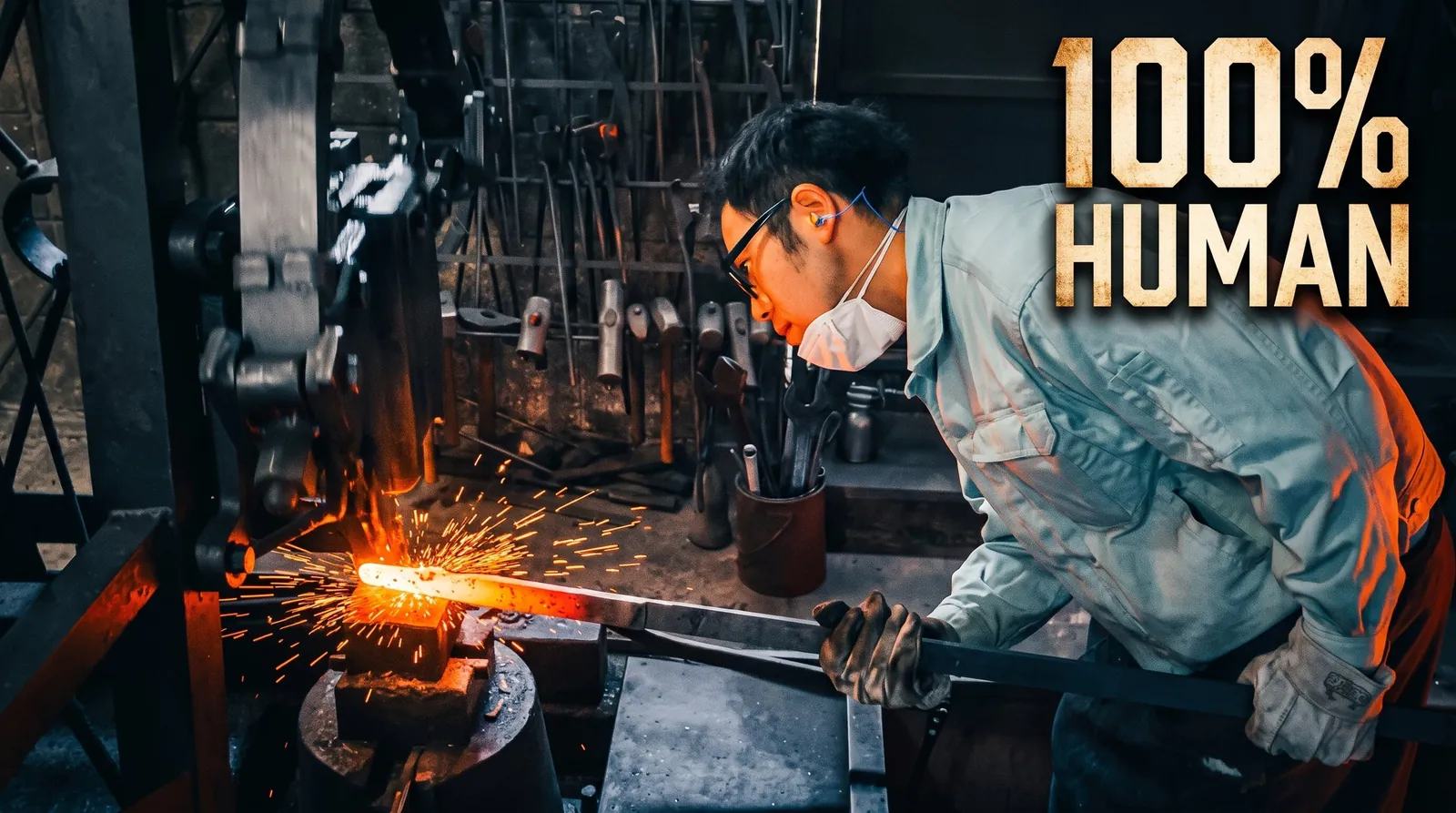
Blades and handles are welded together by hand, by three or four technicians at that facility (5:07). For all the automation, one bath step is still judged by the human eye, and Mino-san still likes to show up and inspect the knives (6:28). Then the part that surprised me most: Mr. Global fills each hollow handle with sand by hand (6:50). Rotating trays through the baths that create those familiar black dimples, he works entirely from memory, with no timer (7:40).
The factory floor
At headquarters, knives arrive in raw form: a blade welded to a handle that's been dipped entirely in black chrome (10:17). From there, it's a true factory, with lines of half a dozen to a dozen people per step; as a handmade-knife enthusiast, I'll admit it was a little depressing to see (11:25). A robot arm grinds the edge for the next step (12:12). Sanding removes the weld lines, and I finally understood why they dip the whole handle: grinding the chrome back off is the only way to get those perfect black dimples (12:46). One station calibrates to each handle shape and sends the settings to three grinders, which must be recalibrated for every new batch (13:56). Then comes a pre-grind of the edge; machines do about 99 percent of the work (14:22).
Most Global knives are sharpened only by machine, and they come off the line genuinely sharp (15:20). A couple of series are hand-sharpened on whetstones (15:46), and Mino-san told me that on his CATRA sharpness tester, hand-sharpened knives measure about 10 percent sharper than his best machines (16:06). Cleaning, inspection, testing and packing are all done by hand, by a team of women working at astonishing speed, in real time, no fast-forward (16:27). Think about it: 100,000 knives a month, all handled by them (16:48). I was told about 200 people touch each knife before it reaches a store (22:29).
| Global | Hand-forged artisan knife | |
|---|---|---|
| Blade | Stamped stainless | Forged by hand |
| Volume | About 100,000 a month | A few per day |
| Sharpening | Mostly machine; some series by hand | By hand on large grindstones |
| Consistency | Very high | Varies with the maker |
| Where to buy | Amazon | Anryu bunka (Burrfection Store) |
Bottom line
Before anyone knocks Global, see how it's made: stamped, highly automated, astonishingly consistent, and still touched by about 200 people, including a founder who fills handles with sand himself. It's the opposite end of Japanese knife making from the forges I usually visit, and both deserve respect. For the full spectrum, read how Japanese knives are made, and for the other extreme, forging with Kisuke Manaka.
First access
Private drops, new knives and sales
Get them from Burrfection and our retail partners before anyone else. No spam; unsubscribe anytime.
Emails from Burrfection Inc. See privacy.