How I Learned Knife Sharpening: Speed Skates, One Stone and Consistency
My sharpening didn't start in a restaurant. It started with my father's two stones under the sink and years of sharpening short-track speed skates. Plus the advice I'd give any beginner.
By Burrfection EditorialJune 17, 2017Updated November 24, 20264 min read
This article contains affiliate links: I may earn a commission if you buy through them, at no extra cost to you. How this works

The short version
- My sharpening skills came from the ice. As a short-track speed skater from 2002 to 2006, I sharpened skates before and after every practice, and that's where my push-and-pull was born.
- Buy the best knife you can afford and a cheap stone. You use the knife every day; you sharpen it once a week or less. Learn on one 1000-grit stone.
- Consistency is everything. Gear doesn't make the edge; a consistent angle does.
My father's two stones
My first memory of sharpening is my father in the kitchen (28:02). He used cheap knives from Chinese supermarkets, maybe $5 to $7 each, and kept two cheap stones under the sink: a black coarse one and a brown finer one. Before he cooked, he'd give the knife a few single strokes on the coarse stone. More than 30 years later, I still remember it vividly.
Where it really started: speed skates
If I have to point to the time in my life when sharpening really mattered, it was short-track speed skating (34:19). I skated from 2002 to 2006 and was trying to make the Olympic team. My skates had 17-inch blades on carbon-fiber boots. A speed-skate blade looks straight, but it has a radius along its length and a bend set into it, and I got really good at setting both (35:41). I'd spend about half an hour sharpening before practice and again after.
Then better skaters started asking me to sharpen their skates, and I was doing seven to twelve pairs a week on top of my own (36:43). That's where I really developed the push-and-pull and learned to sense tiny changes on the edge and on the stone. I don't have a restaurant background; I washed dishes in my mother's restaurants. My sharpening skills were developed on the ice. It's an unorthodox path, but it's my story.
Years later, reading knife forums, I kept seeing the same dozen people repeating what retailers said, so I bought a dozen stones and about half a dozen Japanese gyutos and started filming myself sharpening them (30:06). That became this channel.
Spend on the knife, start on one stone
If I had to choose, I'd buy the best knife I can afford and a cheap stone (8:30). You use the knife every day and sharpen it once a week, or every couple of months. I can sharpen a knife on a brick; I did, a fairly soft knife, on a brick from my backyard, and the cut was so smooth I'd guess the brick is closer to 1500 or 2000 grit (5:58).
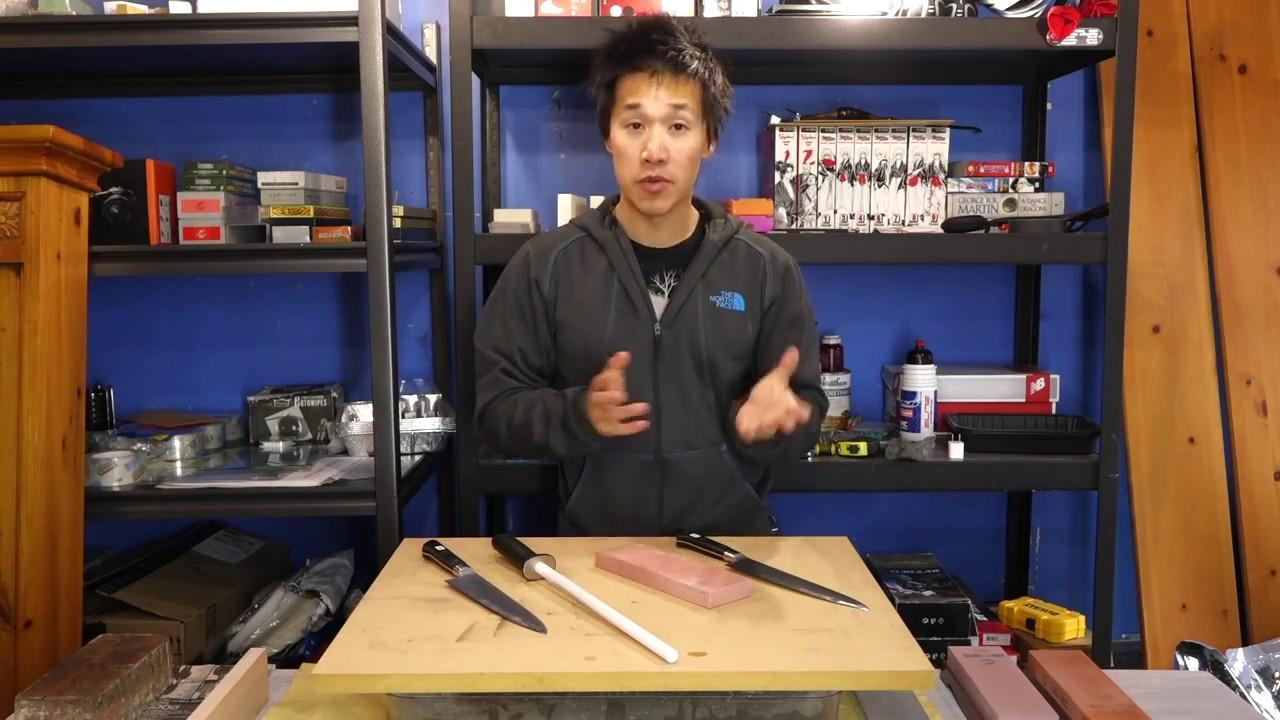
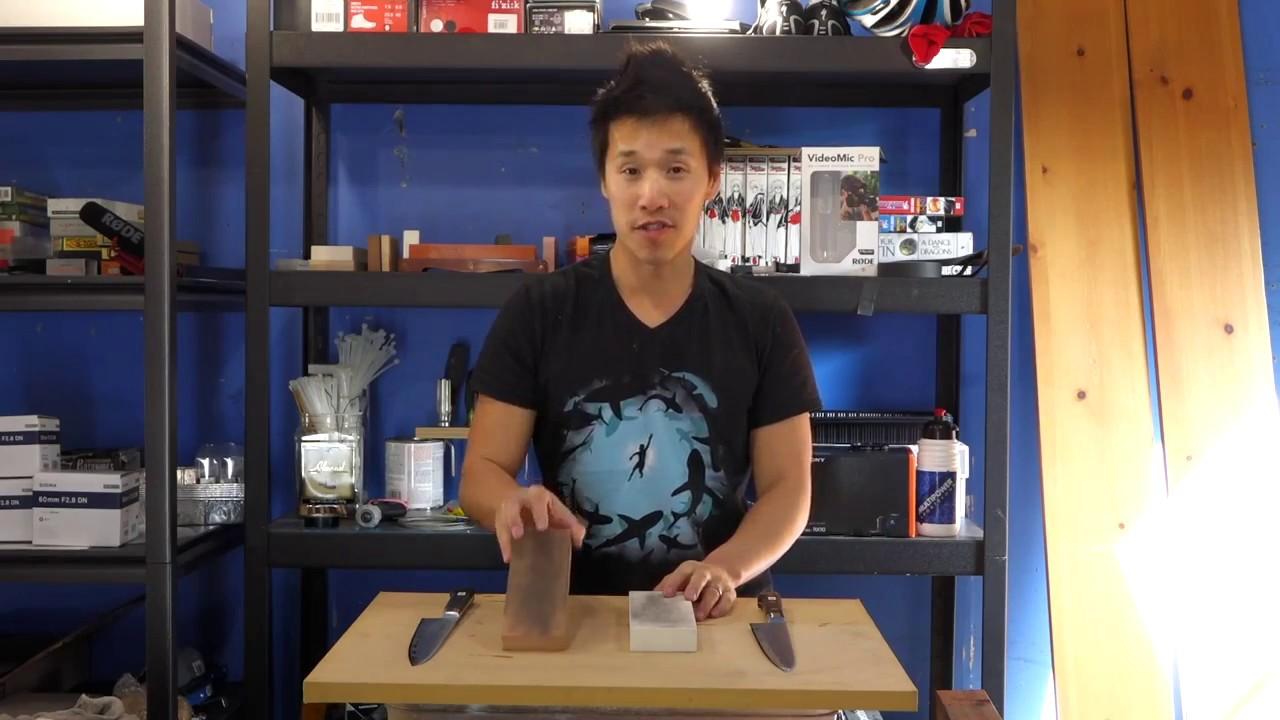
As a beginner, you don't need a 6000 (10:16). Hone your technique at the 1000-grit level, because that's where most of your knife's performance comes from. If the edge isn't good off the 1000, a 6000 won't fix it. Get one good 800 or 1000 stone and worry about polishing and stropping later. Budget stones work: the King KW65 1000/6000, the Whetstone Cutlery 400/1000, one of the better 400/1000 stones I've used, hard and slow to dish, and the Sharp Pebble 1000/6000, which is harder than the King with better feedback (9:34). A budget stone plus a good strop can give you as good a result as a Chosera or a Shapton.
Grit jumps, and why I stop at 3000
Going from a 1000 straight to an 8000, or even a 10,000, is fine (18:05). A stone in between only saves you time removing the scratches; it comes down to time and budget. My personal finishing stone is the Chosera 3000, now the Naniwa Pro 3000: a semi-mirror finish and an amazing edge (19:11). I prefer a kasumi finish anyway; to me a high-gloss mirror can look a little cheap.
Honing rod or strop?
A rod, ceramic or steel, realigns an edge whose teeth have rolled over (20:34). It suits softer knives like a Wüsthof at 55 to 58 HRC. At 60 HRC and up, daily use barely rolls the edge. A strop polishes the polish: after the stones, it removes the last microscopic bits from the edge. In a professional kitchen, I'd use a ceramic rod for knives under 60 HRC, and for harder knives keep a 3000 or 6000 stone or a strop and use it once or twice a shift (58:04). Light stropping doesn't fatigue the steel, while a rod bends the teeth at a microscopic level. My own routine is in how to keep your knives sharp every day.
Caring for stones and knives
I flatten with an Atoma 400, letting the plate's weight do the work with no more than a pound or two of pressure; weekly or every other week, it takes 30 or 40 seconds (15:13). Don't leave a soaking stone in water overnight: years ago a King 1000 left that way turned like clay and bowed (65:05). A King KDS survived an overnight soak but went sticky and stopped cutting until I dried it on its side for a week. I store all my stones on their sides.
Magnetic knife strips don't hurt a knife or its heat treatment; only overheating does (49:12). For carbon steel, wipe the blade with food-grade mineral oil every two or three days, or nightly; the patina still forms, just more slowly and more evenly (61:54). And for wooden handles, I mix equal parts raw linseed oil, mineral spirits and varnish or salad-bowl finish; about three coats, each cured 24 hours with a light sanding between, makes a handle nearly waterproof (52:44). More than three starts to feel plasticky.
Bottom line
I get good edges even off 120 to 300-grit stones, and that's because it comes down to technique, and the key word is consistent (72:31). You don't need a strop or five stones to get a razor edge. Buy the knife first, learn on one good medium stone like the Naniwa Pro 800, and practice until your angle is steady. When you're ready for a setup, start with the sharpening kits at the Burrfection Store, and follow along with how to sharpen a Japanese knife from A to Z.
First access
Private drops, new knives and sales
Get them from Burrfection and our retail partners before anyone else. No spam; unsubscribe anytime.
Emails from Burrfection Inc. See privacy.