How to Remove Rust and Patina From a Carbon Steel Knife: 4 Methods Compared
Steel wool, sodium bicarbonate, 3M microfinishing film and a rust eraser, tested on a Masamoto KS with six months of patina. One is clearly the easiest.
By Burrfection EditorialAugust 21, 2017Updated November 21, 20263 min read
This article contains affiliate links: I may earn a commission if you buy through them, at no extra cost to you. How this works
The short version
- My favorite: a rust eraser. It's cheap, clean, small and portable, it removes nearly all the patina, and once a week is plenty.
- Runner-up for frequent use: sodium bicarbonate on a damp rag. It's very cheap and great on light patina, but it won't touch a deep, set-in one.
- Skip the steel wool. It barely removes set-in patina and leaves metal dust you don't want around kids.
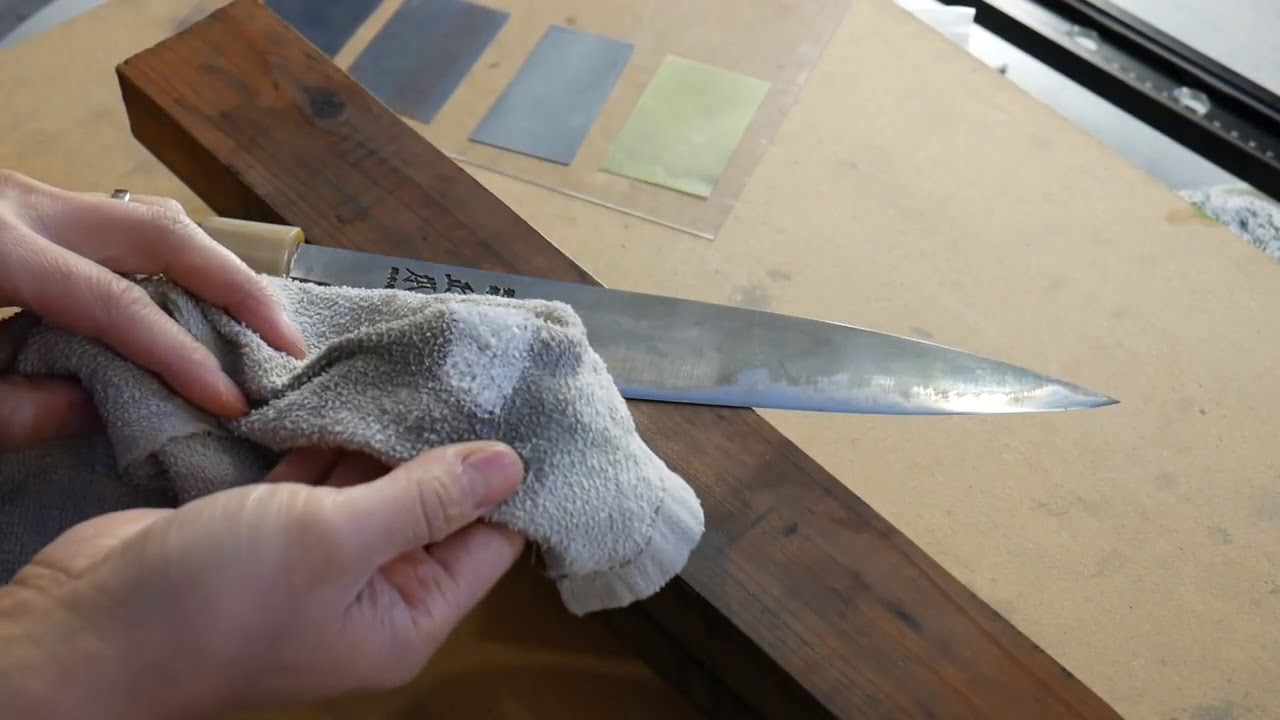
Every carbon steel knife develops a patina, and the longer you own it, the stronger it gets. You can slow it down, but you can't avoid it completely (0:20). A friend brought me his Masamoto KS after about six months of use. I'd helped him finish the handle, and he was tired of rubbing the patina off every couple of weeks as it got tougher and tougher to remove. So I tried four ways to take it off.
Method 1: 0000 steel wool
Make sure both the knife and the 0000 steel wool are dry (2:10). If you use it wet, the wool itself rusts and you can't reuse it; dry, you can use it a couple of times. Rub with the grain, along the knife's polish lines. It only takes off the very top layer of patina, though, so it isn't effective for set-in patina, and it takes a lot of time pressing into one area (2:32). It also throws off fine metallic dust you really don't want to inhale. With children at home, I don't recommend it.
Method 2: sodium bicarbonate
This is a chemical approach (3:36). I use Arm & Hammer sodium bicarbonate, about $2 for a three-pound box at a store like Target. Sprinkle a little on a damp rag and rub the blade with the grain (4:00). Rest the knife on a stable platform with a firm grip. Don't press it flat on a bench with only the tip and handle touching, or you risk bending it. And never rub toward the edge, or you'll lose skin, or worse.
It does a pretty good job, leaving a very fine scratch pattern that isn't a big deal and a nicely polished surface (5:34). It dissolves as soon as it touches water, so cleanup is easy. Its limit is depth: it takes off the first couple of layers of patina, but not one that's deeply embedded after months of use (1:27).
Method 3: 3M microfinishing film
3M microfinishing film isn't rated in grit but in microns (6:21). The coarsest in the pack is roughly 1000 to 2000 grit, and the finest gets down to a few microns, enough for a near-mirror polish. I cut the sheets into small rectangles and use them wet or dry, with water on the blade and a firm grip, rubbing with the grain (6:44). A few seconds brought the knife back to its original sheen. But a pack of four to six sheets costs about $20, so it's more of a specialty product. I wouldn't buy it just to remove patina (8:01).
Method 4: a rust eraser
A rust eraser made for knives costs about $10 and comes in three grades: coarse, medium and fine, the fine one with red lettering (8:44). Wet the knife and rub with the grain. Even a brand-new, slightly hard eraser gave a finish similar to, if not the same as, sandpaper or the microfilm, removing pretty much all the unwanted patina (9:53). It's much cheaper than film and lasts a long time, and using it once a week is more than enough to keep patina and rust from building up.
| Steel wool (0000) | Sodium bicarbonate | 3M microfinishing film | Rust eraser | |
|---|---|---|---|---|
| Works on | Only the top layer | Light patina | Set-in patina | Set-in patina |
| Cost (2017) | Cheap | About $2–3 a box | About $20 for 4–6 sheets | About $10 |
| Mess | Metal dust | Dissolves in water | Clean | Clean |
| Best for | Avoid it | Frequent light cleaning | Polishing enthusiasts | Weekly maintenance |
| Where to buy | Amazon | Amazon | Amazon | Burrfection Store |
Bottom line
These are only four of many methods, but my favorite is the rust eraser: easy, clean, cheap, small and portable (10:16). If you clean your knife every day or every week, sodium bicarbonate is a great, cheap second choice that also handles plenty of other kitchen cleaning. If you have money to spend, 3M film is a decent option. I'd stay away from steel wool. For more on living with carbon steel, see my Masamoto KS vs. Masamoto VG comparison and my Yoshihiro Aogami Super review, where I tested oil against patina.
First access
Private drops, new knives and sales
Get them from Burrfection and our retail partners before anyone else. No spam; unsubscribe anytime.
Emails from Burrfection Inc. See privacy.