Japanese Knives Are Too Cheap: What I Learned Forging a Knife With Kisuke Manaka
A day at the spring hammer with master smith Kisuke Manaka was the most dangerous, humbling thing I've done, and it convinced me hand-forged knives are underpriced.
By Ryky TranSeptember 5, 2025Updated November 25, 20263 min read
This article contains affiliate links: I may earn a commission if you buy through them, at no extra cost to you. How this works
The short version
- Hand forging is brutally hard: controlling a spring hammer's pedal, keeping a billet perfectly square and folding a san mai blade took more finesse and strength than I had.
- It's dangerous: a billet that kicks up can cost you an eye, and the belt-driven grinders can catch you.
- My conclusion: Japanese smiths who forge knives one at a time aren't charging enough.
Meeting Kisuke Manaka
After this day, "Japanese knives are way too cheap" was the only title that made sense (0:09). Forging a knife by hand was the most dangerous and most difficult thing I've ever done (0:29). My teacher was Kisuke Manaka, a renowned smith in Kasukabe, Saitama Prefecture (1:10). He also makes farming tools, a big part of life where he lives (2:27), and his top-of-the-line knives sell for over $2,000, including a katana-style slicer that is simply magical (2:48).
The spring hammer
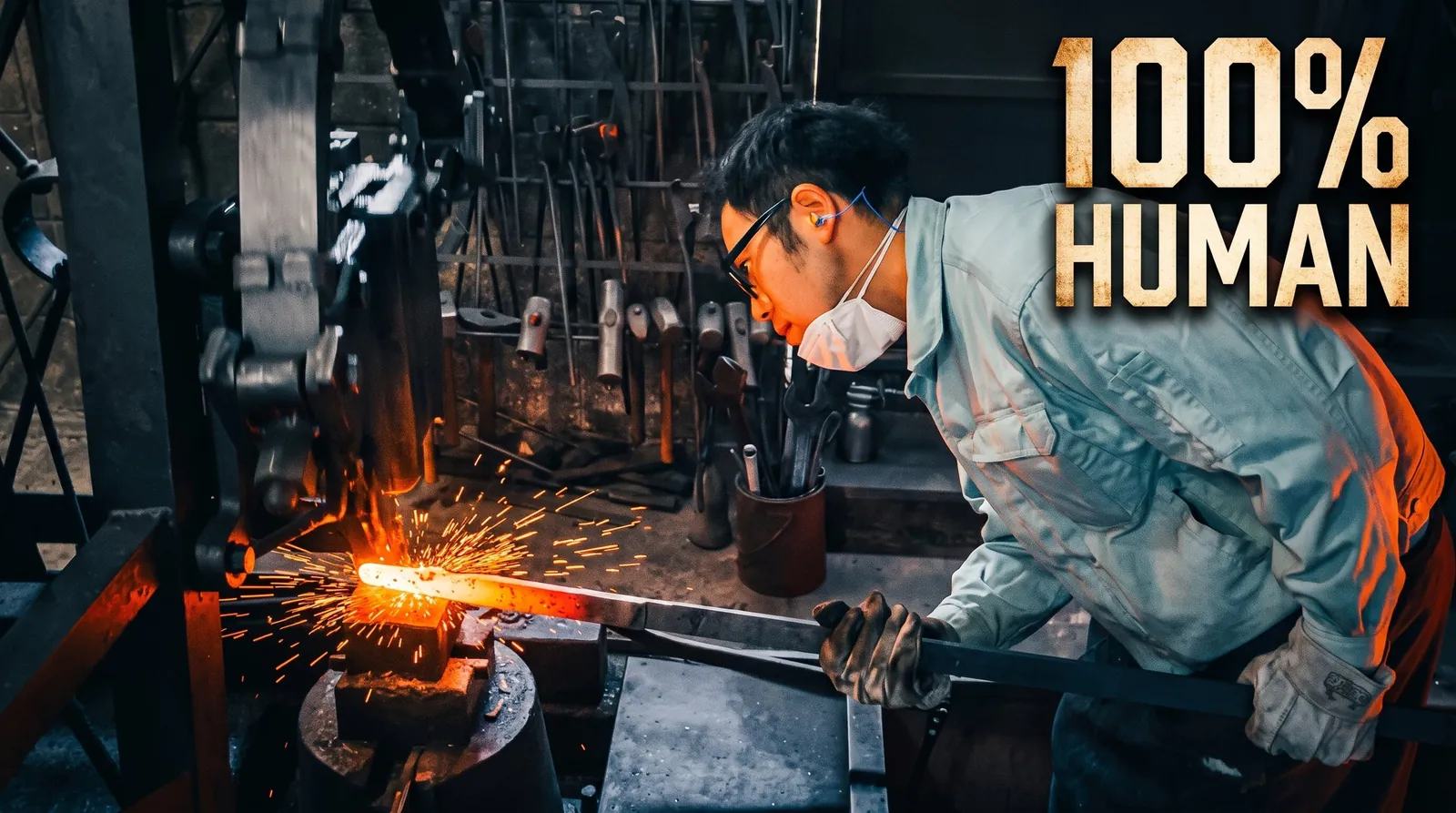
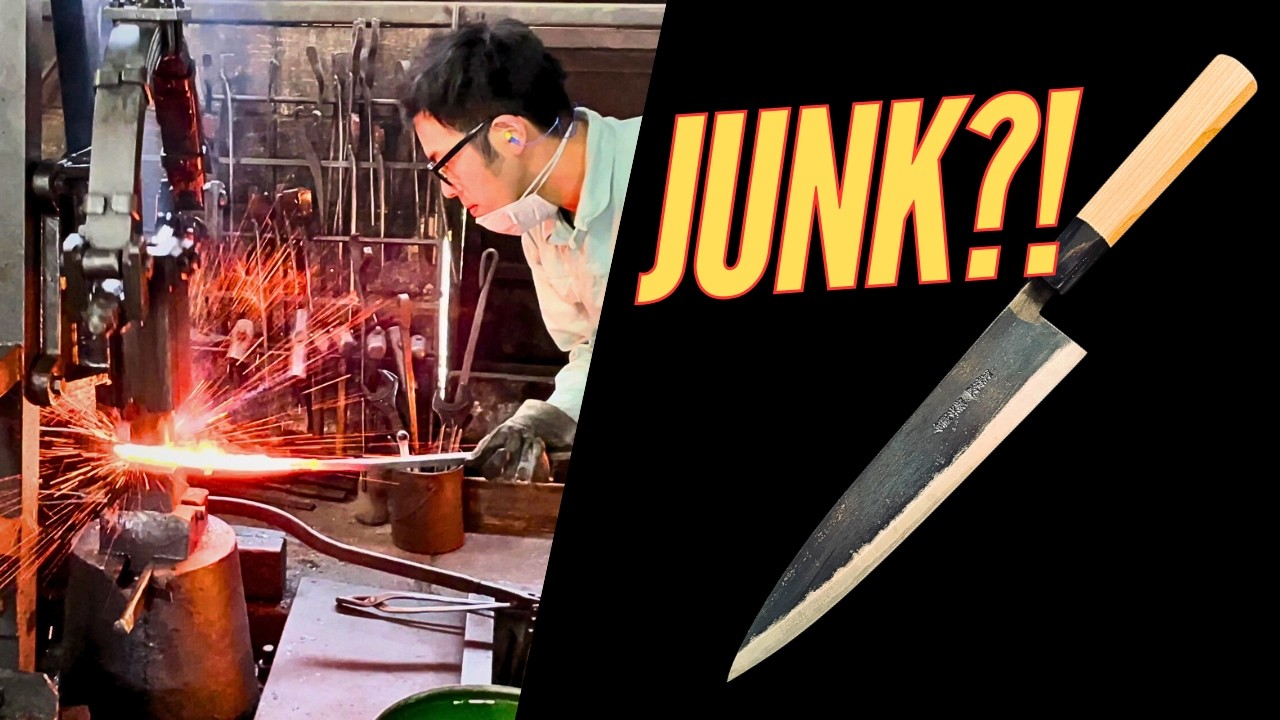
He told me to wear something I didn't mind burning (3:11). The first drill was hammering a small piece on both sides to make sure I could strike straight, which is harder than it looks (3:32). Then he explained the real risk: if your angle is off, the hammer can kick the stock up into your eye (4:24). I rarely hesitate in daily life; at the hammer, I hesitated for a long time.
The hardest part was the pedal (5:44). I couldn't find the balance point between striking too hard, too soft or not at all, and every time I lifted off and pressed again, that point seemed to move. The anvil isn't flat either; it has a slight dip, so the stock slides (6:51). Hand hammering was hard in a different way, and when I couldn't generate enough power while holding the stock, Manaka-san held it for me so I could just swing (7:11).
Folding a san mai blade
Next he folded the cladding to take the Aogami core steel, the san mai construction you see on so many Japanese knives: a hard cutting layer in the middle, cladding on each side (8:54). You have to keep the billet perfectly perpendicular to the hammer, or the line warps and one side of the cladding ends up bigger than the other (9:34). Once the groove skews, it's very hard to correct, and he had to step in so we wouldn't lose the stock. It was one of the hardest physical things I've ever done (11:26).
Flattening the blade is harder still: as you hit it, it bows in the center, so you're constantly moving around the edges (12:27), while also changing your pedal pressure between the flat and the edge (13:10). Then I put in tsuchime hammer marks, the patterns you see on many handmade knives, which are done by hand, one strike at a time (15:05).
Cutting and grinding
Before hardening, the blade is cut to a rough shape and ground along a chalk line (16:38). The grinders are driven by belts running from the ceiling; walk carelessly and you can hit your head on a belt (16:59). Grinding takes little strength but a lot of finesse, sitting almost at ground level with the blade braced against your shin (17:40). I engraved my name, Ryky, in a kanji-style engraving (18:02).
The finished knives
Later, a box arrived (19:16). Manaka-san had heat-treated my blade, finished the grind and turned it into a bunka, because I'd told him I love bunkas. He also sent the ATS-34 stainless blade I'd hammered after forging, heat-treated to about 64 HRC (20:22), and one of his own 210mm knives with a gorgeous finish (20:43). I'll put handles on the ones I made and use them every day; they'll never be for sale (21:04).
Bottom line
If you ever get the chance to try knife making, take it: you'll appreciate every knife, and the people who make them for a living, far more (21:51). After a day at Manaka-san's forge, I stand by it: Japanese smiths who forge their knives one at a time are not charging enough (22:12). To see that work in other forges, read how Japanese knives are made and visiting Hinoura Hamono, and browse Manaka Hamono's knives at the Burrfection Store or the gyutos at Gyuto.com.
First access
Private drops, new knives and sales
Get them from Burrfection and our retail partners before anyone else. No spam; unsubscribe anytime.
Emails from Burrfection Inc. See privacy.