Amakusa Natural Whetstone Review: My First Natural Stone vs. a Synthetic 1000
A lumpy, gritty stone cut from a Japanese mountainside. It got a VG10 knife to 244 on my sharpness tester, but it's slower and softer than any synthetic 1000 I've used.
By Ryky TranNovember 1, 2018Updated November 24, 20262 min read
This article contains affiliate links: I may earn a commission if you buy through them, at no extra cost to you. How this works

The short version
- It works: one Amakusa stone and a strop got a VG10 knife to 244 on my PT50A tester, very sharp.
- It's slow, soft and gritty, slower than any synthetic 1000 I've used, and lumpy out of the box. Flatten it first.
- For the same money, a synthetic is better. I'd buy a Suehiro Cerax 1000, or for about $10 more, a Chosera 800.
My first natural stone
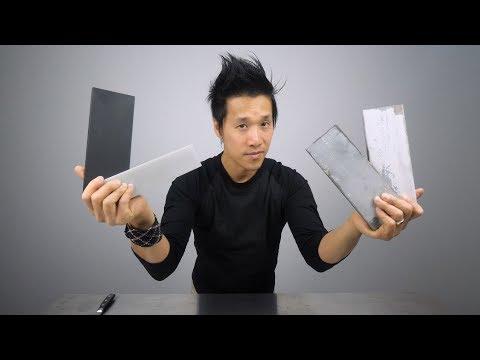
This was the first natural stone I'd ever used: an Amakusa that I think is around 1000 to 1200 grit (0:00). It was really lumpy out of the box (0:29), but I used it without flattening first to see how it did (0:52). It's a fairly soft stone that builds a lot of slurry, and on a VG10 knife it wasn't raising a burr (3:38); on my synthetic stones, a burr forms by the second or third pass (3:59). Eventually it came, and I deburred with a few fast, light passes (6:58).
Stropping and the sharpness test
Then I stropped with single pulls on a leather strop with compound (9:15), on purpose skipping any higher-grit stone, to see what this one stone could do (9:36). On paper the edge was clean with no skips (11:19), and it push-cut across the grain (11:44). My PT50A tester measures the grams it takes to cut a filament (12:06); under 300 is high-end kitchen-knife territory (12:27). This knife scored 244, very acceptable from one stone and a strop (12:49).
The verdict
It's much slower than what I'm used to, a Chosera, a Cerax or a Debado (13:10), and I wouldn't use it straight out of the box unless you're experienced; flatten it first (13:30), with 220-grit sandpaper or drywall mesh on a flat surface (13:50). It's also very soft and builds a lot of slurry, which slows me down and hides the burr (14:32). It's softer and slower than any synthetic 1000 I've used (14:52).
The appeal is the connection to something ancient: it's cut straight from a mountainside (15:14). But for around $60 I'd recommend a synthetic, like the Cerax 1000, or for about $10 more the Chosera 800 (15:35). It's fun to use, and this was only my first time; see how to flatten whetstones before you try one (15:55).
| Amakusa (natural) | Suehiro Cerax 1000 | Chosera 800 | |
|---|---|---|---|
| Speed | Slow | Fast | Faster |
| Feel | Soft, gritty, lots of slurry | Smooth, great feedback | Hard, instant feedback |
| Out of the box | Lumpy; flatten first | Flat | Flat |
| Where to buy | Amazon | Burrfection Store | Burrfection Store |
Bottom line
The Amakusa is a fun first taste of natural stones and can get a knife very sharp, but it's slower, softer and grittier than a good synthetic 1000 at the same price. Buy it for the experience, not the performance. For Japan's other famous stones, see the natural stones in my Tokyo knife-shopping guide, and for America's answer, my Arkansas whetstones review.
First access
Private drops, new knives and sales
Get them from Burrfection and our retail partners before anyone else. No spam; unsubscribe anytime.
Emails from Burrfection Inc. See privacy.