Push and Pull vs. Crescent Stroke: Which Sharpening Method Fits Your Knife?
A flat Japanese gyuto and a curvy Kramer-style chef's knife shouldn't be sharpened the same way. Your knife's profile decides the stroke, and here's why.
By Ryky TranAugust 8, 2020Updated November 25, 20264 min read
This article contains affiliate links: I may earn a commission if you buy through them, at no extra cost to you. How this works

The short version
- Match the stroke to the profile: push and pull for straighter gyuto and Sabatier-style profiles, the crescent stroke for curvy Kramer-style Western knives.
- The wrong stroke slowly ruins the profile: crescents round off the tip and heel of a straight knife, and push and pull leaves flat spots on a curved one.
- Moving up grits: keep the same final stroke, one per side, on the next stone. Stropping is optional.
Two very different profiles
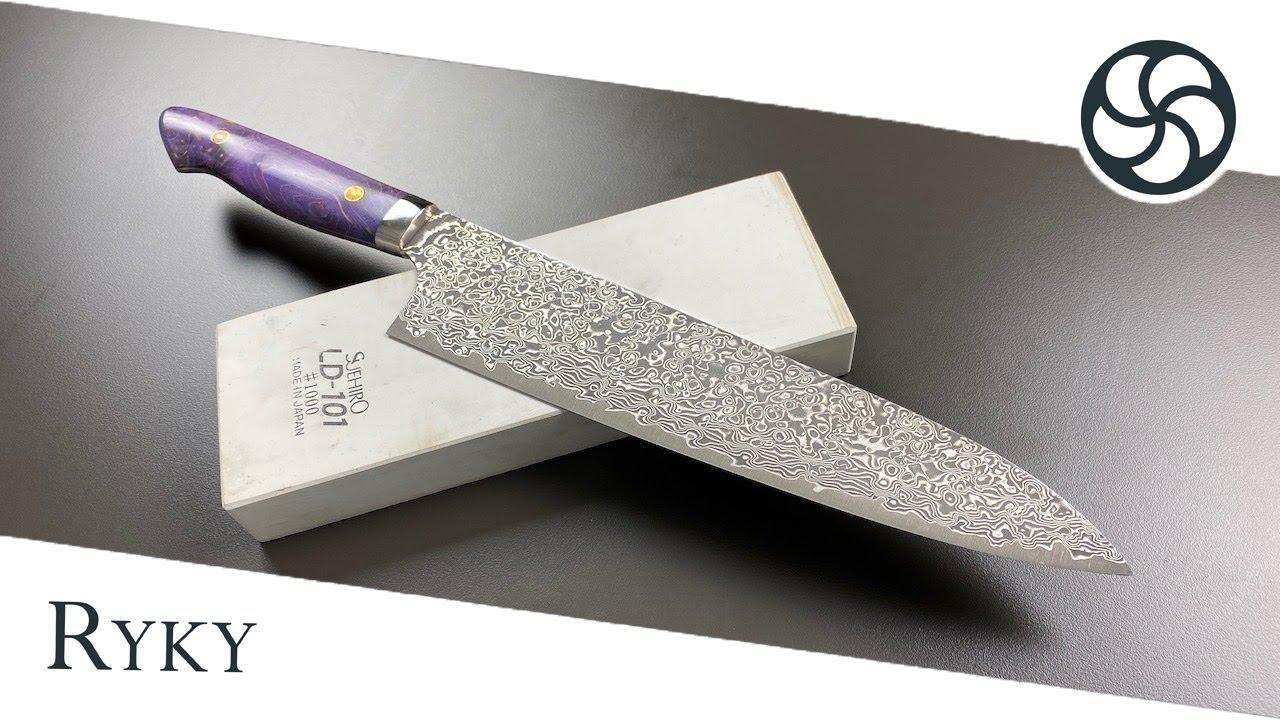
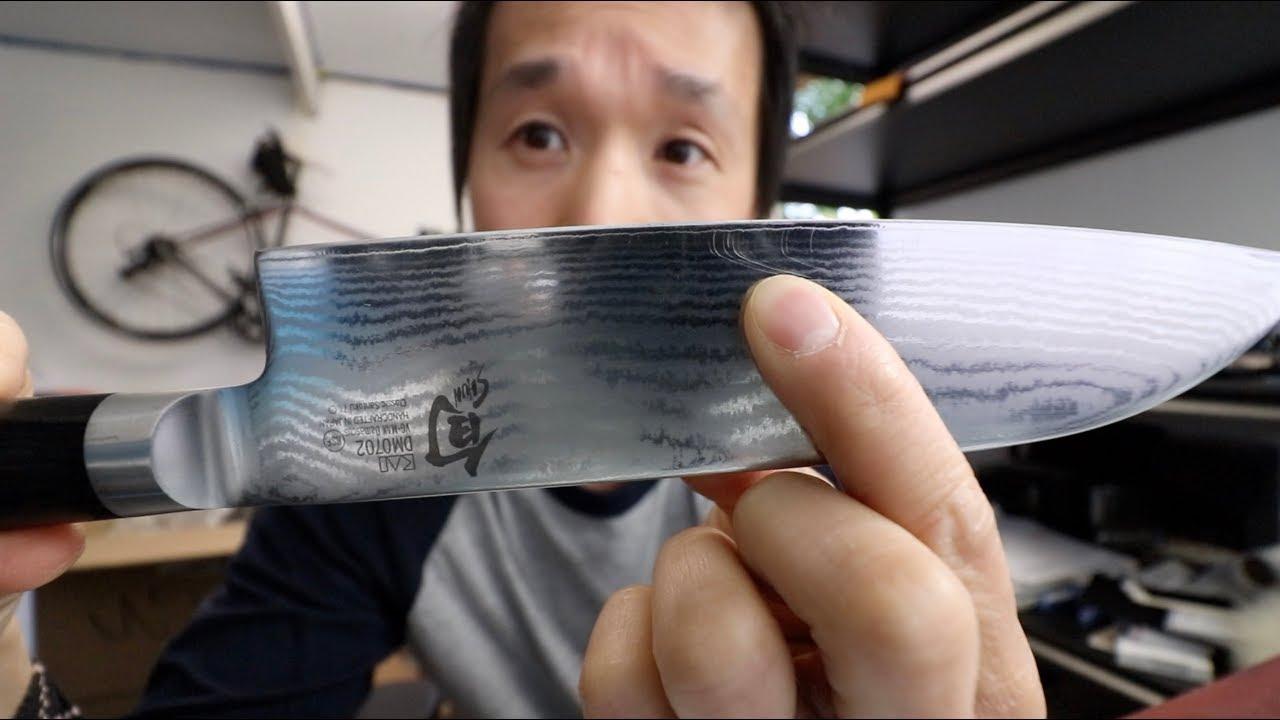
After my Kramer sharpening video, many of you asked whether you should sharpen a Japanese knife the same way (0:23). So I sharpened two knives with very different profiles side by side: my own VG-10 gyuto, with a Sabatier-style profile, and a Kramer-style Western chef's knife with a big belly (0:45). For stones, I used my Naniwa Pro 800/3000 Burrfection Edition and a rolled buffalo-leather strop (1:27).
The best method comes down to the profile (1:47). If your knife looks more like a gyuto, use push and pull. If it looks more like a Kramer, the most popular knife with that shape, use the crescent method. I call it that because you move in a crescent-shaped arc.
Why push and pull is faster
Push and pull works one section of the blade at a time, so each section gets more work than when you sweep the whole edge in a crescent (2:08). People also find it easy to put weight behind a linear stroke, though I don't consider pressure a good reason (2:29). And you sharpen at roughly 45 degrees to the stone, sometimes closer to perpendicular, and the more perpendicular you go, the more steel the stone removes (2:50).
Protecting the ferrule at the heel
On the left side, from the middle of the knife to the heel, I turn the knife closer to perpendicular to the stone (3:11). If you keep the same angle of approach all the way, you'll scratch the top corner of the ferrule. You have other options: lift the heel, which changes your geometry and defeats the purpose of a shallow angle (3:32), or switch hands and keep both sides at 45 degrees, which looks clean but is hard unless you've taught yourself to sharpen ambidextrously (3:53). Turning the knife at the heel is the easiest compromise, and in sharpness there's no difference; switching hands is purely about aesthetics (4:15).
Can you use the "wrong" stroke?
Yes, but here's why I don't recommend it (4:36). On a straighter knife, a crescent stroke gives the tip and heel the most time on the stone (4:57). After maybe half a dozen to a dozen sharpenings, you'll have a rounded heel and tip, and the profile is ruined (5:18). You can do it carefully, but it takes far more concentration than push and pull.
The reverse is true too. A Kramer-style knife has an obvious belly in its front half and does much better with curved strokes (5:39). Push and pull works, but unless you give every section the same number of strokes, you'll develop flat spots, again after a dozen or so sharpenings of uneven pressure and time (6:21).
Edge-leading strokes on a curved knife
I've often said I put pressure only on the edge-trailing stroke, yet on the Kramer-style knife it looks like I'm pressing on the edge-leading stroke (7:01). On that profile, going tip to heel edge-trailing makes me hit the belly too aggressively, and over time I'd wear a flat spot into it; going heel to tip edge-leading gives me much better contact (7:22). On the gyuto, the opposite is true. That's why my finishing strokes go tip to heel on one knife and heel to tip on the other.
Moving up grits and stropping
When I move to the next stone, I take my last stroke and replicate it: one stroke per side, without raising a new burr or starting over (8:05). Plenty of sharpeners repeat the whole process on each stone, and that's fine (8:27). I prefer my way for consistency: switching between push and pull and single strokes creates small variations, and your angle can drift by half a degree or a degree between stones (8:48).
Do you need to strop? No (9:09). In my tomato test, I skipped the strop entirely and still got clean cuts off a 140-grit diamond plate (9:31). A strop removes the last micro-burr; I strop my own knives on leather, but newspaper or cardboard works if you can't afford one, and compound just speeds things up and adds polish (9:52). If you want one, the premium equine leather strop is a good start.
| Push and pull | Crescent stroke | |
|---|---|---|
| Best for | Gyutos, Sabatier-style and straighter profiles | Kramer-style and curvy Western profiles |
| Speed | Faster: one section at a time | Slower: the whole edge each pass |
| Risk if misused | Flat spots on a curved belly | Rounded tip and heel on a straight edge |
| Finishing direction | Tip to heel, edge-trailing | Heel to tip, edge-leading |
| Where to buy | Naniwa Burrfection Edition 800/3000 (Burrfection Store) | Kramer by Zwilling (Amazon) |
Bottom line
There's no single best sharpening stroke, only the best stroke for your knife's profile. Look at your knife: straight and Japanese, push and pull; curvy and Western, crescent. Sharpening isn't mysticism; there's no secret technique beyond practice (10:34). For step-by-step guides, see push and pull on a gyuto and the Kramer-style crescent stroke.
First access
Private drops, new knives and sales
Get them from Burrfection and our retail partners before anyone else. No spam; unsubscribe anytime.
Emails from Burrfection Inc. See privacy.