How to Sharpen a Nakiri on a Whetstone (and Why I Ignore the Factory Angle)
A straight-edged vegetable knife needs push-and-pull strokes in sections, an angle you find by feel, and a deburr on the stone. One stone is enough.
By Burrfection EditorialJanuary 21, 2017Updated November 24, 20265 min read
This article contains affiliate links: I may earn a commission if you buy through them, at no extra cost to you. How this works
The short version
- Find your angle by feel, not by the number on the box. This nakiri's box says 8 to 12 degrees, but at 12 degrees I was a hair away from grinding the Damascus cladding.
- A straight edge wants push-and-pull strokes, done in two sections, rather than one long sweep from heel to tip.
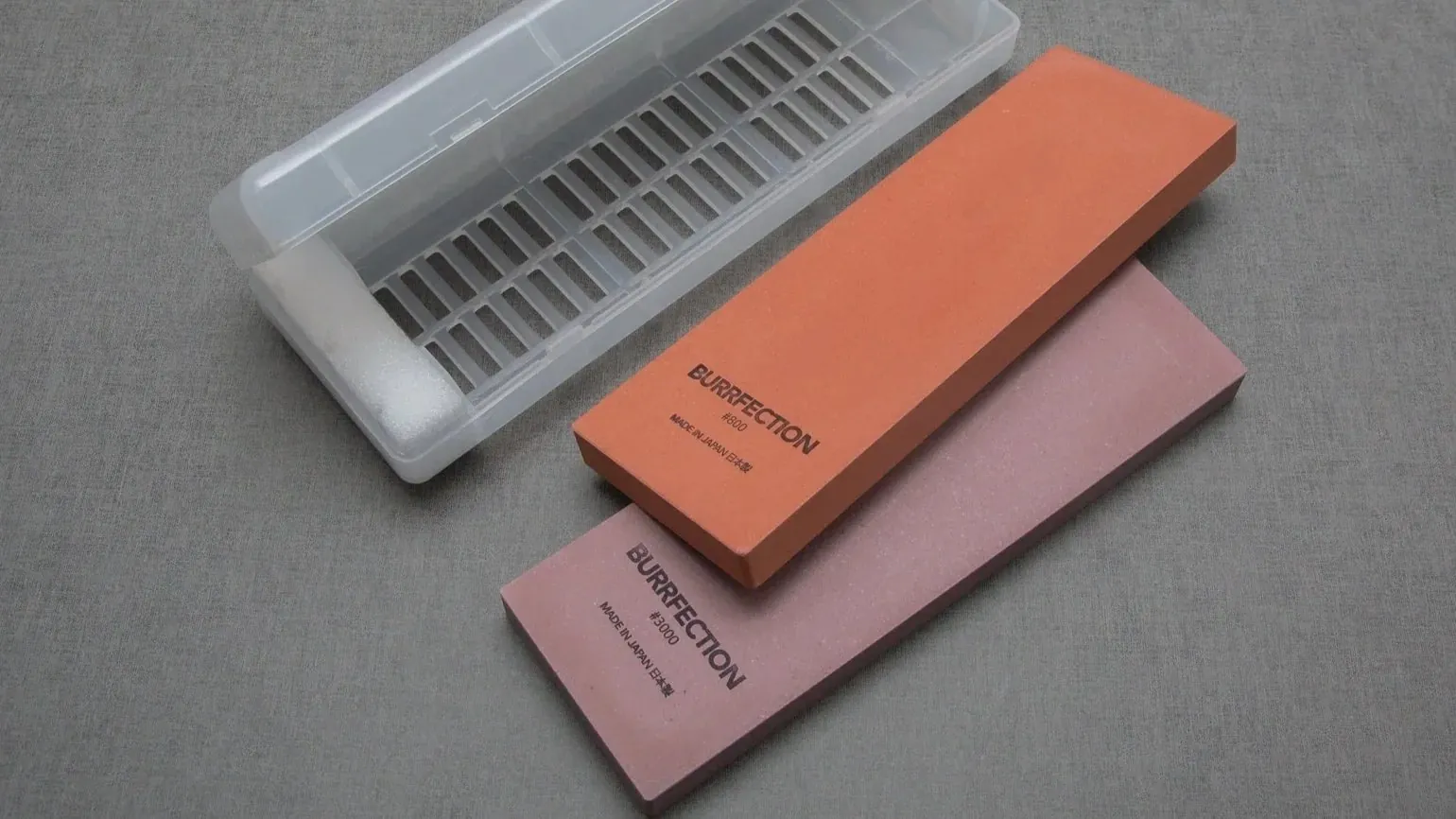
- One stone is enough. On my Naniwa Pro 800 (the Chosera 800), with the burr removed on the stone itself, it cleanly feathered paper.
The knife
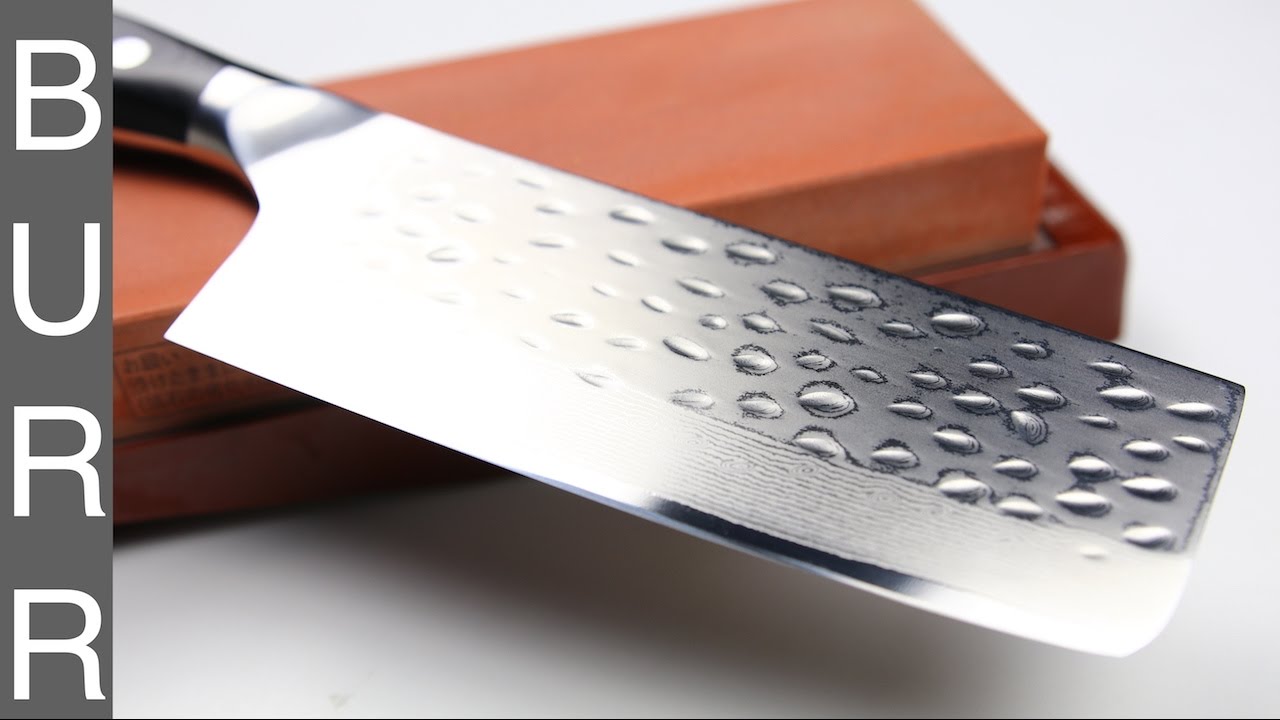
A lot of you asked me about nakiris, so this one is a Dalstrong Shogun Series X nakiri (0:00). It has a 50/50 bevel, which means it doesn't matter which side you start on; it's just a matter of preference. If you're still deciding whether you need one, my gyuto vs. nakiri comparison shows why a nakiri chops vegetables so well.
Why I don't give you an angle
People message me saying I'm doing beginners an injustice by not telling them what angle to sharpen at. Here's the problem nobody talks about (0:42). Lay this knife flat on its bevel and there's already a gap at the spine. At what's probably 12 degrees, you're a hair away from grinding into the cladding, and you don't want to ruin a beautiful clad knife. That's exactly why people ask me how they ended up scratching the Damascus on their knives: their angle is too low. The box says 8 to 12 degrees, and that may be true, but the factory does it on a grinding wheel, where steep angles are much easier. On a whetstone there's far more surface contact, so the low end of that range eats into the cladding.
So I find the angle the way I always do: I run the knife on the stone, play with the angle, and feel for the one with the best friction (2:27). Trying to hold 8 to 12 degrees, the knife slipped, like it was hydroplaning. The angle that felt right was steep enough to fit a rust eraser under the spine, something most of my Japanese knives can't do. Maybe that's 18 or 20 degrees; I honestly don't care what the number is. Knives are shaped differently, and this one is a fairly thick wedge right behind the edge, so no single number works for every knife.
Push-and-pull, in two sections
This nakiri has a very straight profile with just a gentle curve near the tip (4:16). If you press on the bottom tip, the top lifts off the stone, and vice versa, so I sharpen it in two sections: the front half, then the back half. People ask why I switch between push-and-pull and a single sweeping stroke. On a straight edge, push-and-pull is the easiest way to hit the whole edge evenly; a sweeping stroke is for curved knives, and on a straight one it doesn't get all of the edge properly.
For the grip on the right side, my middle finger goes up to the choil, my thumb lies down on the blade, and my index finger rests on top (5:44). Bring that finger back just a hair so your hand isn't tense; when I straighten it out too much, I cramp up. Keep your hand as relaxed as possible and sharpening gets much easier.
The stone is my Chosera 800, my workhorse (6:06). It has five or six dozen sharpenings on it, maybe more, and I've never flattened it. The reason is simple: I use as much of the stone's surface as I can instead of keeping everything in the center, so it doesn't dish.
Feel for a micro-burr, then switch sides
After two passes I could feel a micro-burr, so I stopped and turned the knife around (7:49). People ask when to switch sides, and for me it's always that tiny burr. If the burr is obvious, you're taking off too much material. Some people like big burrs and drag the knife through wood afterward; I like micro-burrs I can strop off on the stone.
For the left side, I place my index finger down close to the heel first, then pinch the knife gently, with my thumb on the spine (8:31). That gives me enough pressure at the heel. One thing to watch: when you move from the front section to the part where the knife sits more perpendicular to the stone, slow down a hair (9:55). With that much of the blade touching the stone, it's much easier to dig in and roll the edge.
Deburring on the stone
Most people will tell you to deburr on cork, felt or wood, and those all work, but I find the edge is cleaner if I strop on the stone (11:15). The stone pulls off the excess burr, and what's left stands up on the apex instead of being torn off or rolled. Because this edge is so straight, I strop from the tip straight up the stone on the right side, at the same angle I sharpened with, 12 times, with no more than the weight of my hand, maybe a pound or two. On the left side, where I'd normally go top to bottom on a knife with a belly, I go bottom to top instead (13:22).
Then I count down: 12, 10, 8, 6, 4, then 2 a couple of times, then single strokes. There's no hard science to the direction; pull toward the edge if that's more comfortable. I know the knife is ready when it stops leaving harsh lines on the stone and the stroke sounds really quiet (17:13).
The result
On plain junk-mail paper, the nakiri made clean cuts and feathered nicely, from a few minutes on one stone (18:44). Who says you need two or three stones, or a 3000 or 6000 grit, to get a clean edge? You don't. It's a matter of learning the right technique for the shape of the knife. For the full start-to-finish routine on a gyuto, see how to sharpen a Japanese knife from A to Z.
Bottom line
Sharpen a nakiri with push-and-pull strokes in two sections, find the angle by feel (on a clad knife, too low will scratch the cladding), keep the burr tiny, and strop it off on the stone with a countdown. One good medium stone like the Naniwa Pro 800 is all you need. Looking for a nakiri? Browse the nakiris at the Burrfection Store or on Gyuto.com.
First access
Private drops, new knives and sales
Get them from Burrfection and our retail partners before anyone else. No spam; unsubscribe anytime.
Emails from Burrfection Inc. See privacy.