How to Sharpen a Paring Knife by Hand on One 1000-Grit Stone
A petty is the best knife to learn sharpening on. Grip, angle, tip-to-heel strokes and a stroke-reduction strop, all on a single Arashiyama 1000.
By Burrfection EditorialSeptember 13, 2017Updated November 24, 20263 min read
This article contains affiliate links: I may earn a commission if you buy through them, at no extra cost to you. How this works

The short version
- Learn on a petty. The whole edge sits on the stone at once, so you learn your angle and wrist control fast. A cheap one is fine.
- Ignore the numbers. Find the angle the knife already has by lowering the spine until it slips, then raising it slightly.
- One medium stone is enough. Two passes per side on an Arashiyama 1000, a light deburr and a stroke-reduction strop gave me an edge that slices parchment paper tip to heel.
Why a petty is the best knife to learn on
If you're new to sharpening, get a petty to learn on (0:41). It's so short that the whole edge sits on the stone at once, which makes the process easy and helps you develop a proper sense of your angle and how to control the knife with your wrist (1:01). Pick up a cheap little petty and practice. Mine here is a Masamoto petty, on an Arashiyama 1000 that had been soaking for two weeks straight.
The grip
Hold a petty higher than you would a chef's knife (1:44). My middle or little finger goes higher up on the tang, my thumb near the bottom edge of the blade, and my index finger on the blade itself (2:05). On such a small knife, that gives you much more control over where the pressure goes.
Finding the angle
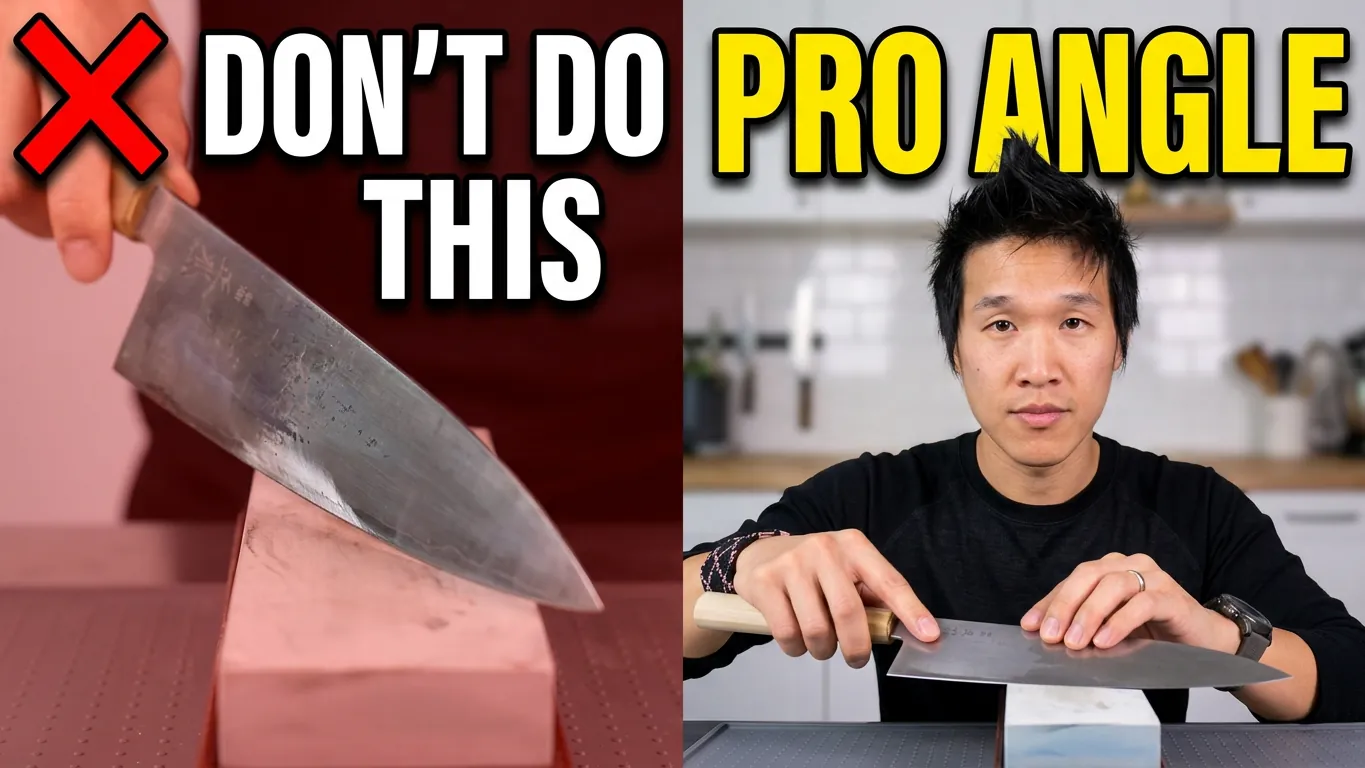
Start at about 25 to 30 degrees, then lower the spine until the knife starts to slip, and raise it slightly from there (2:29). I ignore numbers like 12 or 15 degrees (3:12). Follow the angle the knife already has, and you keep its profile consistent from sharpening to sharpening.
Strokes from tip to heel
Work from the tip to the heel without moving the knife much on the stone (3:36). On a blade this short there's no need to walk your fingers along the edge. At the tip, don't go straight up and down or you'll flatten the belly; instead, slide your right hand away so you get a gentle rocking motion (4:42). From the middle to the heel, use straight strokes. And give the outer edges of the stone a few strokes too, since they often get neglected (6:07).
For the left side, if you can't switch hands, change the knife's orientation on the stone instead: at the tip, I go from about 45 degrees across the stone to about 50 (7:31). Then find the edge angle the same way, by letting it slip. At the heel, turn your wrist out so the tang doesn't hit and scratch the stone (8:37).
Two passes per side raised a very minor but healthy burr (10:01).
Deburring and the stroke-reduction strop
You don't need wood or felt to deburr; a couple of very light passes per side on the stone is enough (10:26). Then I strop on the stone with stroke reduction: 10 strokes per side, then 8, 6, 4 and 2, then single strokes repeated about four times, and finally four or five more per side (11:35). Use only the weight of the knife. This brings the tiny remaining burrs out to the apex so you can remove them cleanly. If you prefer leather, the same idea works on a leather strop.
The result, and the soaked Arashiyama
Parchment paper reveals every imperfection in an edge (15:54). This edge isn't perfect, it came off a 1000-grit stone, but it's very sharp, even with damp paper. I didn't polish it, because I use this knife as a utility knife.
As for the stone: after two weeks of soaking, the Arashiyama 1000 had no load-up and a much snappier feel than it has after a 15 to 20 minute soak (9:20), which made me wonder why it's marketed as splash-and-go. That's just this stone; don't assume every stone likes being soaked that long. A King 6000 side, for example, does not.
Bottom line
A paring knife or petty is the easiest knife to learn on: hold it high, find the angle by feel, sharpen tip to heel with a gentle rock at the tip, and finish with a light deburr and a stroke-reduction strop. One medium stone gets you a very sharp working edge. For the same technique on bigger knives, see my single-stone sharpening guide and how to strop a knife, and to choose a stone, my best 1000-grit whetstone picks. Complete sharpening kits are at the Burrfection Store.
First access
Private drops, new knives and sales
Get them from Burrfection and our retail partners before anyone else. No spam; unsubscribe anytime.
Emails from Burrfection Inc. See privacy.