How to Strop a Knife: The J-Strop, Leather vs. Whetstone, and Loading Compound
Why I add a little J to my strokes, how to strop straight and curved knives, when to strop on a stone, and the mineral-oil trick for loading compound evenly.
By Burrfection EditorialSeptember 23, 2017Updated November 21, 20266 min read
This article contains affiliate links: I may earn a commission if you buy through them, at no extra cost to you. How this works

The short version
- Strop with the same motion you sharpen with, but only on edge-trailing strokes, with almost no pressure. A small "J" at the start keeps the tip from digging into the leather.
- Match the stroke to the profile. Straight knives get a short, nearly linear J; curved knives need a bigger J, or the belly slowly flattens over the years.
- To load a compound block evenly, prep the leather strop with a drop of mineral oil first. About ten strokes per side on a loaded strop clean up an edge noticeably.
If you've watched me sharpen, you've seen the little J-shaped motion I make when I strop (0:00). Here's why I do it, how it changes with different knives, how stropping on leather differs from stropping on a whetstone, and how I load compound onto a strop.
A quick disclaimer first: I'm not a professional sharpener, and I don't claim to know the one proper way to strop (1:44). I share what works for me, and I'm always learning and changing my methods. People sometimes tell me I'm doing sharpening an injustice by stropping on a whetstone instead of leather. I get the same result, so I don't buy another piece of equipment I don't need. Don't take any YouTuber's method as the law of the land; if something else works for you, great.
The basic idea
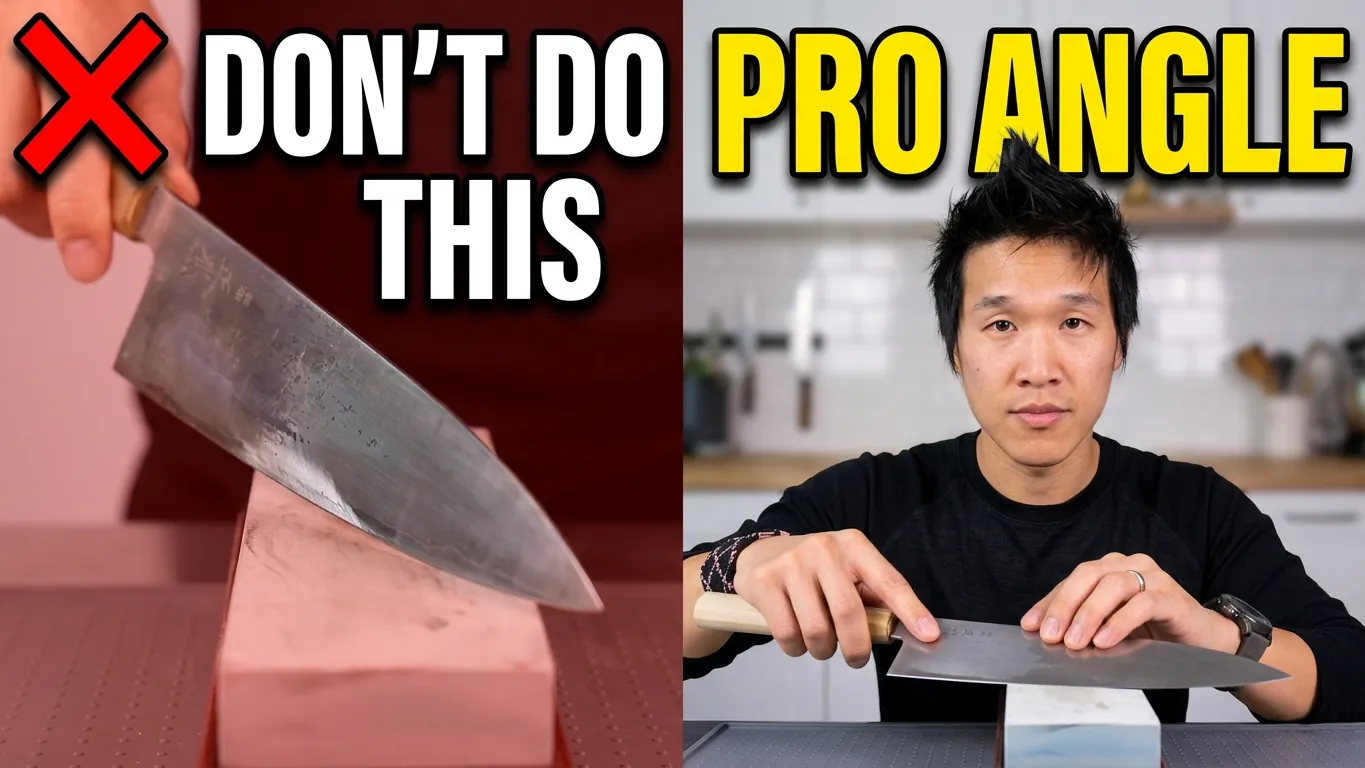
Stropping mimics your sharpening motion, with one difference: you only work on the edge-trailing stroke, moving the knife spine-first, away from the edge (1:01). On leather especially, never do an edge-leading stroke, or you'll cut into the strop and ruin it. I demonstrated with two quite different knives: a fairly straight Dalstrong kiritsuke and a curved Dalstrong 8-inch chef's knife.
The J-strop on a straight knife
On the straight kiritsuke, I start each stroke with a very slight J, a light push outward, and then the stroke becomes a nearly linear pull, because the edge has only a minor curve (3:53) (3:32). Here's why: on leather, a sharp, pointed tip can dig in if your angle is even slightly too high at the start, especially when you're learning. Pulling the tip slightly to the side as you begin, then moving up toward the center of the strop, removes that risk (4:56).
The left side is harder for most people. Your arm is extended, your elbow almost straight and your wrist far from your body, so you lose leverage (5:41). The easy fix is to strop that side from heel to tip instead. As long as you keep the same angle you sharpened at, the result is identical; nothing says you must strop both sides the same way.
If you struggle to hold the angle along the whole blade, it's perfectly fine to strop one section at a time (7:52). Use extremely light pressure, because it's easy to roll the edge as you set the knife back down, and keep your wrist at one consistent angle. Over time you'll build the muscle to go tip to heel in one stroke.
The J-strop on a curved knife
On the curved Dalstrong, my J is noticeably bigger, so the strop follows the rounded belly as I move up the blade (9:46) (9:22). If you strop a knife with a pronounced belly using straight, linear pushes, you'll slowly wear that belly flat. It can take years to notice, but I've had many subscribers ask why their knife felt "funny" at the belly, and that was usually the reason (10:28).
The good news is that the curve also lowers the risk of digging in. Let the knife roll with the strop and it almost guides itself. That's the key to good stropping: you're only guiding, not pressing. I apply no extra pressure at all (11:10). If your wrist mobility is limited, you can skip the J entirely by going backward, heel to tip, or by working in sections.
Don't flick your wrist
One more tip, mostly for the left side of the blade (12:42). When you reach the belly and tip, it's tempting to snap your wrist forward at the end of the stroke. Don't. That flick turns the stroke edge-leading, and you'll cut the leather (13:23). Go slowly, hold your angle, and if needed, work in sections so you never have to twist the knife.
Stropping on a whetstone
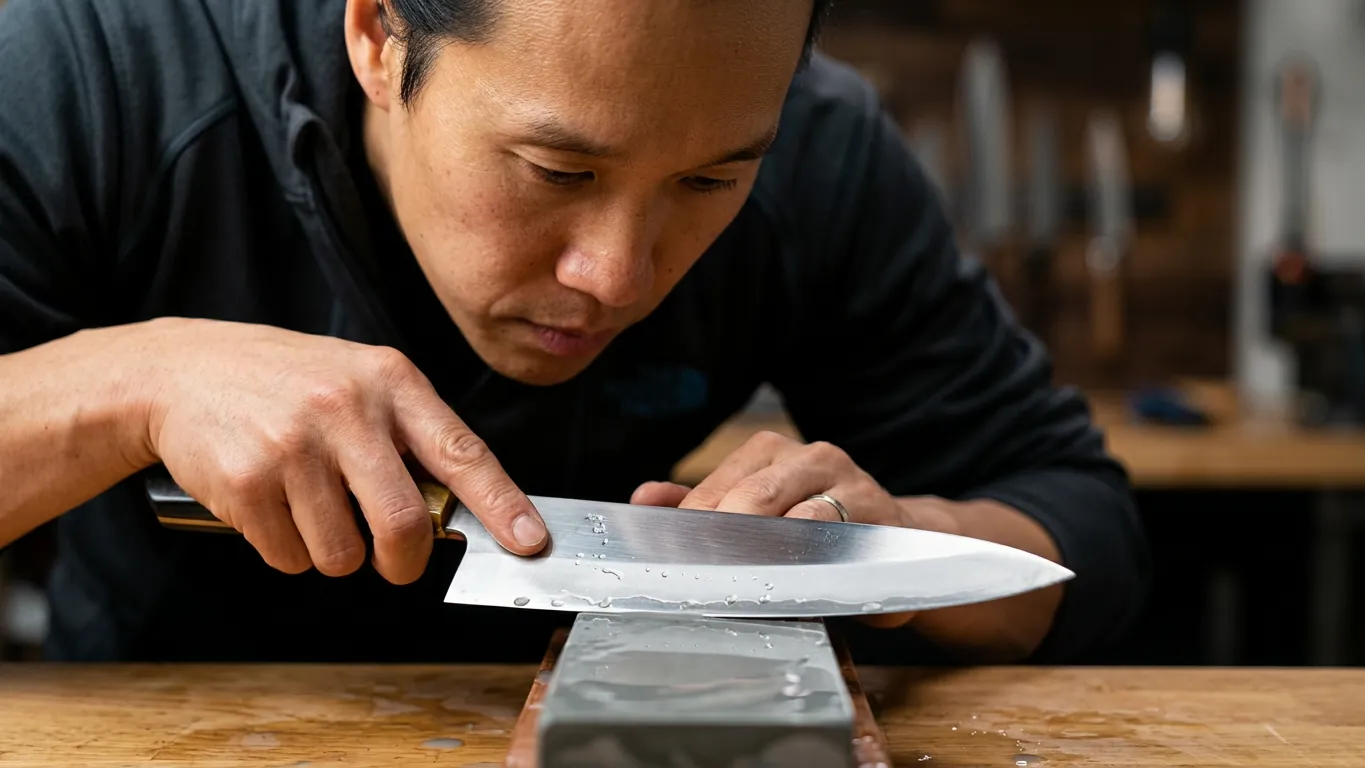
Before moving up to the next stone, I always strop on the stone I just used, here my Chosera 3000, one of my favorite polishing stones and a great sharpening stone too (15:17) (14:56). By this point you should have the muscle memory for your sharpening angle. On the straight kiritsuke I hold that angle and push in a nearly linear stroke, with a much smaller J, since there's no leather to cut (16:22). I still follow the slight curve near the tip unless I want to straighten the profile. I use no pressure, often just one finger on the blade, and the angle stays the same from start to finish.
With the curved chef's knife, I switch to edge-leading strokes on the stone (18:09). A stone can't be cut, and following a constant curve backward on a hard, slippery stone is difficult even for me; I'm not always confident I reach the whole edge. Straight pushes would gradually flatten the belly, so I use a crescent stroke that follows the curve (19:11). You can still J-strop edge-trailing if you compensate with your wrist, go in sections, or go backward. On a stone, a wrist turn near the tip won't cut anything, but I'd still just hold the angle and let the knife run its course.
How to load a strop with compound
Compound comes in a few forms (2:09). A diamond spray like DMT's half-micron (about 50,000 grit by my estimate) is the easiest to use and by far the most expensive. Diamond paste in syringes, like DMT Dia-Paste, runs roughly $5 to $30 a tube and is my pick if you'd rather skip the work of loading a block. The cheapest is a buffing compound block, about $7 to $10 a pound. Blocks were designed for cloth buffing wheels, which melt the compound on, but a block like that can load something like 50 strops (3:54). Keep blocks of different grits apart so they don't cross-contaminate.
You don't need an expensive strop for compound, just good, sturdy leather on a solid wood base. Horsehide is lovely but very expensive; a good cowhide leather strop is all you need (6:45). To load it, rub the block over the center of the strop; turning the block onto a corner warms it up faster. It goes on in uneven, flaky streaks, which is where most people get stuck (10:26).
The fix is mineral oil, which you'll find cheaply in the laxative aisle at a pharmacy. Rub a single drop into the compound and it softens into an even paste; then add a bit more compound (10:48). Better still, put a drop of oil on the leather first, then rub on the compound. That gave a thinner, more even coat with less effort (14:38). You only need a very thin layer. Cooking oil works if you have no mineral oil.
After the compound dried, about ten strokes per side on either strop cleaned up a slightly rough edge, tip to heel, with smooth, clean paper cuts (26:12). The white compound felt like roughly 3000 to 4000 grit: not quite a mirror, but a very clean edge.
Bottom line
Stropping is simple: the same motion as sharpening, edge-trailing only, with no real pressure, plus a little J to protect your tip and follow the belly. On a stone you have more freedom, including edge-leading strokes on curved knives. For a strop, the Burrfection Store's leather strops, including raw equine that needs no compound at all, are a good place to start. To see stropping as the last step of a full sharpening session, read how to sharpen a Japanese knife from A to Z.
First access
Private drops, new knives and sales
Get them from Burrfection and our retail partners before anyone else. No spam; unsubscribe anytime.
Emails from Burrfection Inc. See privacy.