King KDS vs. Suehiro Cerax 1000: The Best Whetstone Under $60
Two of the most realistic 1000-grit choices: the faster, polishing Cerax, or the lively King with a 6000 on the back. Which one wins depends on whether you want one stone or two.
By Burrfection EditorialSeptember 15, 2017Updated November 21, 20264 min read
This article contains affiliate links: I may earn a commission if you buy through them, at no extra cost to you. How this works

The short version
- Best single sharpening stone under about $60: the Suehiro Cerax 1000. It's faster, has excellent feedback, and leaves a finish like a 2000-grit stone.
- Best combination stone: the King KDS 1000/6000. About $60 gets you a true, lively 1000 plus a 6000 I rate as highly as the Arashiyama 6000.
- Both will get your knives very sharp. Deburring and a quick newspaper strop matter more than which one you pick.
After finishing my series on 1000-grit stones, I wanted to put these two head to head, because for most people they're the most realistic choice (0:00). The Naniwa Chosera 800 won that series, but at about $80 to $90 it's almost twice the price, and the Chosera 1000 costs even more. These two retail around $60, and as sharpening stones they're pretty much perfect.
Suehiro Cerax 1000: fast and refined
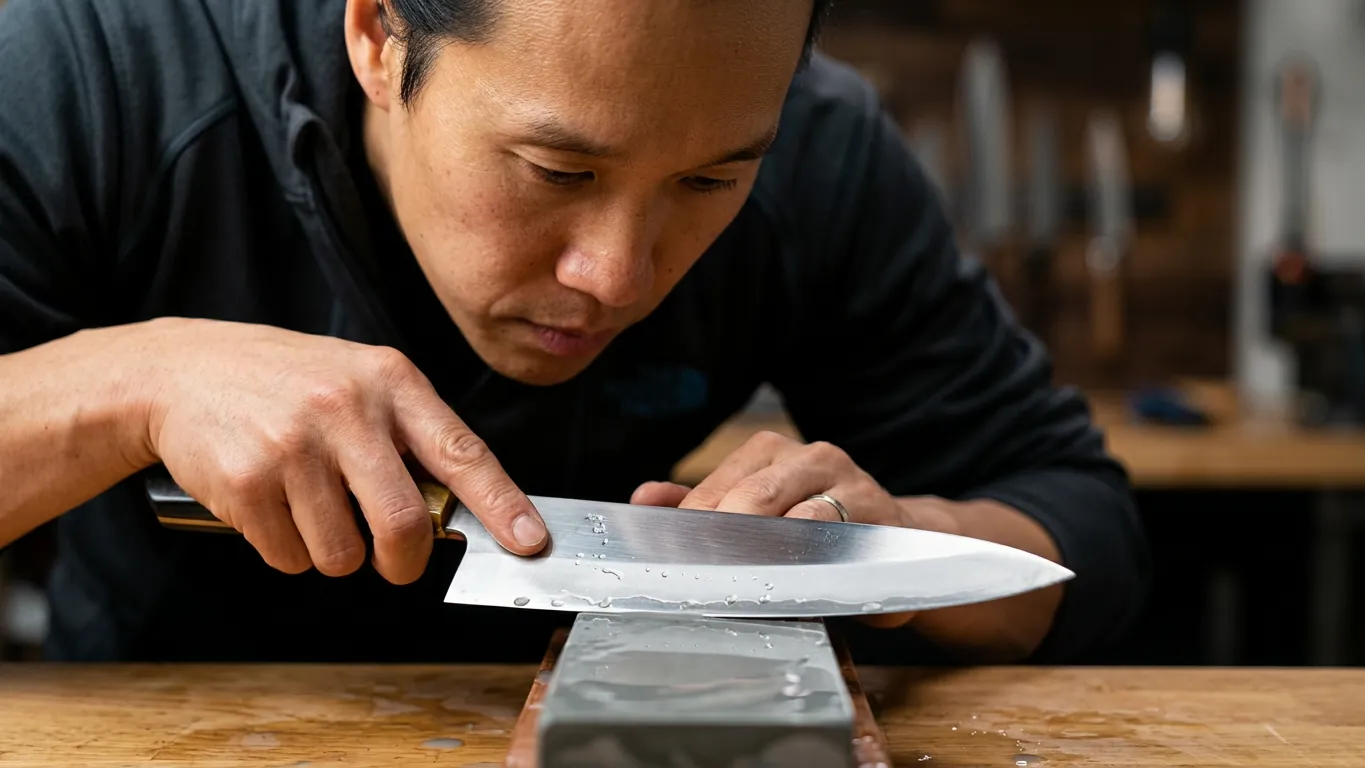
The Cerax 1000 is an amazing cutting stone: very fast, with excellent feedback and tactile feel (1:05). After three or four months of use I honestly can't name a negative. The only time it felt slightly muted was right next to the Chosera, an aggressive, hard stone, and that hasn't happened since. It also polishes like a 2000-grit stone while cutting at the speed of a 1000, which is very hard to achieve. Suehiro did a wonderful job formulating it.
King KDS 1000: the reliable classic
No matter how much I like another stone, I always come back to the King (2:31). The formula has always been reliable and consistent, and it's a stone you can't get bored of. It cuts slower than many newer stones. In this session the Cerax raised a burr in three passes on the first side and two on the second, while the King took five passes on the first side and two or three on the second (3:12). Both have been that consistent through the whole series.
Feedback and hand feel
Because the King is a true 1000-grit stone without the Cerax's polishing effect, it has a slightly snappier, livelier feel (3:33). For feedback, I'd give both at least a 9; I can't separate them. For hand feel, to my own surprise, I prefer the King. If the Chosera is a 10, the King is a 9 and the Cerax an 8.5 (4:39). On speed, though, there's no contest: the Cerax is the fastest-cutting stone I have, tied with the Chosera.
The cut test and the finish
Any stone in this series will produce a really sharp edge (6:04). The trick to making a 1000-grit stone shine is the sharpening and deburring process, plus a quick strop on newspaper to clean up the edge (6:46). I hadn't touched a polishing stone in a couple of months, and both knives cut cleanly straight off these stones.
Up close, the Cerax edge is extremely well polished, not quite a mirror, but much finer than a typical 1000-grit finish, close enough that you can almost see your reflection (14:19). The King leaves visible micro-scratches, a very even scratch pattern that most people will recognize as a true 1000-grit finish. It's a very nice edge, just not a polished one, and that's not why you'd buy it: the King has a polishing stone on its other side (15:45).
Which one should you buy?
If you want one stone for about $60, just one, with no polishing stone, buy the Cerax 1000 (7:47). It lacks a half-notch in hand feel, but it cuts much faster and still has excellent tactile feedback, and that speed difference matters to me (8:09).
If you have about $60 for a sharpening-and-polishing setup, that changes everything. The King KDS, the newer formula, gives you a 1000 side and a 6000 side, and I've said before that its 6000 is just as good as the Arashiyama 6000 (9:13). You can't get that combination anywhere but King. To pair the Cerax 1000 with a polishing stone, you'd need something like a Naniwa Super Stone 3000 or a Suehiro Rika 5000, and you'd spend over $120 for the two. The KDS's 6000 side is thinner, but if you sharpen on the 1000 and only polish and strop on the 6000, it will last just as long as the 1000 side (10:41).
| Suehiro Cerax 1000 | King KDS 1000/6000 | |
|---|---|---|
| Passes to raise a burr | 3, then 2 | 5, then 2–3 |
| Feedback | 9+ | 9+ |
| Hand feel | 8.5 / 10 | 9 / 10 |
| Speed | The fastest I have (tied with the Chosera) | Slower |
| Finish | Like a 2000 grit, near-polished | A true 1000-grit scratch pattern |
| Price (2017) | About $60 | About $60 for both grits |
| Best as | A single sharpening stone | A one-stone sharpening and polishing set |
| Where to buy | Burrfection Store | Amazon |
Bottom line
You'll love either stone; I'm keeping both for a long time, right next to my Chosera (11:45). For a single sharpening stone under about $60, the Suehiro Cerax 1000 wins. For a combination stone, the King KDS is still the king. For the full head-to-head on King's 1000, read my King Deluxe 1000 vs. Chosera 800 review, and see the best whetstones by grit for the bigger picture.
First access
Private drops, new knives and sales
Get them from Burrfection and our retail partners before anyone else. No spam; unsubscribe anytime.
Emails from Burrfection Inc. See privacy.