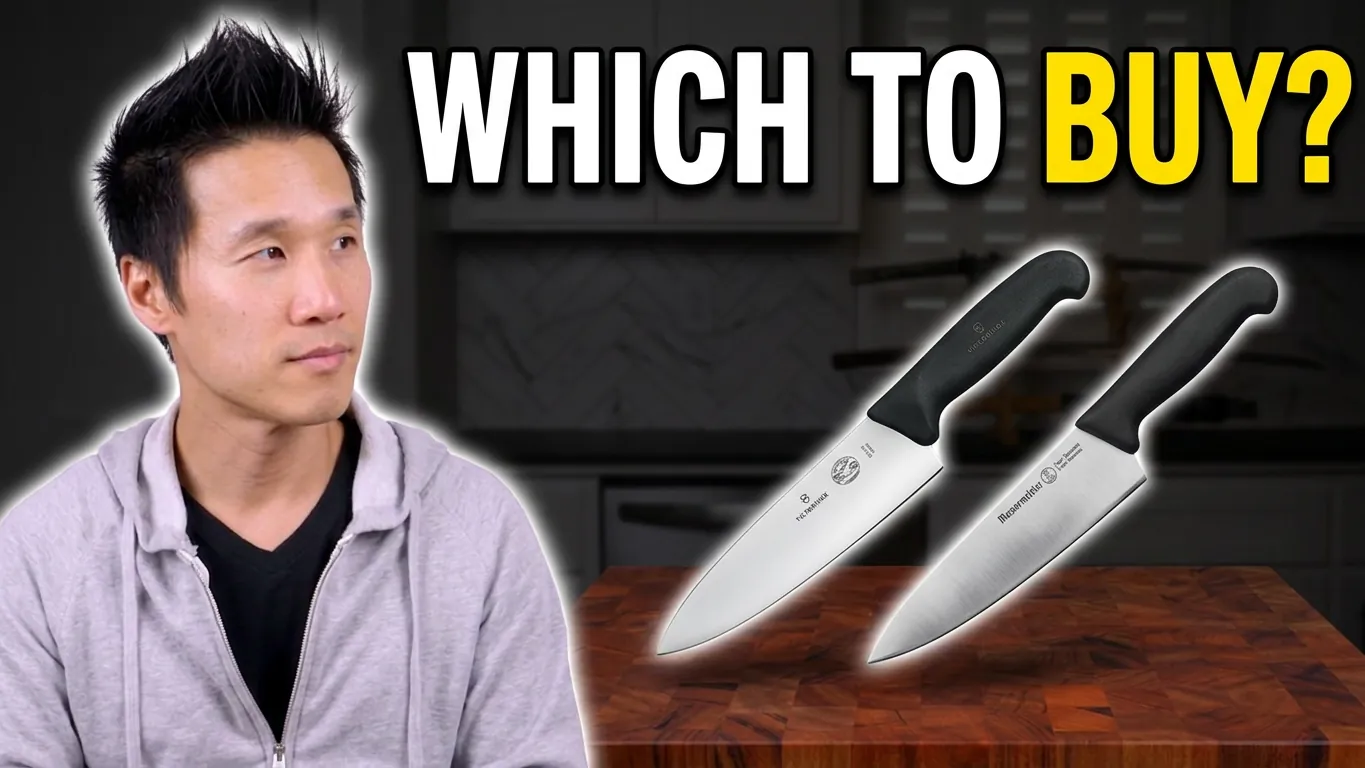
Best Chef's Knife Under $20? 6 Budget Knives in a Rope Test
Six chef's knives from $7 to $25, straight out of the box, cutting half-inch manila rope until they quit. Two made one cut. The winner surprised me, and so did my Best Buy.
By Burrfection EditorialDecember 2, 2017Updated November 24, 20264 min read
This article contains affiliate links: I may earn a commission if you buy through them, at no extra cost to you. How this works

The short version
- Most cuts: the Kuma, 92. The Mercer Millennia was close behind at about 80.
- My Best Buy: the Mercer. At $15 it was cheaper than the $25 Kuma, more comfortable, better for rocking, and it has no bolster to get in the way of sharpening.
- Don't buy the no-name cheap knives. The unbranded $7 toy knife made one cut, and with no brand behind them, you never know what you are getting. If you shop on Amazon, start with my list of real Japanese knives on Amazon instead.
The test
Lots of you asked for a budget knife review, so this is strictly an edge-retention test, out of the box, with no sharpening (0:00). None of the knives had been used for anything before (2:48). I cut half-inch manila hemp rope, which is really hard and really difficult to cut (4:15), and I only counted clean cuts. When a cut didn't go through, I retried the same count, and I stopped after three failed attempts at three different sections of the edge (28:57).
The lineup:
- a $7 to $8 knife that felt like plastic, basically a toy (0:41);
- a black, nonstick-coated knife with no name on it, about $10;
- the Utopia Kitchen, about $15, heavy, with a slight concave gully in the grind (1:02);
- the Equinox, $10 or $15 (2:05);
- the Mercer Millennia, $15 on Amazon when I made this (3:10);
- and the Kuma, $20 when I first reviewed it and $25 at the time of the test.
The results
The toy knife made one cut. Don't buy it (6:25). The black no-name knife made 40 (9:23), the Utopia one (11:21), and the Equinox 15 (12:59). The Mercer made about 80 (18:00), and the Kuma 92 (22:28).
The two knives that failed probably came badly sharpened from the factory, and it could have been a fluke (23:57). This test only measures out-of-the-box sharpness; it doesn't mean they can't be sharpened (24:17).
| Knife | Price when tested | Rope cuts | Where to buy |
|---|---|---|---|
| Kuma | $25 | 92 | Amazon |
| Mercer Millennia | $15 | About 80 | Amazon |
| No-name black nonstick knife | About $10 | 40 | Don't buy |
| Equinox | $10–15 | 15 | Amazon |
| Utopia Kitchen | About $15 | 1 | Amazon |
| No-name "toy" knife | $7–8 | 1 | Don't buy |
The middle of the pack
The Equinox feels OK in the hand, with decent balance, but its finger guard is massive, thicker than the handle itself (24:41). And remember, sharpness doesn't equal edge retention: I could make almost any of these knives as sharp as my $100 knives, but they won't hold it (25:25). The black no-name knife was extremely light and well balanced (26:08), and it made a respectable 40 cuts, but like the $7 toy knife, it has no brand behind it and you never know what you'll get. Don't buy these cheap no-name knives.
Mercer vs. Kuma
The Mercer has a really girthy handle (26:50). My one complaint is that the handle widens at the front, where a bolster would normally be, which makes a pinch grip uncomfortable (27:10). It's stamped steel, but it cost only $5 more than the black knife and performed twice as well (28:15). It's the tallest knife here, with a curved profile and no flat spots, and I think it may hit the sweet spot for budget and performance (28:36). At $15 against the Kuma's $25, the Mercer is the better value (29:18).
If you handle a lot of greasy food, or you're a line cook, I think the Mercer is better, thanks to its grippier handle that works without a pinch grip (29:58); I believe it's also NSF-certified and the Kuma isn't (30:19). For a home cook with smaller hands, the Kuma's smaller handle will feel better (30:42). It has a straighter profile with a gentle belly, good for slicers (31:02). If you rock on the board, the Mercer is the better knife (31:43).
The Kuma's bolster is my deal breaker. On this sample there's already a gap over the last inch and a half near the heel (32:29), and as you sharpen it over the years, that gap grows until the bolster stops the heel from reaching the board (32:51). The Kuma is fairly soft, I'd guess low 50s HRC, so it wears faster than, say, a Wüsthof at 57 to 58, which makes the bolster problem arrive sooner (34:40).
So the Kuma won on performance, but my Best Buy for performance, profile and comfort is the Mercer (33:34). Of the six, the Mercer and the Kuma are the ones worth buying, and the Mercer is the most future-proof (33:57).
Take it with a grain of salt
Cutting rope is extreme, and it doesn't tell you how a knife cuts vegetables (36:04). It's a measure of how long an out-of-the-box edge lasts, nothing more.
Bottom line
Under $20, the Mercer Millennia is the knife I'd buy: comfortable, good for rocking, no bolster, and a solid edge out of the box. The Kuma cut the most rope and suits smaller hands and slicers, but its bolster will become a problem as you sharpen it. For more on the Kuma, read my Kuma chef knife review, and to keep any cheap knife sharp, how to sharpen cheap old knives. Skip the no-name cheap knives; if you shop on Amazon, my list of real Japanese knives on Amazon is a safer bet. And if you're ready to step up, the Burrfection Store and Gyuto.com have Japanese gyutos that hold an edge far longer.
First access
Private drops, new knives and sales
Get them from Burrfection and our retail partners before anyone else. No spam; unsubscribe anytime.
Emails from Burrfection Inc. See privacy.