Kuma Chef's Knife Review: A $20 Knife With a Masamoto KS Profile
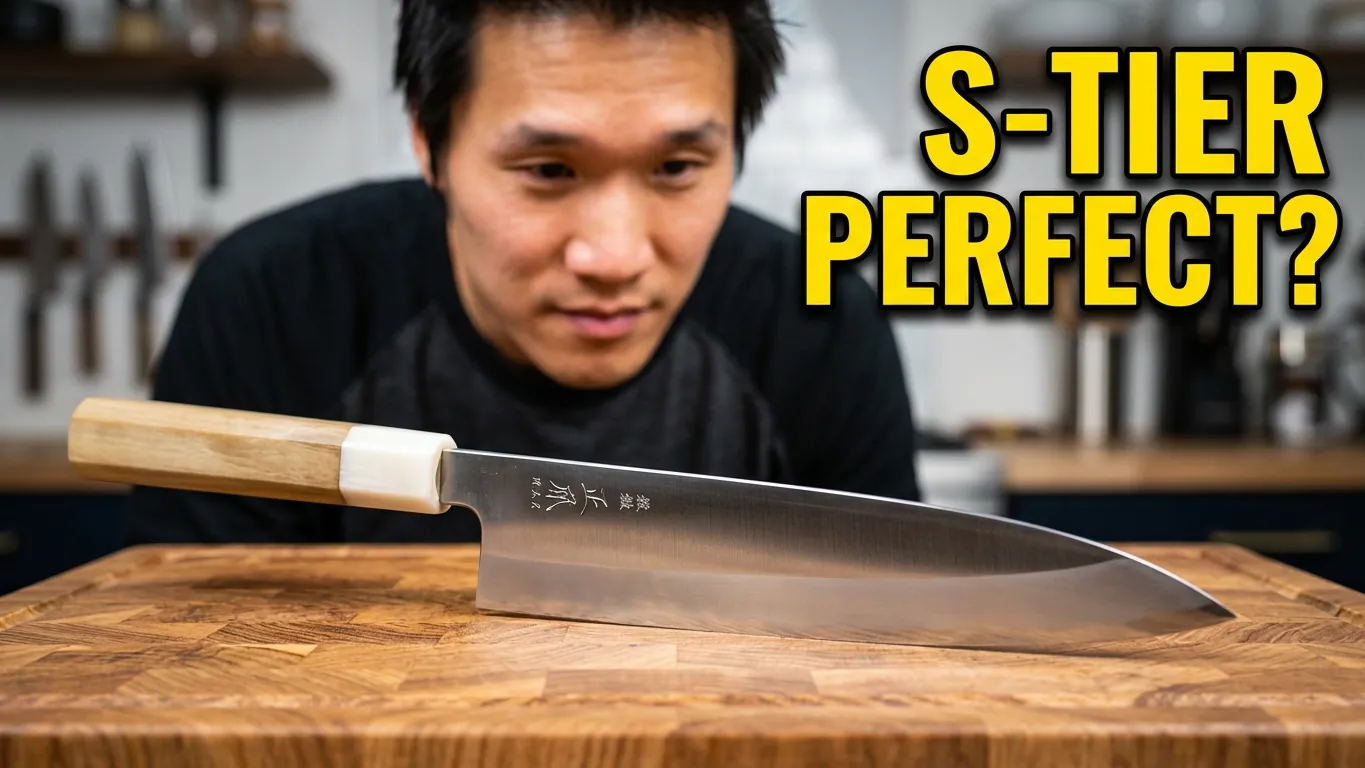
A nice ping, a comfortable rounded bolster, real sharpness out of the box, and a profile that lines up almost one-to-one with my $300 Masamoto KS.
By Burrfection EditorialFebruary 21, 2017Updated November 24, 20264 min read
This article contains affiliate links: I may earn a commission if you buy through them, at no extra cost to you. How this works

The short version
- The Kuma chef's knife is a surprise at about $20. It has a nice ping, decent fit and finish, a rounded bolster that's comfortable in a pinch grip, and a sculpted handle.
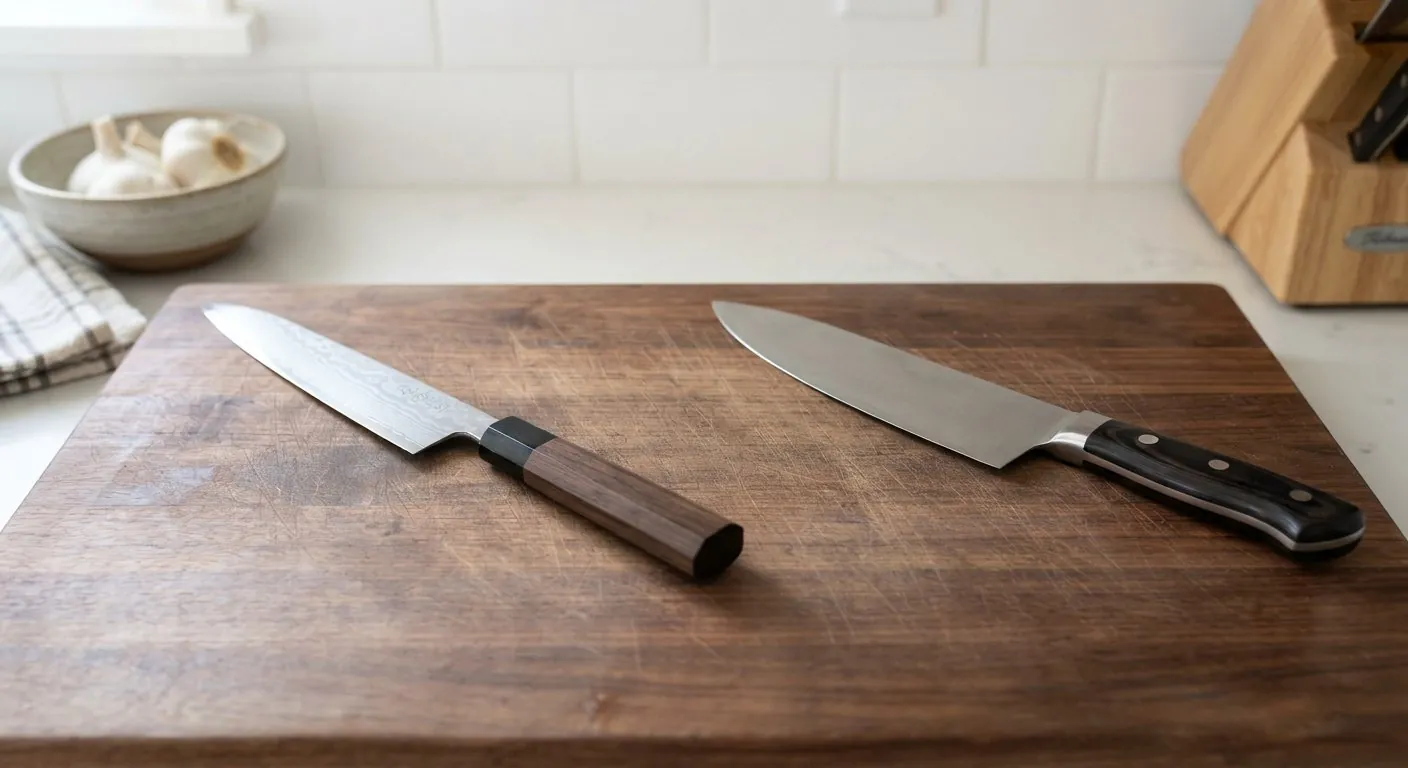
- The profile is the story. Laid against my Masamoto KS, it's almost one to one, with just a slightly more pronounced belly.
- It's genuinely sharp out of the box. That's more than I can say for some $300 knives that arrive in my studio.
A budget series
Lots of you asked me to review knives in the $30 to $40 range, which makes sense (0:00). Most people at home don't want to pay more than that for a knife, and before I got into Japanese knives, my own knives were all cheap; I had trouble paying more than $20 or $30. The knives on my channel usually run from $50 to $300, and as fun as those are, a lot of you would be better served by reviews of affordable knives.
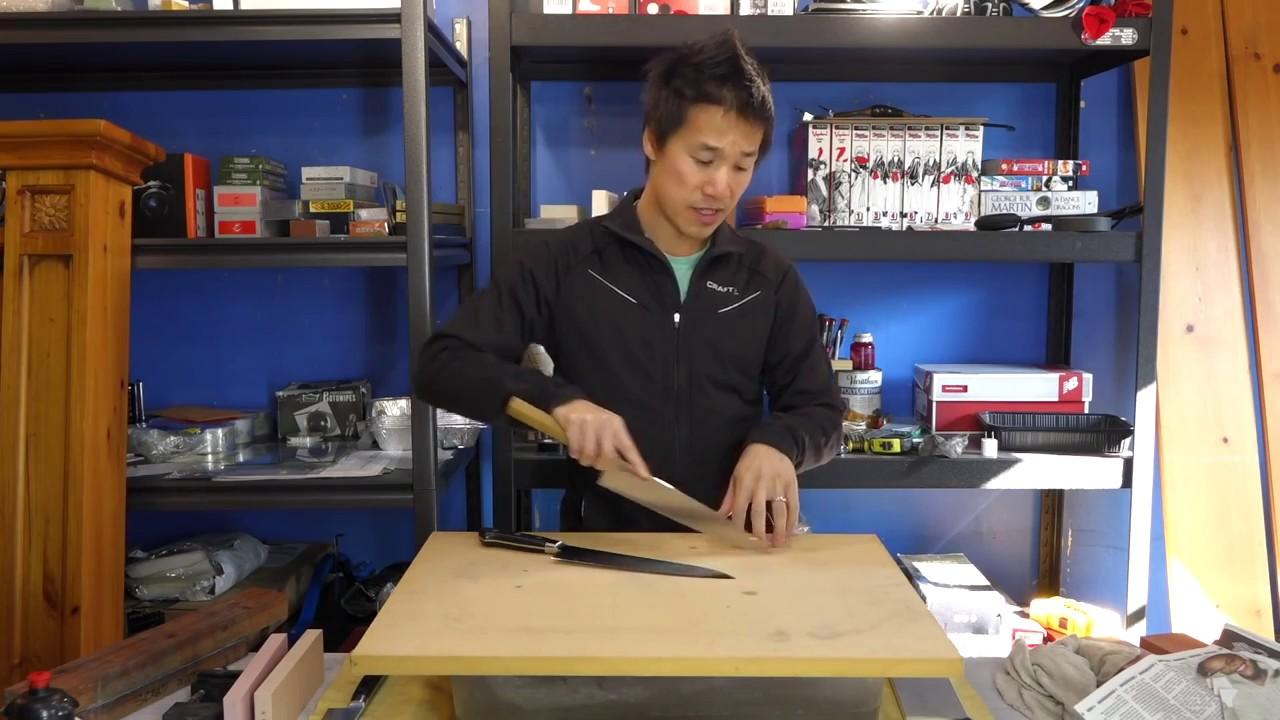
So I ordered a pile of budget knives from $10 to about $25 and whetstones up to about $35 (0:00). I bought them purely on price; I'd never heard of most of these companies, and that's the gamble you take shopping this way. On the stone side: a "Love This Kitchen" 800/3000 kit with a coarse cleaning stone, which I bought to see if it could be a poor man's version of my Chosera 800 and 3000; a Sharp Pebble 400/1000 and a Sharp Pebble 1000/6000 on a bamboo base; and the King KW65 1000/6000, the budget sibling of the King KDS I used for six or seven months straight (5:53). The Sharp Pebble 1000/6000 comes with a sharpening angle guide, which I think is a waste of time, and the base gives height, but I'd rather use a rubber base.
On the knife side: a roughly $10 Kitchen + Home knife with a nonstick coating, a Utopia Kitchen 8-inch chef's knife, a Seizo yanagiba and gyuto at around $11 or $12, and an Equinox 8-inch chef's knife at about $20 with a full bolster, oval handle and a proper chef's-knife belly (9:44). The Seizo yanagiba was the one I was most curious about: it feels like plastic, with cheap wood and a plastic ferrule, but it has a straight shinogi line, and a $10 yanagiba might be a smart way to learn single-bevel sharpening before spending $250 to $300. I found out how that went in why you shouldn't buy a cheap sushi knife. The plan for the series: sharpen these knives on these stones, because if you buy a $10 knife, you're probably not buying an $80 stone.
First impressions of the Kuma
Kuma had been on my shopping list, because a couple of you asked about them, and within the hour they reached out to offer a review sample (0:21). The first test with every knife is the sound test, and it has a really nice ping, which surprised me (1:05). Most knives I test under $50 or $60 give more of a thud.
The fit and finish is fairly decent. The edges of the spine aren't as polished as on a $100 knife, but they're acceptable and won't cut you. The bolster surprised me most: it's very nicely rounded and comfortable in a regular grip or a pinch grip (1:48). The handle is nicely sculpted. The rivets are slightly indented rather than perfectly flush, but at $20 I really don't care. It's not a tall chef's knife, about as tall as a Tojiro DP.
Side by side with the Masamoto KS
The profile is what stopped me (2:52). My Masamoto KS 240mm is one of the most beloved knives in my studio, probably the most famous of all Japanese gyutos, and rightly so. Lay the Kuma against it, and the profiles are almost one to one (3:57). The Kuma has a slightly more pronounced belly, and it's not as elegant, but the overall design is very similar. Maybe the KS was the standard Kuma designed to, or maybe the old French Sabatier knives. Either way, it's shocking to get that profile for $20 when, as of early 2017, the KS had gone from about $220 a year earlier to over $320. That doesn't mean it will perform like a $300 knife.
Out of the box, the Masamoto slides through paper like it's nothing. The Kuma was really sharp too, which surprised me, since even $300 knives sometimes arrive dull (6:29). If it sharpens well and stays sharp for a week or two, it could be the best buy of the year at $20.
Bottom line
For about $20, the Kuma has a nice ping, a comfortable bolster and handle, real out-of-the-box sharpness and a profile borrowed from one of the best gyutos ever made. To see how it holds up on the stones, read $20 Sharp Pebble vs. Shapton Glass and expensive knife, cheap stone or cheap knife, expensive stone?. If you can stretch your budget, see my best Japanese knives under $100, or the real Masamoto KS on Gyuto.com.
First access
Private drops, new knives and sales
Get them from Burrfection and our retail partners before anyone else. No spam; unsubscribe anytime.
Emails from Burrfection Inc. See privacy.