How Often Should You Flatten Your Whetstones? Less Than You Think
I sharpened on a flattened side and a side with 10 sharpenings on it. No difference. What slows a stone down is embedded metal, and a nagura fixes that.
By Burrfection EditorialAugust 30, 2017Updated November 24, 20263 min read
This article contains affiliate links: I may earn a commission if you buy through them, at no extra cost to you. How this works

The short version
- You don't need to flatten before or after every use. After 10 sharpenings on an unflattened side, the edge was identical to the flattened side.
- Clean, don't flatten. What slows a stone down is metal embedded in its surface, not a dish of a micron or so. A quick rub with a nagura fixes that.
- Flatten when you can see a groove, and more often for single-bevel knives. An Atoma 400 is my pick for the job.
The test
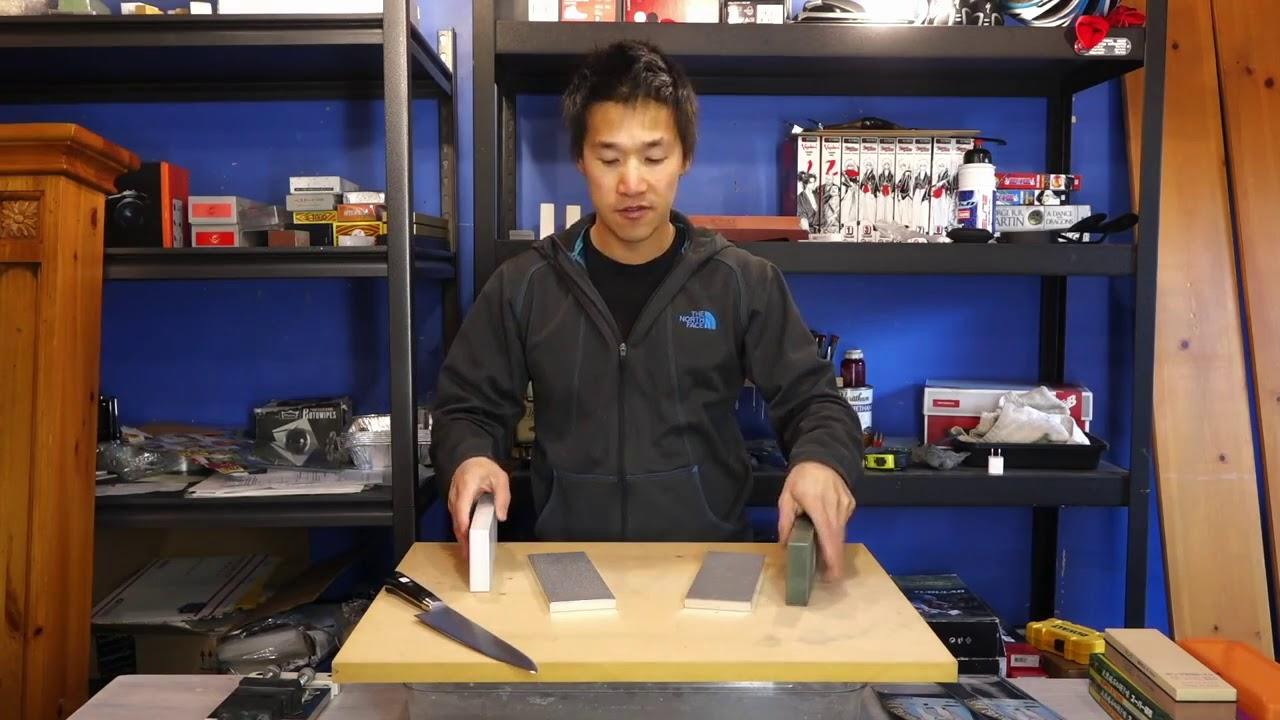
I only flatten when I can see a groove or a dish (0:00). To test whether that's enough, I took my Suehiro Cerax 1000: one side had about 10 sharpenings on it and had never been flattened, and I flattened the other. I chose the Cerax because it cuts fast; soak it 30 minutes, or 45 if you want it to feel smoother (9:00).
To flatten, draw a pencil grid on the stone, then work it on a diamond plate until the grid is gone (3:59). I prefer the Atoma 400 to the 140 for this: it removes less and leaves a better finish (4:21). Before every sharpening, though, I just run a nagura over the stone; a cheap one I got for about $5 works fine, and any brand will do, far cheaper than a flattening plate (5:03).
The result: no difference
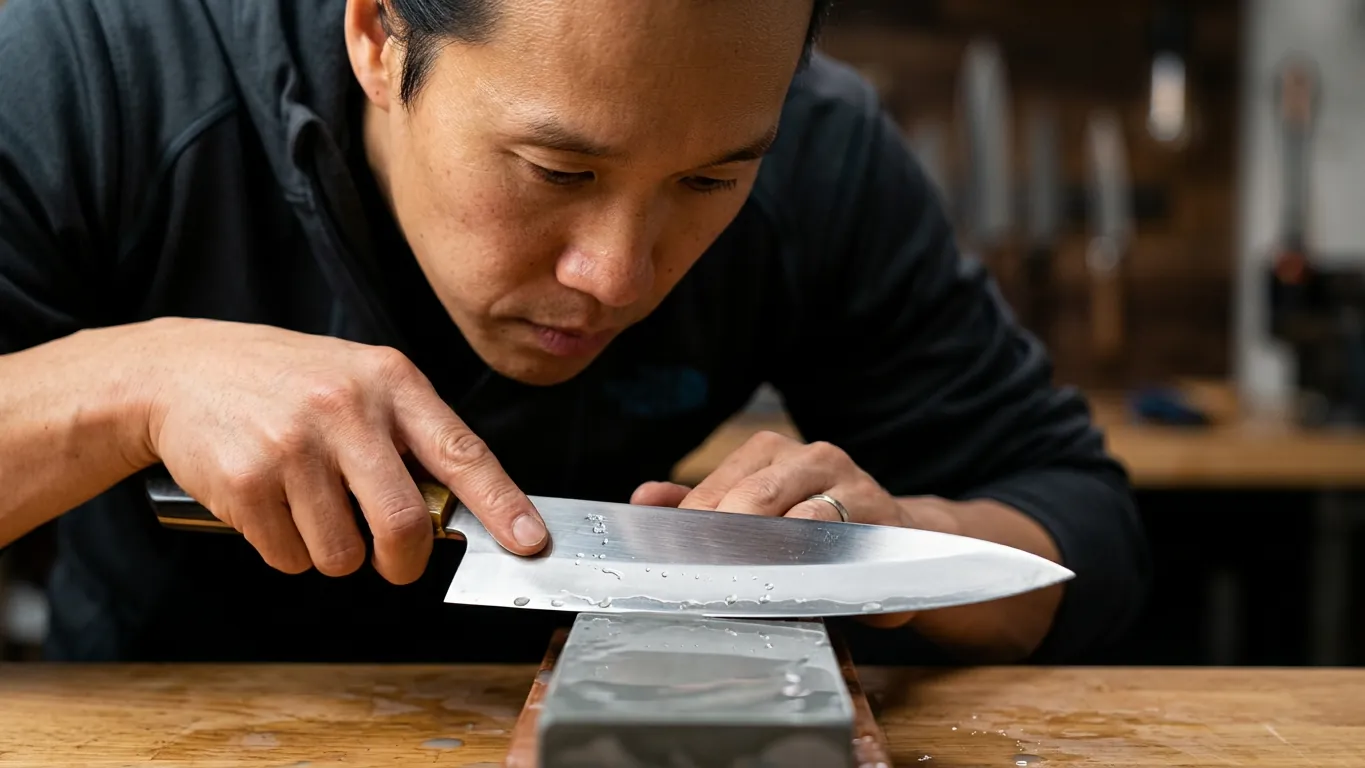
I sharpened a knife on each side the same way, with the same deburring and stropping, keeping the strokes equal on both sides (36:47). Both sides raised a burr in four passes on the first side and two on the second, with the same feel; the unflattened side loaded up slightly more (42:11). On newspaper I found no difference in sharpness (41:24). The idea that an unflattened stone gives you an 18-degree edge instead of a 15-degree one is, in my opinion, bogus. You can go at least 10 sharpenings without flattening.
The real way to keep a stone flat is to use all of it: the whole width and length, not just the center, which is how grooves start (12:59).
Single-bevel knives are the exception
Double-bevel knives, even asymmetric 70/30 or 80/20 grinds, don't change this (3:17). Single-bevel knives, with a 100/0 grind, are different: they need a truly flat stone, so flatten more often (2:32). My yanagiba sharpening guide shows why.
Why constant flattening wastes stone
Should you flatten before or after every use? The quick answer is no (0:21). Murray Carter is the one well-known expert I've heard say the same (1:05). Twenty passes of the Atoma 400 over my Cerax 1000, a Bester 1200 and a King 1000 removed more slurry than any sharpening session (1:48). The groove you're removing is maybe a micron deep, and removing it won't make your knife any sharper (2:33). Your knife only touches a few microns of the stone's surface; what actually hinders cutting is metal embedded in it (5:11).
So my routine is: soak the stone, then rub a nagura over the surface until it's clean (4:46). Naguras are as soft as chalk and won't affect your sharpening (8:33). These days I often use a rust eraser for the same job. One warning if you do use a coarse plate: the Atoma 140 removes about three times what the 400 does, so after it you have to smooth the surface again, especially on polishing stones like a Rika 5000 or an Arashiyama 6000 (10:30).
When a flattening plate is worth it
Flattening plates still earn their place (12:19). If a stone has a real gully, or it's been damaged, or you own a lot of stones, a diamond plate is the right tool. Mesh screens and sandpaper on a flat surface are cheaper alternatives that work, though I prefer a plate (44:20).
Bottom line
Flatten when you can see a groove, flatten more often for single-bevel knives, and otherwise just clean the stone with a nagura or rust eraser before you sharpen and use its whole surface. When you do flatten, an Atoma 400 is gentler than a 140. For the coarse end of the range, see my Atoma 140 review and 5 knife sharpening myths you can ignore.
First access
Private drops, new knives and sales
Get them from Burrfection and our retail partners before anyone else. No spam; unsubscribe anytime.
Emails from Burrfection Inc. See privacy.