How to Sharpen an Asymmetric (70/30) Knife and Keep the Factory Grind
Start on the 30% side, sharpen by feel until you have a micro-burr, then keep the factory ratio in your stropping strokes. Shown on a Masamoto VG.
By Burrfection EditorialJanuary 25, 2017Updated November 24, 20263 min read
This article contains affiliate links: I may earn a commission if you buy through them, at no extra cost to you. How this works

The short version
- Start on the side with less grind. On a 70/30 knife that's the left side, so you get it out of the way and spend your time on the right.
- Don't count strokes while sharpening. Go by passes until you have a micro-burr on each side; the ratio matters in the stropping.
- Strop at roughly the factory ratio, like 10 strokes on the 30% side to 20 on the 70% side, counting both down, then finish with single strokes on each side.
The knife and the stone
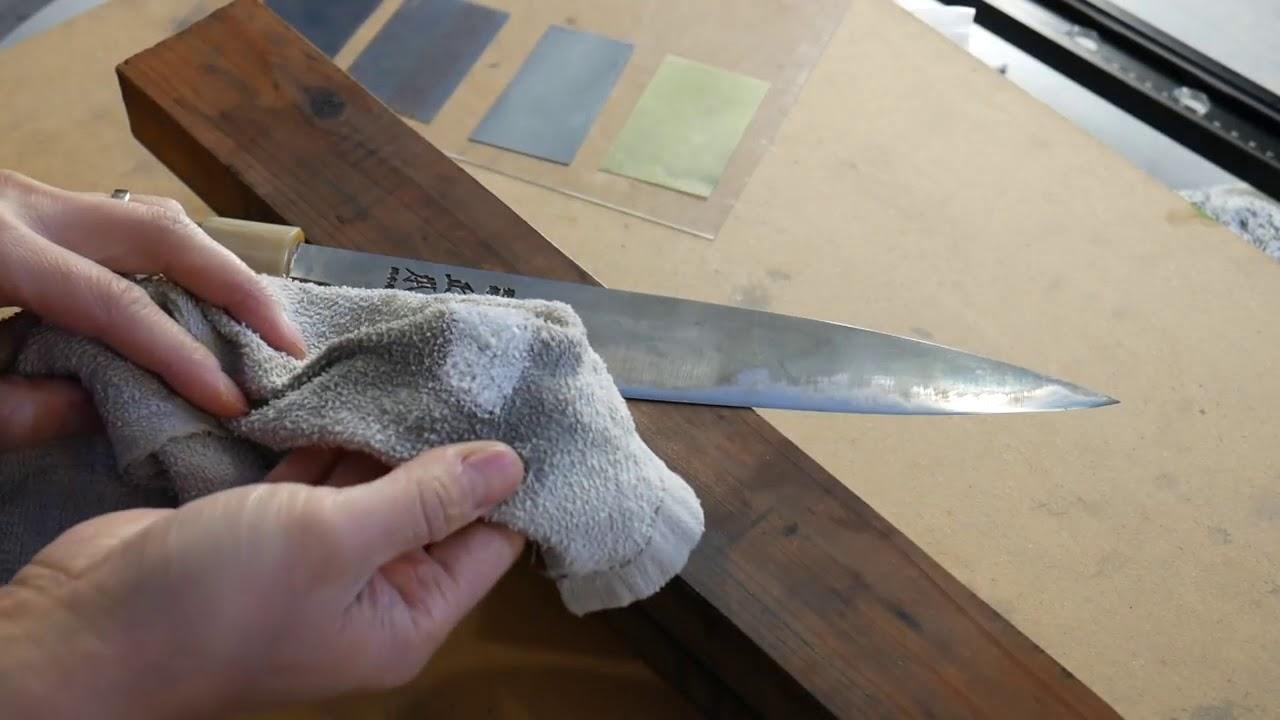
The knife is my Masamoto VG 210mm gyuto, on the Shapton Glass 500 (0:00). Like all Shapton Glass stones, it's splash-and-go: throw some water on and you're ready. The knife was still fairly sharp from an earlier session, so I dulled it with about 20 strokes on my brick first.
What makes this session different is the grind (1:10). According to the manufacturer's specs, it's a 70/30 grind: 70% of the grind on the right side of the knife, 30% on the left. I honestly don't know exactly what that means in degrees; all I know is that it isn't a 50/50 grind. You can see it in use: in my cut test against the Wüsthof, this knife veered to the left going through a butternut squash (see Masamoto VG vs. Wüsthof Classic Ikon). That's what you get with an asymmetric grind. In day-to-day cutting it's still excellent: very sharp and very thin. The steel is a hyper molybdenum vanadium stainless heat-treated to about 59 HRC, and it's a very good performer even though it isn't a 60 (4:09).
Sharpen by passes, starting on the 30% side
Normally I start on the right side, but here I start on the left, the 30% side, so the side with the least grind gets done first and I can spend more time on the right (2:13). You can count strokes if you want, but it gets confusing. When you're sharpening, you're really just trying to establish a burr, and you don't want to sharpen any longer than it takes to get one. So I go by passes, and I don't worry about the ratio until I get to stropping.
Two passes gave me a really good micro-burr on the first side. I matched that with two passes on the other side, which also gave a micro-burr: the working burr I needed to start stropping (6:06).
Keep the ratio in the stropping
This is where people get confused. Realistically, you don't have to do anything different with an asymmetric knife. But if you're particular about keeping the factory dimensions, here's what I recommend (6:27). On a 50/50 knife you'd strop one to one. On a 70/30, you keep roughly a 3-to-7 ratio, or 4-to-6 if you prefer. It doesn't have to be exact, as long as it's close.
I started with 10 strokes on the 30% side and felt the burr: it had already rolled over, so 10 was a good starting point (8:24). Then I doubled it to 20 on the 70% side; the burr was even finer after that. From there I counted both sides down by two: 8 and 18, 6 and 16, 4 and 12, 2 and 10, then another 2. Since this is a straight edge, I strop from the tip, though you can go from the heel; either way, you're pulling the burr up to the apex. By the time you get to the very last strokes, most of the sharpening and polishing has been done at your ratio, so I finish with single strokes on each side, at the same angle, until the edge feels clean (12:17). With an asymmetric grind, you just have to go by feel at the end.
One 500-grit stone, a sharp edge
Normally you wouldn't stop at a 500; you'd go to a 1000 and then a 3000 or 6000. But I'm testing one stone at a time, and the knife came off it fairly sharp, cleanly handling a hard cut on paper (14:46). The stone surprised me, too. It felt pretty good on the Wüsthof at 57 HRC and excellent on the Masamoto at 59, so I expect it to feel even better on harder knives (15:51).
Bottom line
Sharpening an asymmetric knife uses the same technique as any other knife. Start on the side with less grind, sharpen by passes until you have a micro-burr on both sides, and keep roughly the factory ratio in your stropping before finishing one to one. The Masamoto VG is a great knife to practice on. For more single-bevel and asymmetric work, see how to sharpen a yanagiba.
First access
Private drops, new knives and sales
Get them from Burrfection and our retail partners before anyone else. No spam; unsubscribe anytime.
Emails from Burrfection Inc. See privacy.