Naniwa Super Stone 400 Review: A Luxurious Coarse Stone That Slows Down on Hard Steel
Excellent feel and a clean edge on a soft German knife, but on a 62 HRC Aogami Super knife it loads up and every extra point of hardness costs you passes.
By Burrfection EditorialJanuary 18, 2017Updated November 21, 20264 min read
This article contains affiliate links: I may earn a commission if you buy through them, at no extra cost to you. How this works

The short version
- The Naniwa Super Stone 400 feels luxurious, with excellent feedback, and leaves a clean edge with a scratch pattern close to a 1000.
- It's great on softer steel. On a roughly 55 HRC Zwilling it raised a burr in four passes and stayed surprisingly clean.
- It slows down on hard steel. On a 62 HRC Aogami Super knife it loaded up and took six or seven passes, and every extra point of hardness added a pass or two.
Super Stone or Chosera?
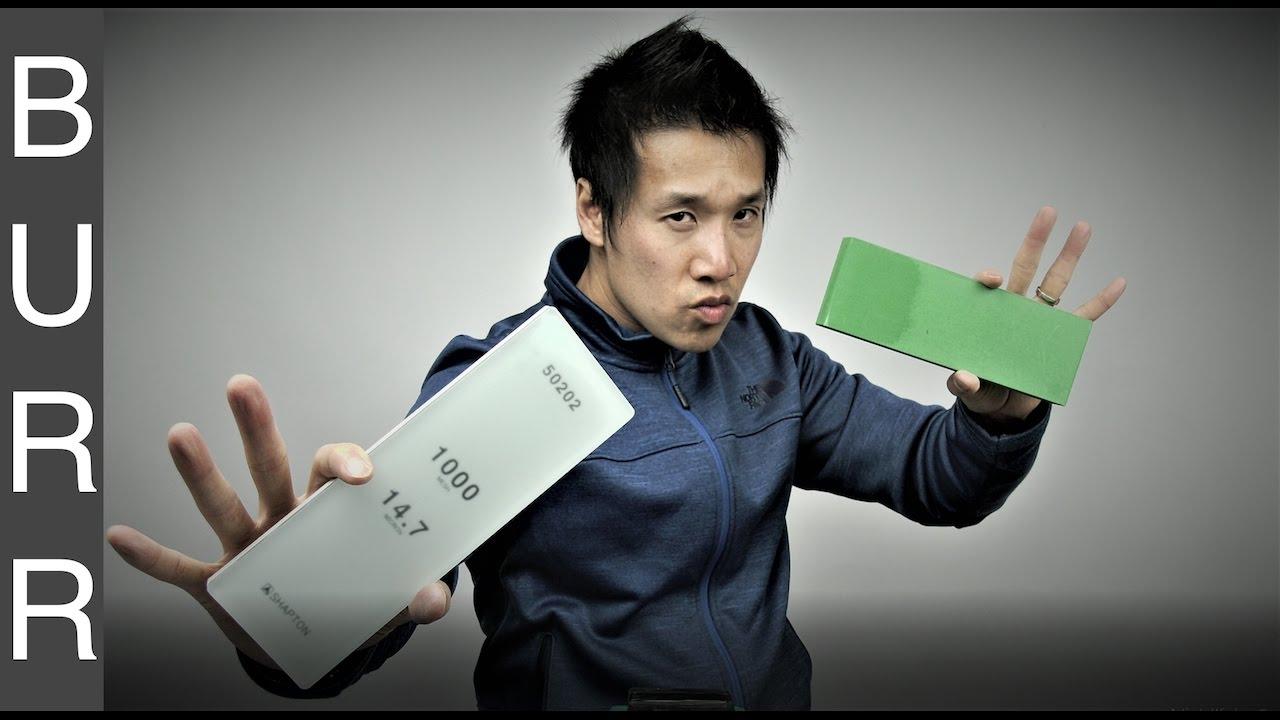
Naniwa has changed its marketing a little: outside Japan, the Super Stones are now sold as the Naniwa "regular" line, and the Choseras as the Naniwa Professional (0:00). Side by side, a Super Stone and a Chosera look almost identical. The only real tell is the stamp: S400 on the Super Stone and P400 on the Chosera (now the Naniwa Pro 400). The Chosera is also a little heavier. I'd never used the 400 extensively, so I was excited to test it.
Setting it up
The two sides of my stone felt different, one smoother than the other, which comes down to how it was cut and stored (1:03). It didn't need flattening, so I just ran it over my Atoma 400 for a few seconds, with no pressure, to clean off any imperfections. If you don't have a flattening plate, a rust eraser or a nagura works too. It's a splash-and-go stone, so you just throw water on it and sharpen. It will darken as it takes on a little water, and that's normal for splash-and-go stones.
On a soft Zwilling: four passes and a clean stone
I dulled a Zwilling chef's knife, rated around 55 HRC, on my brick and started counting passes (3:28). It took four passes to raise a burr on the first side and two or three on the second, a touch slower than the 120 and 320 stones in this series, which raised burrs in one to three passes. The Super Stones have always felt luxurious, with excellent feedback; they're just not very hard (6:09). Because softer, coarser stones wear faster, rotate the stone or use as much of its surface as you can so it doesn't dish early (8:12).
What surprised me was load-up, or the lack of it (10:41). The 800 and 3000 Super Stones I'd used before loaded up and stayed loaded until I used a nagura. This 400 cleaned up just by wiping it with my hand. I finished with a countdown of edge-trailing strokes on the stone, 20 per side, then 16, 12, 10, 8, 6, 4, 2 and 1, to stand the burr up on the apex without any pressure.
The best way to clean it
To clean the stone I tried three tools on different sections: a nagura, a fine rust eraser and a medium rust eraser (17:40). They all work, but the medium rust eraser felt best. The fine one is too fine for a stone this coarse, and the nagura works nicely but wears away quickly, so it's worth saving. My trusty medium rust eraser is my go-to for this stone.
The edge
The polish is quite nice for a 400: the scratch pattern is clearly visible, but even, and in terms of scratch pattern it's close to a 1000 (19:38). On crumpled paper the edge had a nice, crispy bite and made clean curved cuts. People often ask whether a 400 like this is a good first stone, and you definitely can start with it. There's a fair amount of material coming off underneath, typical of lower-grit stones, but after one session I wouldn't call it fast-wearing (23:34).
On a 62 HRC Aogami Super knife
Then I tried something harder: a Tosa Cutlery kurouchi gyuto with an Aogami Super (Blue Super) core, heat-treated to 62 HRC, one of my favorite rustic workhorses (0:00). Its tip had gotten banged up in daily use, so I started there. I work tips on the ends of the stone, the areas people neglect most, and angle the knife a little more steeply so the point gets sharpened properly (3:14). Honestly, a 400 that's relatively soft for its grit isn't ideal for tip repair; a 320 or even a 120 is better.
This is where the Super Stone showed its limits. By the sixth pass, the load-up was slowing the cutting, and my palm could no longer clear it (8:15). It took six or seven passes on the first side and five on the second, versus five and three or four for a 61 HRC Shun chef's knife. In my experience, every single point higher on the Rockwell scale adds one to two passes on this stone (18:14). If your knives are around 62 HRC, I'd steer you away from the Super Stones. You can use one, but sharpening will take quite a while. A quick rub with the rust eraser made the stone look new again.
The reward for the extra time is a very, very clean edge, the best-feeling edge in the series on this knife and one you could take straight into the kitchen (20:37).
Bottom line
The Naniwa Super Stone 400 is a pleasure to sharpen on, gives a clean edge with a near-1000 scratch pattern, and stays clean on softer German steel. On hard Japanese steel around 62 HRC it loads up and slows down, so plan to clean it with a rust eraser and add a pass or two per point of hardness. If most of your knives are hard, the Shapton stones in my Shapton 120 vs. Atoma 140 comparison handled everything from 55 to 66 HRC. For complete setups, see the sharpening kits at the Burrfection Store.
First access
Private drops, new knives and sales
Get them from Burrfection and our retail partners before anyone else. No spam; unsubscribe anytime.
Emails from Burrfection Inc. See privacy.