Shun Pro Yanagiba: The Most Beautiful Sushi Knife, and How to Sharpen It
A liquid-metal finish, a seamless stainless ferrule and a razor edge out of the box, plus my full Chosera progression from 400 to 10,000 on a subscriber's 210mm.
By Burrfection EditorialDecember 13, 2016Updated November 21, 20265 min read
This article contains affiliate links: I may earn a commission if you buy through them, at no extra cost to you. How this works

The short version
- The Shun Pro yanagiba is one of the most beautiful knives I've seen. A raised, mirror-polished "liquid metal" finish, a seamless stainless ferrule, and an edge that's a 10 out of 10 out of the box.
- Sharpen the flat side perpendicular to the stone, keep your fingers centered, and use the whole length of a flat stone. It's no harder than a chef's knife once you get the mechanics.
- A medium rust eraser cleans every grit from 120 to 10,000 for far less than a nagura.
A knife too beautiful to use
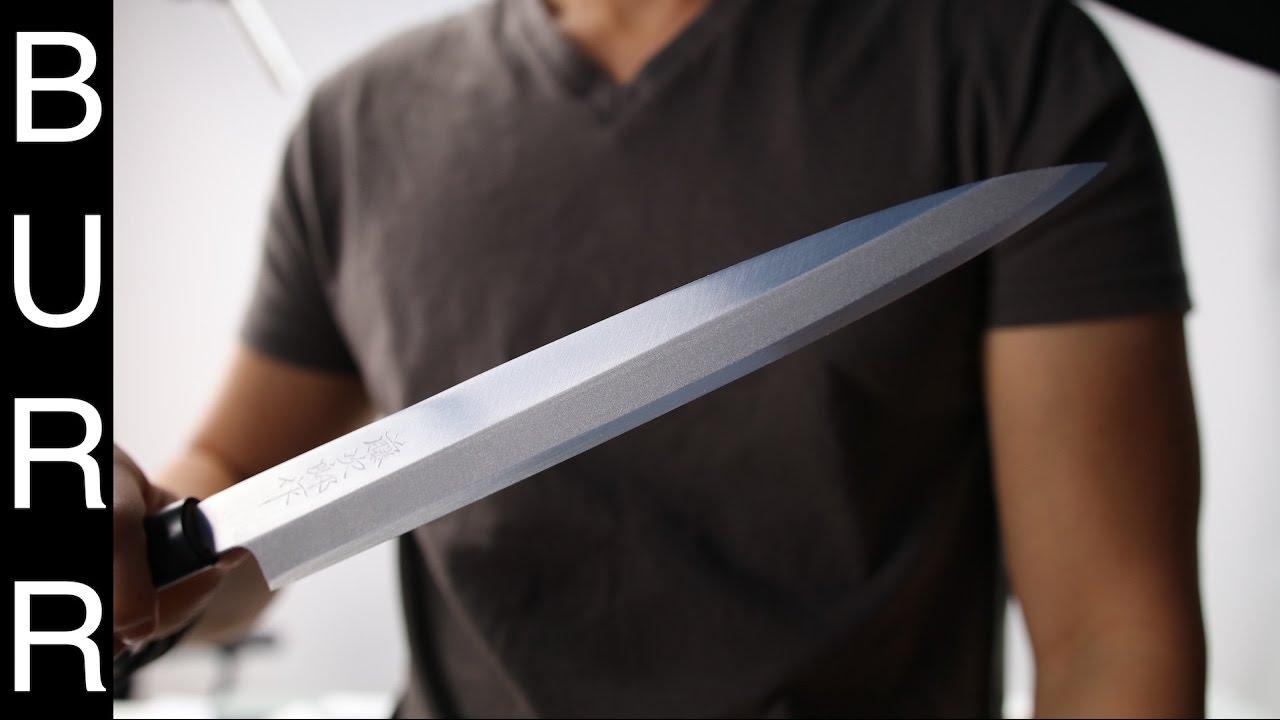
I've said every Japanese knife lover needs at least one yanagiba. Once you have one, you want another, because they're that beautiful (0:00). This one looks like someone drizzled liquid metal down the right side of the blade and polished it to a very high gloss (0:54). The finish is slightly raised, embossed like the logo, and I honestly don't know how you'd polish it.
The sharpening dilemma
That's also my one worry: how do you sharpen it? (1:37) Normally you lay a yanagiba on its shinogi line and sharpen away, but this shinogi line has what looks like a 20,000-grit polish. Sharpening means scuffing a finish the maker spent so much effort on.
Fit, finish and balance
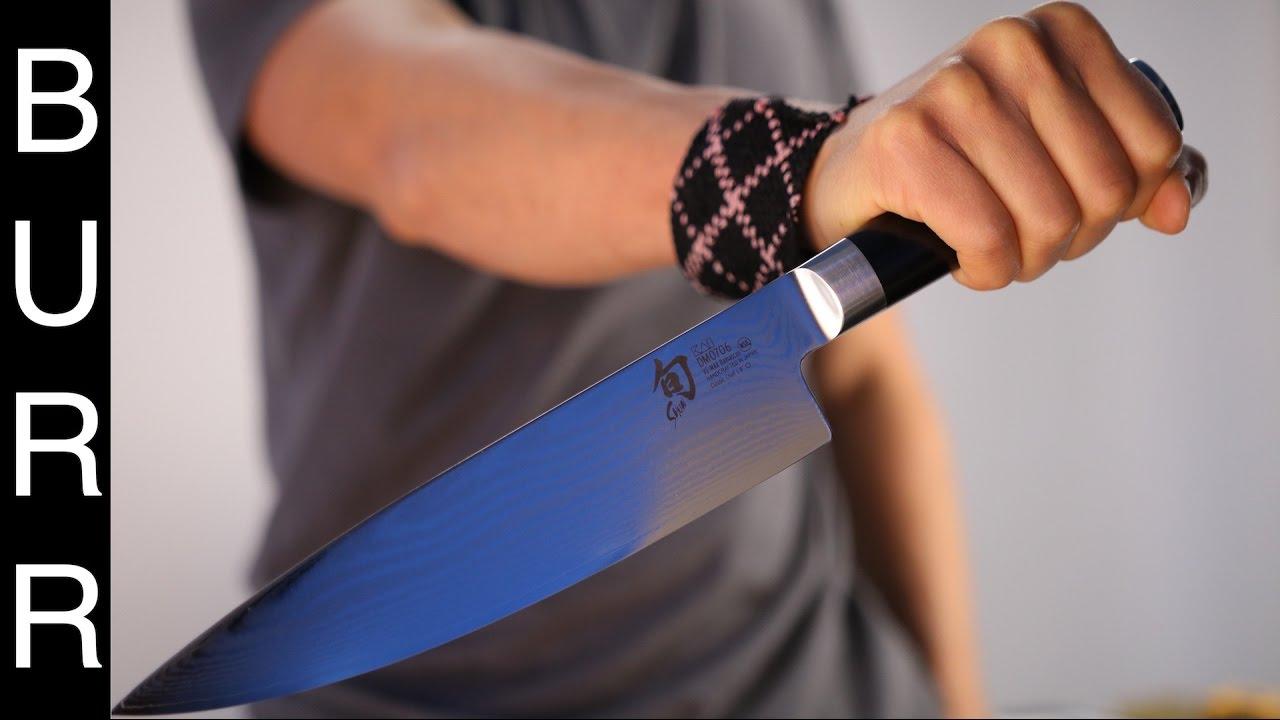
The choil is very well rounded, as you'd expect from Shun, and everything is beautifully polished (2:19). Like all yanagibas, it isn't thin at the spine. That thickness gives it the stability to cut through fish and helps slices fall away, but it tapers down to a wickedly thin, razor-sharp edge. The ebony pakkawood handle is among the best handles out there for fit and finish, and the full stainless ferrule joins it with zero step (3:21). You feel the change in texture, but no bump, which is really hard to do. The metal end cap matches the Shun Pro look and balances a blade that would otherwise be heavy up front, which gives you more control.
Out of the box it's a 10, razor sharp, and it sliced my crumpled paper effortlessly (4:24). I'll use mine, because it wouldn't be right to buy a knife and not use it.
Sharpening a 210mm Shun yanagiba
I have the 270mm version; a subscriber sent me his 210mm to sharpen (0:05). It had an edge, but a rough one, and someone had lifted the knife at the tip to add a small micro-bevel in the first inch. That's minor, and it will disappear with proper sharpening over time. My stones were all splash-and-go Naniwa Choseras: the 400, the 1000, the Chosera 5000 and the 10,000, all flattened in a previous session (1:09). Brand new, the 5000 soaked up some water on first use, which I'd never seen a Chosera do, but it's still a splash-and-go.
Why the flat side goes perpendicular
People ask why I sharpen the flat side of a yanagiba perpendicular to the stone instead of at 45 degrees (4:07). At an angle, most people push down into the stone, and instead of keeping the back perfectly flat they create a plane that turns it into more of a V. Sharpening at an angle also creates a wear pattern that isn't perpendicular to the knife, unlike the factory polish, and over time the knife performs unevenly.
If you have trouble keeping the knife balanced, keep your fingers over the center of the stone and never push down harder on one side (6:25). If that's still hard, work in sections: ten strokes on the first third, then shift over with a little overlap and do ten more. It's a little different from a chef's knife or a santoku, but once you get the mechanics it's no more difficult.
The progression
The Chosera 400 just sets the stage, clearing major imperfections from the blade face and edge (5:37). Keep throwing water on it: laying the knife flat pushes the water off, and these stones don't absorb it. The 1000 is the main cutting stone (10:30). For a single-bevel knife, a flat stone is essential, even though I don't like flattening, and you want to use the entire length of the stone rather than moving around it the way you might with a chef's knife (12:26). Use less pressure to avoid large burrs. It's easy to tilt this knife, and I still make mistakes when I rush, so take your time.
On the 5000 you're no longer sharpening, just removing tiny bits from the edge, so be very gentle (17:16). The new 5000 felt a bit sticky and softer than the 3000, and the knife caught for a split second, another reason to avoid pressure. It left a nice mirror polish. The 10,000 needs even less time, since all the hard work happens at 1000 and below (19:59). With so much of the blade in contact with the stone, it felt stickier than polishing a chef's knife.
Cleaning stones: the rust eraser trick
My find of the century: a medium-grit rust eraser cleans stones so well that I've completely stopped using naguras (22:40). Just wet it and run it flat along the stone. I've used it on everything from 120 to 10,000 grit, and a few swipes make a stone look new. My Suehiro naguras work well too, but at $20 to $30 each they wear down to nothing in 20 or 30 uses. To dry my stones, I stand them on their sides on the counter, with something soft like a stack of magazines beside them in case one tips over (26:09).
The result
On damp magazine paper, the knife glided through with the grain all the way to the tip, and then straight across the grain, which is really hard to do (27:35). It's a very, very sharp knife, and it didn't take a lot of work, just some practice with single bevels.
Bottom line
The Shun Pro yanagiba is still one of the most beautiful knives in the world, with Shun's best fit and finish and a razor edge out of the box. Sharpen the flat side perpendicular, use the whole length of a flat stone, keep the pressure light, and clean your stones with a rust eraser. For a deeper single-bevel walkthrough, see my yanagiba sharpening guide, and browse the yanagibas at the Burrfection Store or on Gyuto.com.
First access
Private drops, new knives and sales
Get them from Burrfection and our retail partners before anyone else. No spam; unsubscribe anytime.
Emails from Burrfection Inc. See privacy.