Should You Thin Your Kitchen Knives? (Plus Primary vs. Secondary Bevels)
Thinning at every sharpening is overkill for most of us. Here's when it makes sense, what you give up, and how a knife's bevels actually work.
By Ryky TranMay 9, 2020Updated November 24, 20264 min read
This article contains affiliate links: I may earn a commission if you buy through them, at no extra cost to you. How this works

The short version
- Thinning isn't necessary at every sharpening: I know chefs who've used the same knives for 30-plus years and never thinned them. I thin mainly after repairing deep chips.
- Thinning takes support away from the edge: on knives under about 62 HRC, a thinned edge gets razor sharp but won't stay that way long.
- My favorite steels: White #2 for the sharpest edge, and R2/SG2 as the stainless compromise.
Is thinning ever necessary?
A Patreon supporter asked about thinning after watching another sharpener recommend it at, or before, every sharpening (0:20). I have a lot of respect for him, and his advice comes from the perspective of a master bladesmith and expert user, and partly from the nature of his own knives (0:47). For most people, though, I think thinning every time is overkill. I have subscribers who are working chefs and have used the same knives for 30-plus years without ever thinning them (1:08).
Thinning is a lot of work, and if you've never done it, yes, it can ruin a blade (1:30). Not destroy it, but ruin its looks, and done wrong you can easily wreck the primary bevel. I thin knives during repairs, when I've removed three or four millimeters of chip; even after two or three millimeters, most knives stay relatively thin. So is it necessary at every sharpening? Certainly not (1:56).
Here's the trade-off. Thinning takes support away from the cutting edge (2:17). On a softer knife, say under 62 HRC, you'll get an edge that's razor sharp for a few days but doesn't have enough steel behind it to stay sharp. If you want absolute performance and don't care about the knife's longevity, thin away. Most people buying high-end knives aren't at that level of sharpening and knife use (2:41). (Thinning was also on my list of knife sharpening myths.)
Primary vs. secondary bevel
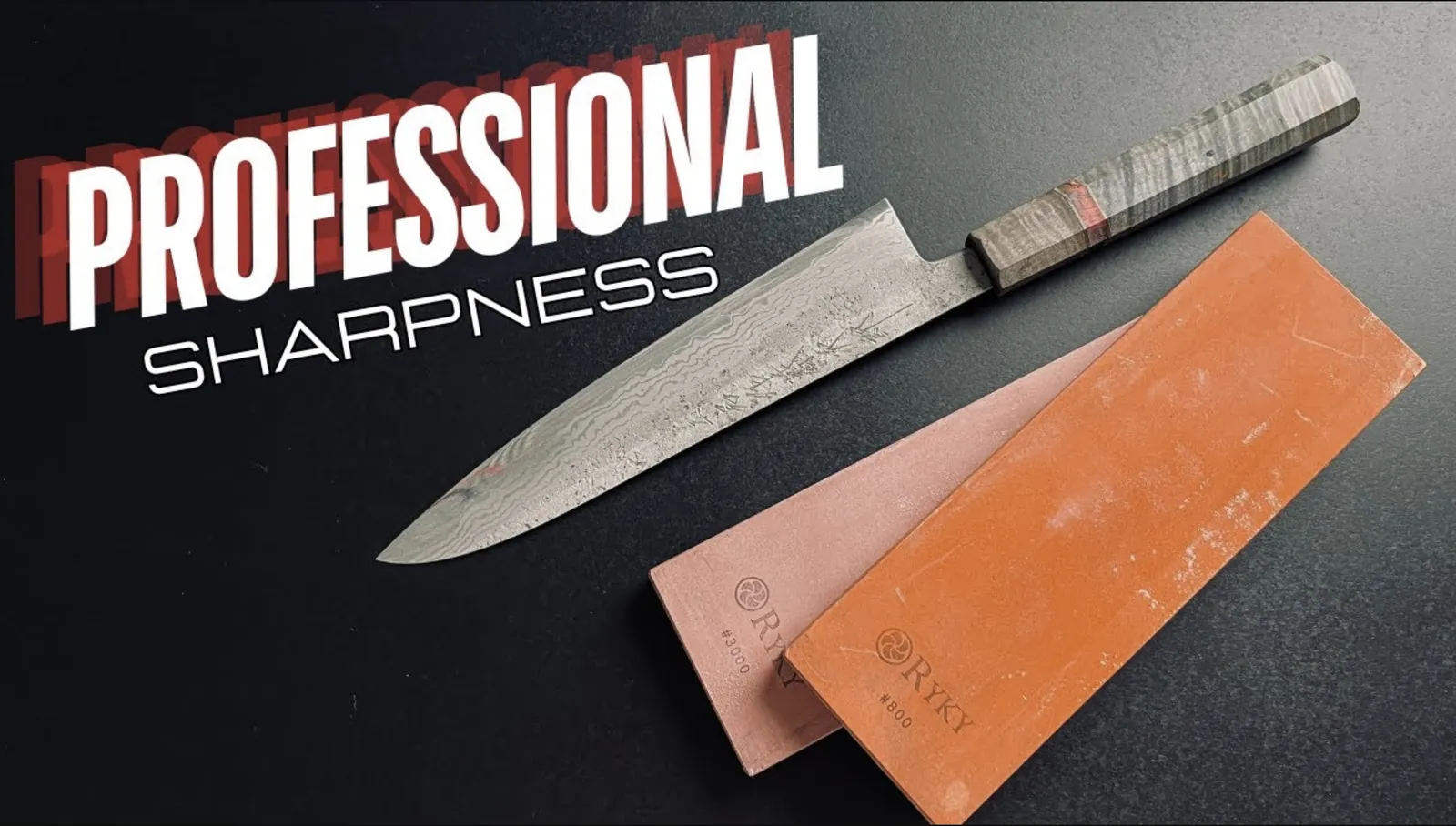
The next question was about primary and secondary bevels (3:03). The primary bevel is the knife's grind, its overall cutting geometry. The cutting edge you actually cut with is sometimes called the secondary bevel (3:23).
On many handmade knives, from places like Echizen, the blade is shaped with a spring hammer, then the profile is polished on a huge rotating grinding wheel, which also puts on that big primary bevel running from about mid-blade to the edge (3:49). Then they add a micro-bevel at the edge; on a Kato, for example, the cutting edge is actually a micro-bevel (4:37). Look down the blade and you'll see consistent thickness from the spine to the middle, then a very aggressive taper to the edge (5:01). (More on that in do micro-bevels work?)
A factory knife like my Yaxell, one of the sharpest knives I own, has no separate micro-bevel; you see a cutting edge about a millimeter wide (5:24). Its grind is put on by a computer-controlled grinder, thinned on sanding belts, and then sharpened by hand by a master sharpener (5:47). Don't walk away thinking only handmade knives are worth buying; Yaxell and Miyabi make great knives, just differently (6:10). If I had to choose, knives with a larger primary bevel release wet and starchy food a bit better, but in absolute sharpness both can be equally sharp (6:34).
Hinoki vs. end-grain cutting boards
I'd used end-grain boards for the better part of ten years, and at the time I'd been testing a Hinoki board for about three weeks (12:36). Sources disagree on care: one says splash the board with water before every use, another says just oil it (13:21). So far I haven't needed to splash it; I simply put washed, wet ingredients straight on the board, and it hasn't stained (13:42). I oiled one side once with mineral oil and left the other raw to compare (14:08). Hinoki is very soft and light, and the surprising thing is that water doesn't soak in, even when left sitting on the surface (14:30). If you're shopping, see the Hinoki boards on Amazon or my cutting board guide.
My two favorite steels
My favorites at home are White #2 and R2/SG2 (15:15). On my PT50A sharpness tester (15:40), my White #2 knives, the Masamoto KS and my Yoshikane White #2, get the sharpest of anything I own (16:05). But I don't hand them to guests, because with kids and friends around, a wet knife with onion on it gets left on the board, and even I do it sometimes (16:27). Come back later and a White #2 knife has heavy patina bordering on rust; that's the biggest drawback of carbon steel (16:54).
SG2 is the great compromise (17:15). It isn't quite as sharp as White #2, but it's razor sharp (my Yaxell came out of the factory at about 123 on the tester) and it's stainless and easy to sharpen (17:41). A good example at the Burrfection Store is the Mcusta Zanmai Revo3 SG2 gyuto.
| White #2 (Shirogami #2) | R2 / SG2 | |
|---|---|---|
| Type | Carbon steel | Stainless powder steel |
| Sharpness | The sharpest I've measured | Razor sharp, slightly less |
| Care | Patina and rust if left wet | Low maintenance |
| Best for | Careful users | Busy kitchens, guests, families |
| Where to buy | Masamoto KS (Burrfection Store) | Mcusta Zanmai Revo3 (Burrfection Store) |
Bottom line
Don't thin your knives at every sharpening. Do it when a repair has thickened the edge, and accept that a thinner edge trades longevity for bite, especially on softer steel. Handmade and factory knives get their geometry in different ways, and both can be extremely sharp. For carbon-steel care, see how to remove rust and patina, and for sharpening technique, my push-and-pull guide.
First access
Private drops, new knives and sales
Get them from Burrfection and our retail partners before anyone else. No spam; unsubscribe anytime.
Emails from Burrfection Inc. See privacy.