What Is a Burr in Knife Sharpening? How to Feel It and Remove It
The burr tells you when to switch sides. Here's how to feel it, why I only want a micro-burr, and how I strop it upright on the stone instead of dragging it through wood.
By Burrfection EditorialApril 15, 2017Updated November 24, 20265 min read
This article contains affiliate links: I may earn a commission if you buy through them, at no extra cost to you. How this works

The short version
- A burr is a thin lip of metal at the very edge. When you can feel it on the opposite side, you've sharpened that side enough to switch.
- Aim for a micro-burr, just enough to feel. A burr big enough to cut your finger means you've taken off too much metal.
- Strop it upright on the stone. Counting down strokes per side stands the burr up on the apex, and that's what makes a knife sharp, even off a coarse stone.
What a burr is
A self-described "bloody beginner" asked me for a video about the burr: what it is, how to feel for it and whether there's a trick to seeing it (0:00). This is my take from my own sharpening; there are other views out there, and I'm not here to argue with anyone. Picture the very tip of your knife's cutting edge. A burr is a thin strip of metal right there, leaning to one side, to the other or standing straight up (0:42). When people say "look for the burr," they mean: if you've sharpened one side enough, you'll feel a lip of material on the other side.
How to feel for it
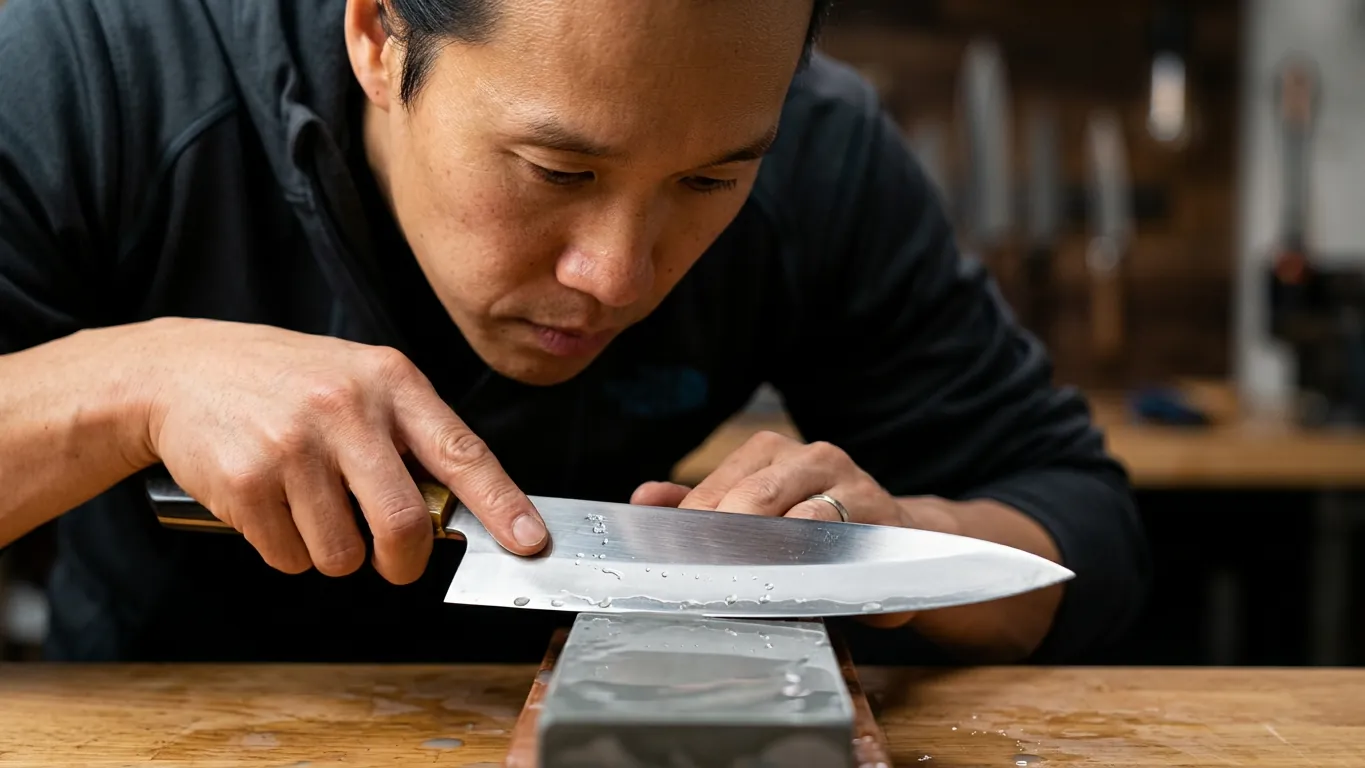
The easiest way to understand a burr is to make one (1:23). I used my new Dalstrong Phantom chef's knife and sharpened just the tip on one side. Then run your finger along the side of the blade, never against the edge, from the spine toward the cutting edge. Where you just sharpened, you'll feel a difference in texture or height. That's the burr. My palm is pretty sensitive, too, so I sometimes use it to compare a section with a burr against one without (23:24).
You can also hear and see a burr that isn't standing straight (2:32). Slice a sheet of paper from heel to tip: where the cut suddenly turns jagged, the burr is leaning over.
Why the burr matters
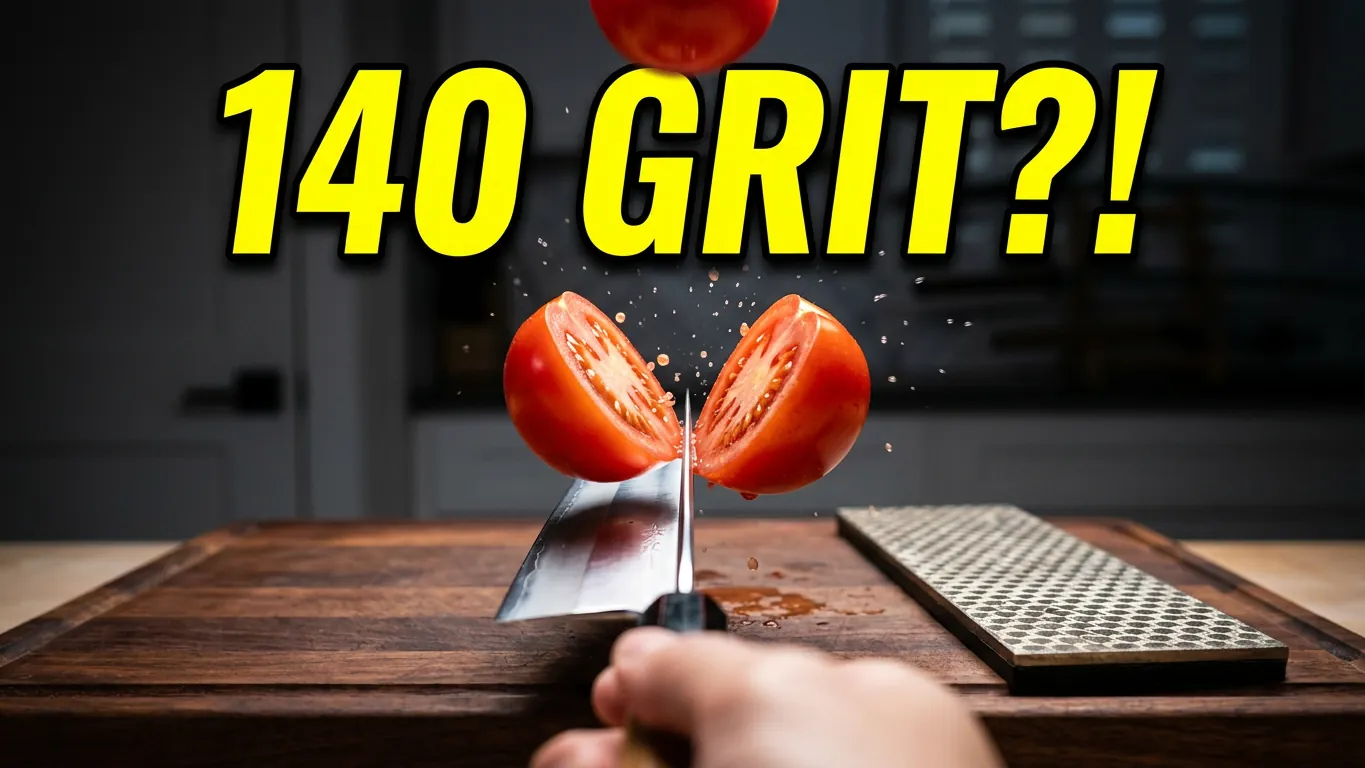
Under a microscope, a 400 or 500 grit stone leaves a bigger burr leaning to one side, a 1000 a shorter one, and even a 6000 still leaves a burr (3:37). You can never fully remove it; under an electron microscope even the finest edge looks like the teeth of a hacksaw. The goal is to make that burr, coarse or fine, stand straight up on the end of the edge (4:19). That's why I could still cut paper easily off a 120-grit stone in my Shapton 120 vs. Atoma 140 tests: even on an extra-coarse stone, the burr was standing on its edge. The burr also tells you when you've removed enough metal on one side to turn the knife over.
Why I want a micro-burr
You'll hear me say "micro-burr" in a lot of my videos, a term I started using for a burr that's just big enough to feel and not intrusive (7:13). People message me that their burr is so big it cuts them when they run a finger along the edge. You don't want that. I just want the burr to fold over and expose itself, and a micro-burr on both sides is easy to remove on the stone. Harder Japanese knives, around 60 HRC and up, tend to form small, well-defined burrs; softer knives form big, obvious burrs that can be harder to get rid of (23:04).
Removing it: wood vs. the stone
The common way is to raise a burr on both sides, then drag the edge through a piece of wood (6:07). That's what I did for a long time, but my knives weren't quite as sharp as when I stropped on the stone and let the burr come off on its own. Wood removes much of the burr, but it also folds part of it back into the edge, and then you have to strop it out anyway, which a lot of people don't spend enough time on (8:14).
Here's what I do instead. If I finished sharpening on the right side, I strop first on the left, against the burr, 12 strokes, pushing it from one side to the other (8:57). Then 12 on the other side. Every time I turn the knife, I reduce the count by two: 10, 8, 6, 4, then 2 a few times (11:27). As the count drops, the burr stands straighter and straighter, until at one or two strokes per side it's standing on the apex of the blade. Twelve isn't magic; it just works for most of my knives and stones. Technically, "stropping" means leather or a fine stone, so on a 1000 call it deburring if you prefer.
Read the lines on your stone
Your stone shows you what the burr is doing (13:55). Sharp, harsh lines mean the burr is still coming off. Hazy gray lines are just normal material. Watch for tiny metal flakes, like hairs cut very short, sometimes in a string up to a millimeter long: that's the burr itself coming off, exactly what you want to see. A 1000 will always pull off some material, no matter how clean the edge is.
Then a polishing stone shortens the burr (16:05). Say it's five microns long after the 1000; light strokes on a 6000 take it down to one or two, still standing on its end. On this relatively straight edge I used edge-trailing strokes, very slow and very gentle. The first strokes pull off more material, then less and less. Clean the stone between checks; my rust eraser is the best load-up remover I've found (18:27). Harder stones always show some lines; what you're watching for is the obvious ones disappearing. After that, you can strop on leather or newspaper if you like; see how to strop a knife.
The result, after a few minutes, was very sharp (21:15). And you don't need a 6000 for that: with proper technique, a 1000 will give you a really sharp knife.
Bottom line
Raise a micro-burr you can just feel, switch sides, and strop it upright on the stone with a countdown instead of tearing it off on wood. Watch your stone for the sharp lines and metal flakes to disappear. To practice, start on just the tip or half the knife, and see the whole routine in how to sharpen a Japanese knife from A to Z. If you're building a setup, the sharpening kits at the Burrfection Store are a good place to start.
First access
Private drops, new knives and sales
Get them from Burrfection and our retail partners before anyone else. No spam; unsubscribe anytime.
Emails from Burrfection Inc. See privacy.