The Artisan Japanese Knives in My Kitchen Drawer: Moritaka, Akazawa, Anryu, Yu Kurosaki and More
Six months to two years of daily use, from $200 to $1,200: what each handmade knife in my drawer does well, what I'd change, and which ones I'm keeping.
By Ryky TranMarch 13, 2021Updated November 25, 20265 min read
This article contains affiliate links: I may earn a commission if you buy through them, at no extra cost to you. How this works

The short version
- Best value: Moritaka and Yoshihiro Aogami Super gyutos perform like knives that cost far more, at around $200.
- The ones I'm keeping: the Anryu (he has retired), my wife's Yu Kurosaki, a Nigara and the Kiyoshi Kato Workhorse.
- Care makes a big difference: a weekly wipe of mineral or tsubaki oil keeps carbon-steel patina remarkably light.
How I chose these knives
These are the knives from my own kitchen drawer, used for at least a month and some for as long as two years (0:00). All are handmade, and price wasn't a factor: they run from about $200 to over $1,200 (1:34). This isn't a ranking. Every one of these makers pours their heart into their work, and to me it would be disrespectful to crown a "best" (53:09). I keep them in a lockable drawer insert rather than on the counter (2:17); see my knife storage guide.
Moritaka: heritage without the price
My 240mm Moritaka Aogami Super comes from a maker with roughly 700 years of history, back to samurai swords, yet a 210mm gyuto starts around $200 (3:04). After six months without cleaning, it had patina along both sides, but the magnolia handle held up well; I always oil new handles before first use (4:16). It's heat-treated to about 64 or 65 HRC and holds a great edge (4:43). My one nitpick: the bevel starts only about half an inch above the edge, so after months of sharpening it thickens; I'd raise the grind a quarter inch (5:50). Its brushed kurouchi finish is something I've never seen elsewhere (6:31), and if this were an Italian brand, it would cost $2,000 (7:18). Fit and finish on the spine and choil is about a six or seven out of ten, not sharp, just not polished (7:41).
Akazawa and Yoshihiro: the Aogami Super twins
The Akazawa is the knife that destroyed my hand in the rope cut test: Aogami Super at 65, maybe 66 HRC, stainless clad, with a 2.2 to 2.3mm spine (8:25). At $350 it includes an ebony handle, which alone is worth $75 to $120 (10:04). (More in my Akazawa review.)
The Yoshihiro Aogami Super was the knife I'd been hunting for: the same performance under $200, with hand engraving, which is rare at that price (11:37). Its fit and finish is actually slightly better, with a rounded choil that's more comfortable for your middle finger in a pinch grip (12:24). It comes with a magnolia handle; add an ebony one and you're still around $250 to $270 (13:54). (See my Yoshihiro Aogami Super review.)
Yoshimi Kato and Saji: underrated and stable
The Yoshimi Kato Aogami Super with a nashiji finish is one of the most underrated knives I've used (15:03). He's humble and not big on social media; he just makes very good knives, with a comfortable gooseneck choil, a nicely polished spine, and a grind starting about three-quarters of an inch above the edge (15:48). I wiped this one with mineral oil every week, and its patina is so light it almost looks stainless, which is a great trick if you're new to carbon steel (16:31). His work is at the Burrfection Store under Masakage Koishi.
My Takeshi Saji 210mm SG2 kiritsuke has a black oxide Damascus that's smoother than most, more like 3,000 to 4,000-grit sandpaper, so starchy food sticks less than on the Kramer SG2 (18:16). What's special is his distal taper: the spine stays thick much further toward the tip, which makes it very stable on the board (19:07).
Anryu and Yu Kurosaki: the keepers
The Anryu Blue #2 tsuchime is one of the most significant knives I own, because Anryu has retired (21:27). I watched him make this knife, placing each hammer mark one at a time (22:11). Its performance is fantastic: gooseneck choil, a polished spine about 3 to 3.5mm at the heel, and very thin at the edge (22:34). I protect it with tsubaki oil, which leaves a better film than mineral oil for long storage (23:18).
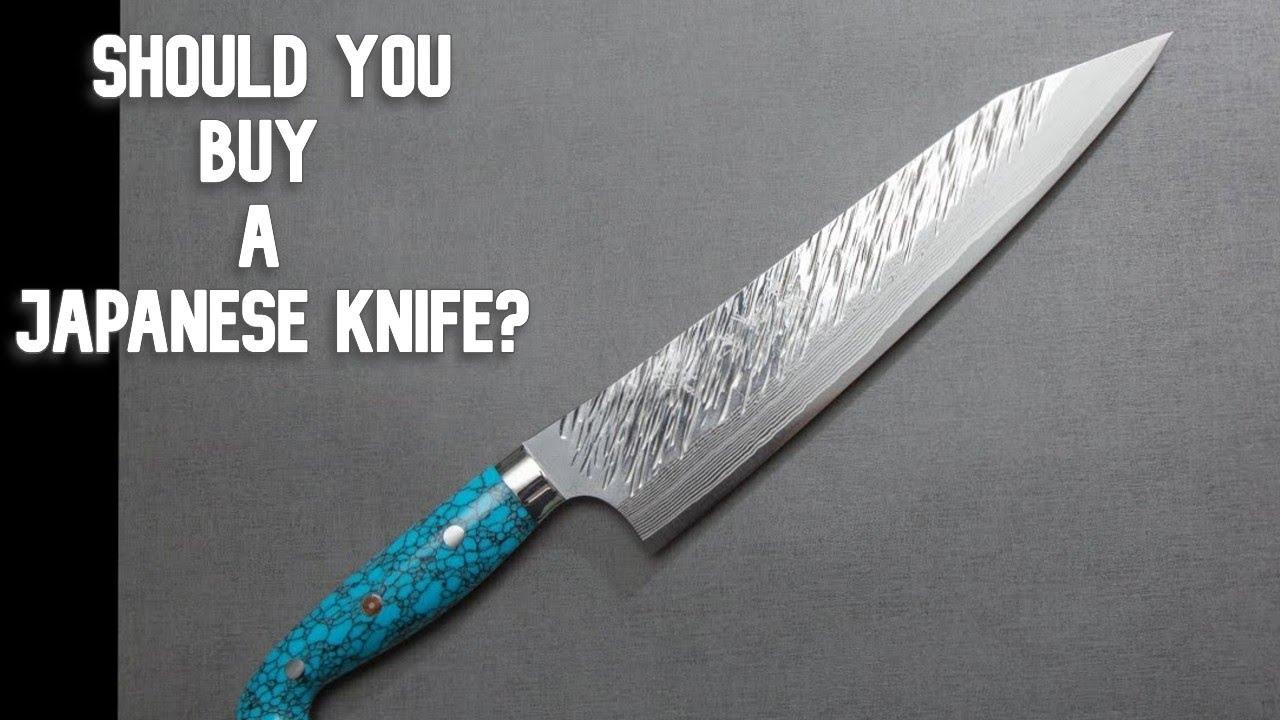
The Yu Kurosaki with the blue turquoise handle is my wife's knife, the largest she'll use because the handle is so comfortable (24:52). It's VG-10, and hand-forged Japanese VG-10 is a world apart from Chinese-made VG-10 (25:37). (See VG-10 vs. VG-Max.) I also ran his VG-10 Fujin and SG2 Shizuku side by side (28:02): in daily use they feel the same, and the only difference I noticed was the VG-10 edge wearing a little faster (29:32). His high grinds, about an inch above the edge, make them very aggressive cutters (30:21).
Nigara, Ikeda and the Kiyoshi Kato Workhorse
My Nigara 210mm kiritsuke has held up beautifully over a few months, apart from some uneven wear on the kurouchi where I squeeze while washing (31:53). Nigara is just four people, two master smiths and two apprentices, yet the quality and range they produce are incredible (32:41). Unlike most kiritsukes, it keeps its height almost to the tip (33:03). I also bought their 240mm migaki-finish SG2, because its hazy satin polish is the closest thing to an Anryu now that his knives are sold out (43:39).
A Takumi Ikeda Aogami Super 240mm, made by Anryu's nephew, was marketed a few years earlier as a "Masamoto KS killer" for around $300 (34:39). It has a Sabatier-style profile and a satin polish that clearly runs in the family (35:24).
The Kiyoshi Kato Workhorse is one of the most sought-after knives in the knife world (37:29): a 4 to 4.5mm spine with an aggressive distal taper and White #2 steel (38:14). At about $1,200 it's the most expensive knife here, and it's top three for performance, but we're splitting hairs (40:34). Your cooking won't improve with a pricier knife; if it did, I'd be one of the best cooks in the world (40:58).
New arrivals worth watching
A Kobayashi R2 210mm laser, about 2mm at the spine, has the best finishing I've ever seen at its price: visually perfect, without a single hairline scratch (45:37). And a Nakamura Aogami Super is the Yoshihiro's twin on paper, both about $200, 210mm and hand-engraved, with slight differences in the choil and belly (49:09). I expect these two to take the crown for the best knife around $200 (51:17).
| Knife | Steel | What stands out |
|---|---|---|
| Moritaka | Aogami Super | Heritage, value, brushed kurouchi |
| Akazawa | Aogami Super (65–66 HRC) | Hard, thin, ebony handle |
| Yoshihiro | Aogami Super | Same performance under $200 |
| Yoshimi Kato (Masakage Koishi) | Aogami Super | Underrated, great grind |
| Takeshi Saji | SG2 | Gentle taper, very stable |
| Anryu | Blue #2 | Hand-hammered, maker retired |
| Yu Kurosaki | VG-10 / SG2 | Comfortable, aggressive grind |
| Nigara | SG2 / Aogami Super | Tall kiritsuke, superb finish |
| Kiyoshi Kato Workhorse | White #2 | The $1,200 grail |
Bottom line
Every knife here will make its owner happy: budget Aogami Super gyutos, tall gyutos, mirror-polished lasers, hand-hammered heirlooms and a $1,200 workhorse (53:56). If you're starting out, a Moritaka or Yoshihiro gives you artisan performance for about $200; if you want a keeper, look for makers like Anryu while you still can. For how I'd choose, read how to choose a kitchen knife, and browse the gyutos at the Burrfection Store and Gyuto.com.
First access
Private drops, new knives and sales
Get them from Burrfection and our retail partners before anyone else. No spam; unsubscribe anytime.
Emails from Burrfection Inc. See privacy.